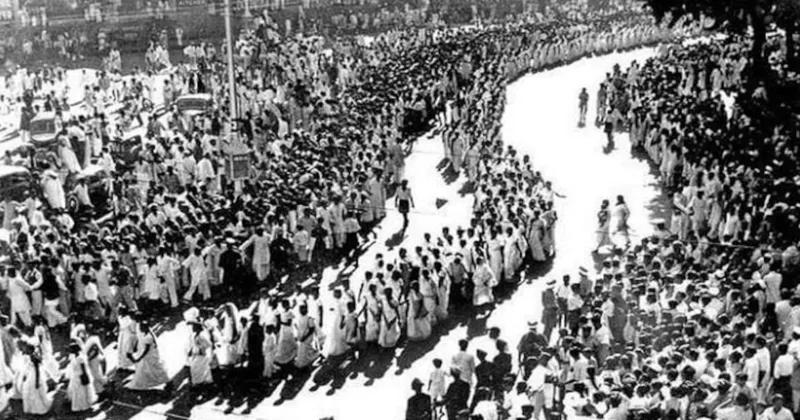
The Quit India Movement, launched on August 8, 1942, marked a turning point in India’s long and arduous struggle for freedom. While history often credits Mahatma Gandhi, Jawaharlal Nehru, and the Indian National Congress with its leadership, the soul of this uprising pulsed far beyond the headlines. It beat in the courage of countless nameless revolutionaries, rural fighters, women, students, and local leaders who rose spontaneously, fiercely, and often fatally against the British Raj. When the top leadership was jailed within hours of Gandhi’s iconic “Do or Die” call, it was these forgotten patriots who carried the movement forward, proving that India’s hunger for freedom was far deeper than a few celebrated names.
One day after the mass arrests, a woman stepped into history with quiet defiance. Aruna Asaf Ali, a radical leader, hoisted the tricolour at Bombay’s Gowalia Tank Maidan on August 9, 1942. This was no symbolic gesture—it was an act of deliberate resistance, a rallying cry to youth and underground networks across the country. Forced to go underground, she became a lifeline of the resistance, operating the secret “Radio,” which defied British censorship and kept the fires of revolt alive in homes, streets, and schools. Her voice crackled across makeshift transmitters, carrying hope, unity, and instructions at a time when formal leadership had been silenced.
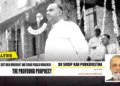
Leaders like Ram Manohar Lohia emerged as the architects of underground rebellion. A socialist thinker and tactician, Lohia organised sabotage operations, circulated underground literature, and orchestrated resistance with remarkable stealth. He set up a covert communication network and broadcast powerful messages urging continued struggle. His defiance turned students and workers into revolutionaries. Alongside him stood Jayaprakash Narayan, who escaped Hazaribagh Jail in a daring jailbreak in November 1942. His story of tunnelling out of prison, evading capture, and continuing the resistance was more than thrilling—it was mythic. Together, Lohia and JP became the pulse of rebellion in North India, showing that resistance did not require grand podiums—it needed courage, imagination, and grit.
Far from the political centres, uprisings flared in unexpected corners. In Bengal’s Midnapore district, a 21-year-old widow named Matangini Hazra became a symbol of peasant defiance. On September 29, 1942, she led thousands toward the Tamluk police station, holding the national flag. When the police opened fire, she kept marching. Even after being shot, she continued, the flag never falling from her hands. She died on the spot, a martyr whose name barely made it into textbooks but remains immortal in Bengal’s collective memory. Her courage echoed the spirit of an India no longer willing to bow.
In Maharashtra’s Satara district, the movement took a radical turn. Under the leadership of Nana Patil and Yashwantrao Chavan, locals formed a parallel government—the “Prati Sarkar.” For almost three years, it functioned as an independent administration, collecting taxes, settling disputes, running schools, and protecting people. This wasn’t just resistance—it was a demonstration of governance, a miniature republic that proved Indians could rule themselves. Guerrilla squads enforced justice and protected the people while evading British control. The Prati Sarkar was not merely an act of rebellion; it was a living, breathing preview of self-rule.
In Bihar, flames of revolt spread quickly through Patna, Arrah, and beyond. Railway stations were sabotaged, and schools were transformed into protest sites. A young Karpoori Thakur, later to become Bihar’s Chief Minister, led student and peasant mobilisations. Despite brutal suppression, the uprising deepened. In Ballia, Uttar Pradesh, local leaders ousted British officers and declared independence for a few days. Though short-lived, the episode exposed the brittleness of British authority when faced with a popular uprising.
Students were often the vanguard of this spontaneous insurgency. With universities shut and leaders jailed, students stepped into the vacuum. They organised rallies, printed pamphlets, and disrupted rail lines. Their fury was raw, but their purpose was clear. In Bombay, Calcutta, Delhi, and Allahabad, they formed underground committees and led strikes, often facing police bullets. These young minds did not wait for instructions—they created their own revolution, one shaped by urgency and conviction.
Women were not silent participants—they were leaders, messengers, and martyrs. Usha Mehta, a young student in Bombay, risked everything to operate the clandestine Congress Radio. She defied the British police with every broadcast, urging resistance and spreading hope. When captured, she was tortured but refused to betray her comrades. Across the country, women marched, organised, smuggled documents, and faced imprisonment. In Odisha, Sashi Bhusan Nayak, a tribal woman, was killed leading a protest—her sacrifice a reminder that the movement belonged to all castes, regions, and communities.
Southern India, too, erupted in resistance. In Tamil Nadu, student and worker uprisings defied colonial curfews. Though early leaders like K. Kamaraj were imprisoned, the seeds they had sown flowered in acts of rebellion across Madurai and Trichy. Kerala saw similar unrest, with local leaders resisting both British and princely rule. In Hyderabad and Travancore, movements led by the Andhra Mahasabha and other groups challenged not just the British but also autocratic native rulers aligned with the Raj. These decentralised uprisings widened the movement’s scope, proving that Quit India was not confined to British India—it had become a national moral revolution.
British repression was swift and merciless. Over one lakh arrests, thousands detained without trial, newspapers banned, and entire villages razed in retaliation. Yet the state’s brutality only hardened Indian resolve. What the British didn’t realise was that by attacking the visible leadership, they had triggered an invisible revolt, spread across millions of hearts. The British Empire had no answer to this kind of spontaneous, decentralised defiance.
Internationally, the movement exposed the deep hypocrisy of colonial rule. As Britain claimed to fight fascism in Europe, it was denying basic freedoms to millions in its colonies. Indian soldiers were dying on foreign fronts under the Union Jack while their homeland remained shackled. This contradiction wasn’t lost on the world, and certainly not on Indians. Leaders like Lohia used this duplicity as a powerful critique of the Raj, making it harder for the British to justify their empire even to their own citizens.
Though the British eventually crushed the Quit India Movement with brute force, the rebellion irreversibly shattered the illusion of imperial invincibility. The sheer scale of spontaneous resistance—from cities to the most remote villages—proved that British rule no longer commanded obedience, only resentment. It became clear that the empire was ruling over a population that had mentally and morally severed itself from colonial subjugation. The Quit India Movement redrew the psychological map of India’s freedom struggle; it was no longer about petitioning the rulers but rejecting them outright. From 1942 onwards, the question was not if the British would leave, but when, and on what terms. Perhaps the greatest legacy of the Quit India Movement was not immediate political change but psychological transformation. It decentralised the freedom struggle and brought ordinary Indians into its heart. It reminded the world that India’s fight was not dependent on a few figureheads—it was a collective uprising born of shared suffering, shared hope, and an unshakable yearning for liberty.
By narrowing our historical gaze to a few familiar names, we risk flattening the rich and diverse tapestry of this resistance. The Quit India Movement was not just Gandhi’s moral moment or Nehru’s political test—it was India’s declaration of selfhood, shouted from rooftops, whispered in radio signals, inked in underground pamphlets, and soaked in blood on village streets. It belonged to everyone who refused to bow.
To remember it fully, we must remember all of it—not just the celebrated icons, but the unrecognised rebels, the defiant widows, the teenage radio operators, the masked guerrillas, and the millions who lit the flame of freedom in places history barely mentions. They did not wait for permission to act. They simply rose—and in doing so, they made it impossible for the British to stay.