It was on August 8, 2019, the Prime Minister of India spoke to the nation. “As a country and as a family, you and us, together, took a historic decision. A system that denied due rights to our brothers and sisters of Jammu, Kashmir, and Ladakh—a system that was a huge hurdle in their development—has now been eradicated. A dream that Sardar Vallabh bhai Patel had, a dream Babsaheb Ambedkar had, the dream shared by Shyamaprasad Mukherjee, Atalji, and crores of citizens, has now been fulfilled’.
As the Hon’ble Supreme Court upheld the revocation of Article 370 on December 11, 2023, the whole Bharat erupted in joy. This fight was first initiated by Guruji and then carried forward by Dr. Shyamaprasad Mukherjee. This fight was fearlessly led by Prime Minister Modi and Home Minister Amit Shah ji, who, on December 6, 2019, took the decision to revoke special status for Kashmir under Article 370. The Jammu and Kashmir reorganisation bill was then brought to Parliament and passed. In 1967, Guruji Golwalker said, ‘There is only one way to keep Kashmir, and that is through complete integration. Article 370 must go. And the separate constitution and separate flag must go too’ (Organiser, Diwali 1967). Today, this integration is complete. As a result of this strong tapasya by these great leaders, the Indian flag flies high through the streets of Lal Chowk today. This is a story of strong determination that will continue to inspire generations to come.
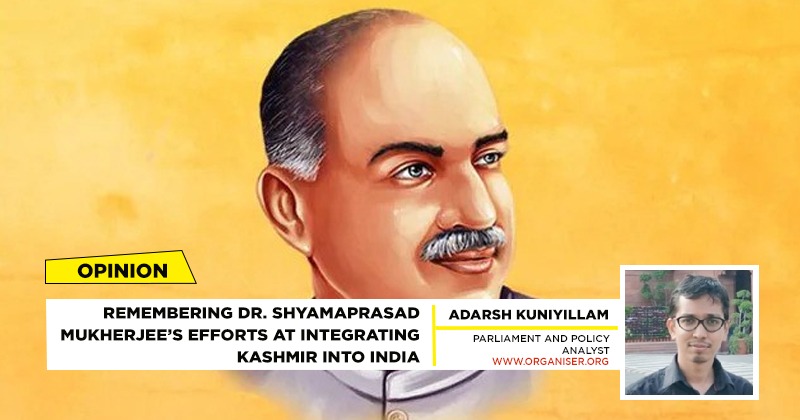
While Guruji took up the cause of Kashmir’s integration into India by speaking with Maharaja and convincing him to sign the instrument of accession to India, Dr. Shyamaprasad Mukherjee spent the last fifteen months of his life for Kashmir and her accession to India. Dr. Shyamaprasad Mukherjee was greatly convinced that Kashmir can’t be won through UNO or peaceful negotiations but by force. However, Pt. Nehru was not willing to send force and was trying to get the matter cleared through the UN. It was this understanding that made Shyamaprasad Mukherjee take on the quest of organizing people’s protests in the region. This was resisted by the ruling apparatus, which eventually led to the arrest of Shyamaprasad Mukherjee and then to his martyrdom in captivity.
Independence came at a huge cost. Not only has it led to massacres of our people, but it has also led to division of India. The idea of Akhand Bharat as a cultural entity was broken by religious fanaticism and greed for the creation of the ‘pure land’. The 498 Princely States acceded to India peacefully integrating into our constitutional scheme of things. Even after being a member of the constituent assembly, Sheikh Abdulla chose otherwise. The Constitutional Assembly gave a temporary set of powers to J&K, considering three things. Firstly, the entire state was not in the hands of India. A large portion of the state was seized by the enemy. Secondly, India, instead of resolving the issue at their end, decided to take the matter to the United Nations. Thirdly was the issue of holding a plebiscite. This was a verbal assurance given to Kashmir and was not fulfilled by the government. These factors have led to the birth of 370.
While Sheikh Abdulla, on the one hand, is critical of the Indian Parliament’s jurisdiction in Kashmir, he was largely silent on Pakistan. Even while proclaiming that he believed in an independent Kashmir, Sheikh had a clear affinity for Pakistan. Sheikh once said in the constituent Assembly of Kashmir, ‘We are a hundred percent sovereign body. No country can put spokes in the wheel of our progress. Neither the Indian Parliament nor any other Parliament outside the state has any jurisdiction over our state’. Dr.Shyamaprasad Mukherjee strongly fought against two parliaments in independent India and came out with the strong proclamation, ‘Is Desh mein, Do Vidhan, DO Pradhan aur Do Nishan Nahin Chalega’. It was this call to integration of Kashmir that has echoed from Kashmir to Kanyakumari and that eventually led to the rise of strong opposition against the Congress government.
Kashmir was the biggest blunder committed by the ruling party at that time. The blind trust put in Sheikh Abdulla and his government by Pt. Nehru aggravated the crisis. Sheikh was highly discriminatory in his approach to his people; he considered the Sunni kashmirs much superior to other people in the area. The dogras were the second largest community of Kashmir after the Sunnis in the region. On March 24, 1952, at the Constituent Assembly of Kashmir, Mirza Afsal Beg declared publicly that Kashmir would be a republic with its own president, judiciary, and national assembly. Immediately after the ousting of Mehr Chand Mahajan as Prime Minister under Maharaja Hari Singh’s reign, Sheikh himself assumed the title of Prime Minister of Jammu and Kashmir. One of the first decisions he made was the arrest of Pt.Premnath Dogra without a trial.
The flag of the National Conference flew high across the state, and the Indian flag was nowhere visible during those days. At around the same time, Pt. Nehru was occupied with protecting the rights of minorities in India. His office was busy running over the drafts of what was to be known as ‘the Nehru Liaquat’ pact. This pact was signed on April 8th, 1950. This pact was the outcome of a six-day talk between both countries. It was agreed that both governments would ensure complete and equal rights to citizenship and security for minority communities in both countries. While we have followed the pact in letter and spirit, Pakistan has never had any plans or intention to follow it. Sensing that this treaty was bound to fail and minorities in East and West Pakistan would suffer, Dr Shyamaprasad Mukherjee resigned from the Nehru cabinet on August 8, 1950. Dr Shyamaprasad Mukherjee then founded the Bharathiya Jan Sangh on October 21, 1951, in Delhi, with the blessings of the RSS.
The Bharathiya Jan Sangh, in its resolution on June 14, 1952, declared Kashmir to be an integral part of India. Thus began the political fight for the integration of Kashmir into India. This was the first time a political party had Kashmir integration as its core agenda. Throughout his tenure in Parliament, Dr. Shyamaprasad Mukherjee lived and fought for the Kashmir cause. He fought verbal debates in Parliament against the mistreatment shown towards Hindus and Sikhs in Kashmir by Sheikh’s administration. As a skilled orator and a brilliant strategist, he was instrumental in forming the first coalition of the Independent India National Democratic Party inside the Parliament. At the invitation of Praja Parishad, a political party founded by Baraj Madhok, Dr. Shyamaprasad Mukherjee decided to leave for Jammu and Kashmir to lead the protests on the ground. To the massive number of supporters gathered at the entry point into Jammu and Kashmir, he assured that ‘Hum Vidhan Lenge Ya Balidan Denge’.
Throughout his journey through the Jammu region, he was greeted with massive supporters—people who wanted the complete integration of Jammu and Kashmir into India. His visit to the state was a massive success. Praja Parishads growing political clout had worried Sheikh, and his approach towards the Dogra community, which was the second largest community after the Sunnis in Kashmir, would never be the same again. In November 1952, Praja Parishad leaders Pt.Dogra and S. L. Sharma were arrested without any grounds. The Sheikh government had started showing its true colours.
Entry into the state of Jammu and Kashmir at those days required a permit. Dr. Mukherjee always questioned this system. While the government of India provided the entry permits, Sheikh necessitated the need for an additional state permit for entry into Jammu and Kashmir. Any permit system, he believed, was against the ideas of the constitution, which he helped build. Across India, the rationing of Pt. Nehru was also being questioned. People in large numbers came out in support of the Praja Parishad and Bharathiya Jan Sangh. This massive support eventually led the Praja Parishad to win 3 out of 4 seats in the bye elections held for the Kashmir legislative assembly in 1953.
On March 8, 1953, Dr Shyamaprasad Mukherjee began his journey from Kashmir to Delhi to enter Kashmir without a permit. On May 10, 1953, Dr Shyamaprasad Mukherjee was arrested on his entry into Kashmir. He was kept in custody at a small hut, denying him the basic treatment that was required for a political prisoner. His health was worsening day by day due to the bad routine in his prison cell. The lack of appetite, poor treatment, worsening weather conditions, and total exclusion from the public all began to cause severe strain on him both mentally and physically. On June 23rd, 1953, Dr. Shyamaprasad Mukherjee breathed his last.
The mystery surrounding Dr.Shyamaprasad Mukherjee is still not completely revealed to the public. Now that Kashmir is fully integrated, it is time for us to reopen the archival materials to understand what exactly transpired during captivity. This alone will do justice to Dr. Shyamaprasad Mukherjee, who has laid down his life for the integration of Kashmir into Bharat.