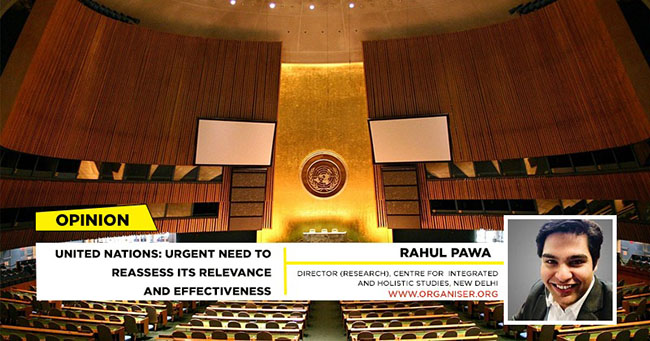
In the aftermath of the Second World War, the year 1945 marked a crucial turning point in the chronicle of global history. From April to June that year, 50 allied nations, bound by shared aspirations and haunted by the scars of recent wars, convened for the landmark United Nations Conference on International Organisation in San Francisco. In a collaborative tour de force, they crafted the United Nations Charter resulting in the founding of the United Nations on October 24, 1945.
Marking the advent of a new world order, it resonated with a deep-seated vow: to protect succeeding generations from scourge of war, to reaffirm faith in fundamental human rights and to promote social progress.
However, insular pursuits by member states, competitive multilateralism, faltering global governance responses to the ever looming spectre of terrorism, pandemic and the machinations of transnational power dynamics threaten the very underpinnings of the UN. Within its corridors, the organisation grapples with an antiquated structure of the Security Council, nuances of peacekeeping operations, the imperative for robust management, enforcement, and budgetary reforms, coupled with the task of ensuring fluid coordination among its diverse entities and organs. These collective pressures cast a long shadow over its foundational tenets of international cooperation, peace, and security prompting the introspection:
Is the UN, in its present iteration, primed to meet the challenges of the 21st century and beyond? Further, can the UN reimagine itself, maintain relevance, and endure as a beacon of hope amidst this global panorama?
At the outset, in 1945, when the United Nations was established, a staggering 750 million people resided in regions controlled by colonial forces, mostly without a voice or representation on the global stage. Today, while that figure has drastically reduced to less than two million, the lack of diverse perspectives in pivotal decisions remains evident, reminding us of the historical imbalances that once, and continue to, shape the global governance discourse. It’s essential to recognise that, despite the UN’s declared commitment to inclusivity and representation, it often appears biased towards Euro-American elites and corporate agendas. This slant is glaringly obvious in development aid, with institutions like the International Monetary Fund (IMF) and the World Bank leading economic development initiatives. While these entities drive the economic agenda, the UN establishes and oversees sustainable development benchmarks. Together, they enact an economic development strategy that is known for its Euro-American focus.
Expansion of Chinese Influence
In recent times, a significant shift occurred in 2019 when the US refused to pay its financial obligations to the UN, paving the way for China to adopt a more influential role at the UN. Recognising the strategic interests and advantages of leveraging the UN, Beijing strategically expanded its influence within the UN, leading four primary agencies and holding deputy positions in nine others by the end of 2020. Echoing this sentiment, during the CPC’s 20th Party Congress in 2022, Xi Jinping emphasised China’s commitment to the international system, underlining the centrality of the UN to China’s global vision. Concurrently, evolving as the world’s second-largest economy, China increased its UN budget contribution from 2 per cent in the early 2000s to 15.25 per cent in 2022, second only to the U.S. at 27.89 per cent, amplifying its stature within the UN system. In light of these dynamics, the potential for the UN to be swayed excessively by a particular nation’s or bloc’s priorities becomes apparent, betraying the very ideals it was established to uphold.
Decision-Making Paralysis
Moreover, its most powerful council, the UN Security Council, with its permanent members and their associated veto powers, represents a geopolitical landscape from a bygone era. This structure often leads to decision-making paralysis when the interests of the P5 countries are at stake. Pressing examples of this structural inefficiency can be seen in Beijing’s recurrent and assertive use of its veto privilege. On several occasions, China has exercised its veto power to prevent resolutions labelling specific Pakistani individuals and entities as terrorists or terrorist entities, a move seen as standing in solidarity with its unwavering ally, Pakistan. This, alongside the UN’s inability to effectively mediate in the recent Russia-Ukraine issue. Despite the organisation’s lofty ideals, it struggled to mediate effectively between the two nations or prevent the escalation of hostilities, underscoring the limitations imposed by the existing design of the Security Council. The ongoing situation in Israel and its neighbouring regions is another testament to the UN’s failure in its fight against terror. Decades of resolutions and peace proposals have yielded limited success, with intermittent flare-ups and enduring tensions continuing to plague the region.
While Hamas’s recent terror campaign against Israel on October 07, 2023 was universally condemned, the UN found itself in a corner about what constitutes a “terrorist act.” This division, largely influenced by member state’s geopolitical interests and regional dynamics, has created an ambiguity. Yet, the absence of a universally accepted definition of terrorism hampers the UN’s ability to act definitively against groups designated as terrorist entities. In light of this, it’s vital for the UN to seize the moment, assert its leadership with conviction, and champion the cause to delineate a globally recognised definition of terrorism. This would not only enhance its credibility but also fortify its resolve in combating terror in all its forms.
Maintaining global peace
However, while its worth noting that the UN’s peacekeeping operations play a vital role in maintaining global peace and security bringing peace to places like Cambodia and Tajikistan in the Past. It is equally important to acknowledge that they have has also faced failures in Rwanda and Bosnia, allegations of sexual misconduct and their inadvertent role in the cholera outbreak in Haiti. Acknowledging that Peacekeepers work in volatile regions often grapple with complex situations amidst internal challenges like bureaucracy and ambiguous mandates. The imperative for the UN to evolve and fulfil its mission effectively, recognising both its accomplishments and deficiencies, is of utmost importance at this time. Beyond zones of conflict, the UN’s World Food Program aids over 80 million individuals, with an additional 69 million displaced persons benefiting from its assistance. Yet, the memory of UN Security Council’s Oil-for-Food program’s launch remains a significant example of its shortcomings. This program, initiated in 1996 to allow Iraq to exchange oil for humanitarian goods, was plagued corruption, abuse and poor oversight, tarnishing the UN’s reputation and raising transparency concerns.
While the UN has played a seminal role in codifying human rights, with instruments such as the Universal Declaration of Human Rights now embedded in numerous national constitutions and International legal frameworks. Its notable failure to address severe violations against Hindus in Pakistan and Bangladesh highlights its bias and susceptibility to political influence. In Pakistan, an estimated 1,000 Hindu girls are forcibly converted to Islam each year, and in Bangladesh, the Hindu population has plummeted from 22% in 1951 to about 8% today due to targeted violence, discrimination, and forced conversions. Despite these alarming statistics and ongoing reports of temple desecrations and physical violence, the UN’s response remains inadequate, raising concerns about its effectiveness in protecting basic human rights in these countries.
On the health front, UN programs are responsible for vaccinating almost half of the world’s children, averting millions of potential fatalities from preventable diseases. However, our attention must also turn to the World Health Organization (WHO) and its handling of the COVID-19 pandemic. The influence exerted by the Chinese government during this critical period casts a shadow over the WHO’s initial response. It is not unreasonable to question whether China’s sway over the WHO affected the organization’s willingness to conduct a fully transparent investigation into the origins of the virus. Furthermore, the WHO’s delay in issuing a global alert may have had a detrimental impact on the pandemic’s early containment, potentially exacerbating its global spread. The intricate relationship between a prominent UN agency and one of its member states has raised significant doubts about the credibility of the World Health Organization (WHO), an organ of the UN entrusted with the crucial task of protecting global health.
Drawing from the myriad challenges and oversights, it becomes palpably clear that the UN stands at a pivotal juncture in its storied history. The very essence of its foundation – to champion peace, rights, and justice – seems to be waning in the face of current global complexities. All these scenarios, when taken together, sound a resounding clarion call for urgent introspection and action. It isn’t merely about adaptation to the changing times; it’s about a fundamental metamorphosis. The UN must undergo a profound transformation in its role, structure, and approach to truly resonate with and effectively address the multifaceted challenges of the contemporary global landscape. The world doesn’t just need a reformed or adaptive UN, but a fundamentally reimagined one.