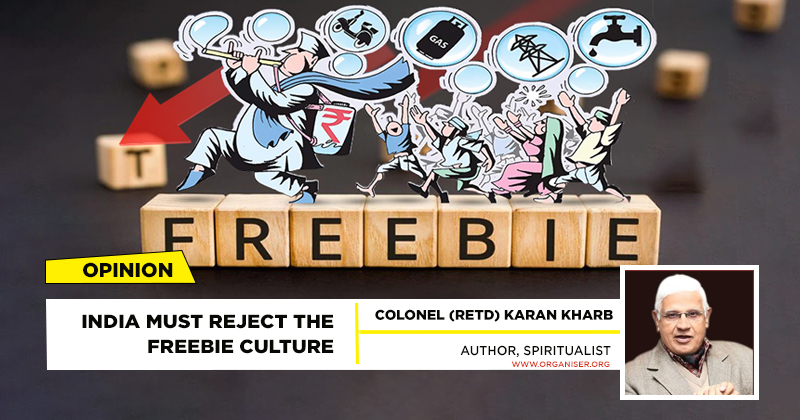
In the intricate dance between welfare and development, India faces the challenge of crafting policies that not only alleviate immediate concerns but also foster long-term growth both at the National as well as State levels. Lately, a new trend has sneaked into the Indian polity to lure voters by offering freebies like free electricity, water, and monthly cash awards for women or household units.
While traditional freebies like electricity, water, monthly cash packets and other short-term relief measures like free rations, their impact on economic sustainability and development is a matter of concern. There is a need for all political parties to adopt a holistic approach that aligns welfare initiatives with targeted development strategies, striking a balance that empowers citizens while propelling the nation forward.
Genesis of Freebies
The scourge of freebies was first seen in Tamil Nadu in 1967 when the founder of DMK CN Annadurai promised 4.5 kg for a token price of Re 1/- if voted to power. DMK won defeating Congress and the scourge of freebies gradually became competitive in Indian politics. Gifts like TVs, laptops, internet, bicycles, scooters, and even saris became competitive and trendy during electioneering while the development schemes, health and education remained pushed backwards making life difficult for the poor. Amma canteens launched by Jayalalitha in Tamil Nadu became quite popular. Along with the rise of youth power, unemployment and the cost of living have been rising in India since the 1990s.
Freebies become Trendy
Arvind Kejriwal and his band of so-called Crusaders against political corruption formed the Aam Admi Party (AAP) in 2012 and made a clean sweep in Delhi (2015) and Punjab (2017) assembly elections riding on their offers of freebies like a monthly quota of free electricity, wi-fi, water, Rs 1000/- for every woman and other attractions like free travels, tours and so on.
Taking the trend further, Congress gave five major guarantees to the voters during Karnataka assembly elections: Rs 2,000/- monthly assistance to women heads of all families (Gruhalakshmi), 200 units of power to all households (Gruhajyoti), Rs 3000/- per month for graduate youth and Rs 1500/- for diploma holders (Yuvanidhi), 10 kg rice per person per month (Annabhagya), and free travel for women in the State public transport buses (Uchita Prayana). All these offers total up to Rs 65,082 crore a year which is 20 per cent of the State budget. Currently, the fiscal deficit of the state is estimated to be Rs 60,531 crore. Add Rs 65,082 crore, and the total deficit rises to Rs 1,25,613 crore! Until now Karnataka has been an economically healthy state, but from now onwards this recurring burden will turn the state into an ill-health.
Although Prime Minister Narendra Modi called this growing trend of freebies a Revadi culture and said it is dangerous for the country and could lead to far-reaching economic consequences, the trend is only gaining momentum. It is forcing the BJP also to play a game that is set on unfair rules.
Long-Term Effects of Freebie Culture
Taking note of the dangerous trend, The Supreme Court warned in 2013, “Budgets for freebies are going above regular budgets. This disturbs the level playing field. Freebies, undoubtedly, influence all people. It shakes the root of free and fair elections to a large degree.” But neither the apex court nor the CEC passed any compelling order to put an end to the ever-rising freebie trend. Riding on their promises of providing a quota of a certain amount of water and electricity free of cost to voters in 2015, AAP stormed to power in Delhi.
As far as farmers and their farm produce are concerned, free electricity, free water, farm loan waivers and subsidies are not sustainable solutions. There is an oft-quoted saying, “Give a man a fish, and he will be hungry again tomorrow. Teach him to catch fish, and you will have fed him and his family for all their future!” Therefore, freebies tend to accustom the beneficiaries to look for more freebies next time. The trend has no incentive to motivate beneficiaries to plan, prepare and endeavour to earn. Freebies extinguish the enterprise in citizens.
Therefore, this trend of freebies must stop and give way to more purposeful and productive methods. Political parties and governments in India must focus their vote-catching tactics to garner public support by launching empowerment programmes to enhance the earning skills and capacities of voters. Some of the measures that are sure to do good to the nation, society, individual voters and the parties contesting in elections are discussed in the following paragraphs.
Incentivise Enterprise and Reward Performance
Skill Enhancement and Job Creation: In the pursuit of fostering a self-reliant workforce, the Union and State governments should pivot towards skill enhancement initiatives. This approach envisions investing in education and vocational training, equipping individuals with the tools needed to thrive in a dynamic job market. The result is twofold: unemployment is reduced, and the nation’s human capital becomes more competitive globally. This approach stands in contrast to unemployment allowances, which might inadvertently discourage active workforce participation and delay the development of a skilled labour force. Prime Minister Narendra Modi launched several skill development programs in India to enhance the employability and vocational skills of the country’s workforce. Some of the key initiatives include the Skill India Mission, Pradhan Mantri Kaushal Vikas Yojana (PMKVY), the National Apprenticeship Promotion Scheme (NAPS), and more.
Political parties and State Governments may explore more and innovate more such programmes including incentive-based competitions and facility creation for the enterprising men and women who may need support and guidance.
Entrepreneurship and Economic Empowerment: Entrepreneurship emerges as a transformative force that drives innovation, job creation, and economic diversification. By offering seed capital, mentorship, and market access, the Union and State Governments can nurture a culture of self-employment, particularly among the youth. This empowers individuals to shape their destinies and contributes to a thriving business ecosystem. In comparison, monthly rewards for idle women without motivation to work, although well-intentioned, could inadvertently hinder women’s financial independence and limit their potential for entrepreneurship and growth.
Strategic Rural Development: The heart of India’s progress lies in its rural landscape. Redirecting focus on the development of rural infrastructure, such as irrigation, connectivity, and access to modern agricultural tools, machines and markets, can spur agricultural productivity and empower local and regional economies. This strategy promotes sustainability and growth, whereas the continuous free supply of resources impedes efficient resource utilisation and strains the State’s financial resources.
Digital Literacy and Modernisation: Digital literacy emerges as a key enabler for the nation’s progression into a knowledge-based economy. Launching programs that provide affordable internet access and digital training can bridge the digital divide, enabling citizens to harness the power of information and technology for their benefit. Even though the AAP Government in Delhi had promised free Wi-Fi access all over Delhi in 2015, it has failed to fulfil its commitment even after eight years in office. A singular focus on free resources might sideline the importance of digital literacy, delaying the transition to modern industries.
Healthcare Accessibility: A healthy nation is a productive nation. Instead of providing free healthcare, the focus should shift towards improving accessibility and quality of healthcare services. Hastily set up make-shift arrangements like Mohalla Clinics have proved wasteful squandering of resources. Instead, setting up well-equipped healthcare centres in rural areas and utilising technology for telemedicine can ensure equitable healthcare distribution.
Affordable Housing Programs: A roof over one’s head is a basic necessity. Implementing affordable housing programs, supported by innovative financing models, can address the housing crisis in urban and rural areas. Such an approach not only provides shelter but also contributes to the real estate and construction sectors.
Rural Infrastructure Development: Investing in rural infrastructure, such as roads, irrigation, and connectivity, can transform India’s rural landscape. Such initiatives ensure better and easier market access for farmers, reduce wastage and stimulate rural economies, thereby fostering overall development across regions.
Environmental Conservation and Renewable Energy: Integrating welfare with sustainable development, India can focus on conservation and renewable energy initiatives. Subsidies and incentives for adopting solar energy, rainwater harvesting, and eco-friendly practices can create a greener future while also generating employment opportunities.
Comprehensive Social Security: Instead of a blanket unemployment allowance or pension, a comprehensive social security system should be devised and established. This system could cover health emergencies, unemployment, and retirement, offering a safety net while encouraging individuals to remain productive and economically active.
Balancing the scales of welfare and development necessitates a comprehensive strategic approach that includes both short-term relief and long-term growth. As India charts its course towards development under the ‘Sabka Saath, Sabka Vikaas’ principle, all the political systems and departments at the Union and State levels must consider innovative measures that empower individuals to actively participate in the nation’s journey while bolstering economic sustainability. The dialogue between welfare and development should pivot from immediate gratification towards sustainable empowerment, ensuring that the nation evolves as a powerhouse of self-reliance, innovation, and prosperity.