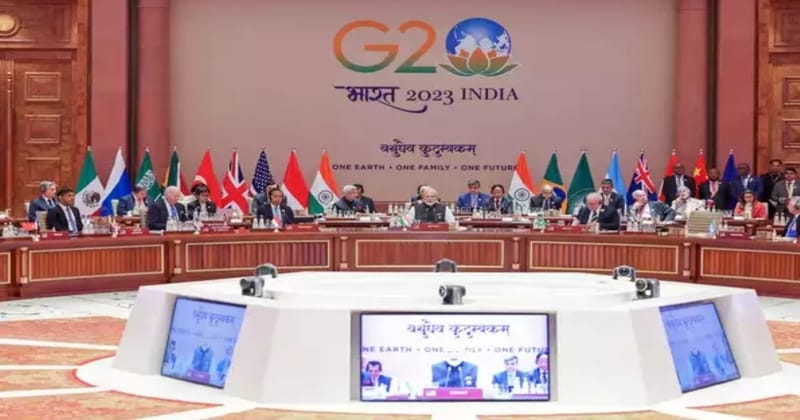
The G20 Summit reached a successful conclusion in Delhi on September 10, featuring numerous prominent global leaders who also engaged in a series of bilateral meetings on the sidelines. The Summit led to the consolidation of a comprehensive framework with the objective of fostering enhanced collaboration among the G20 member nations, the European Union, and the recently incorporated African Union.
India faced several challenges at the beginning of its G20 Presidency last December. The global economic landscape was marred by turbulence, which was aggravated by the lingering effects of the COVID-19 pandemic. The Ukraine conflict and the resultant sanctions against Russia further complicated matters, effectively dividing the G20 into opposing factions, Maheep, a leading expert on India’s Foreign Policy, wrote. Maheep is also the Principal Investigator of a National Project on India’s Soft Power Diplomacy. Crafting a unified joint statement became a herculean task, even in the previous year. India’s Presidency also unfolded against the backdrop of ongoing bilateral tensions with China, primarily around territorial disputes. This perennial friction introduced an additional layer of complexity for India’s G-20 Sherpa team, as China frequently acted as a disruptive force during numerous meetings.
Moreover, the Indian Government deviated from tradition by scheduling the G20 Summit two months earlier than the customary November timeframe. Officials had two months less to work towards the Joint Communique. New Delhi clearly faced a formidable obstacle in its efforts to reach a consensus towards the preparation of a Joint Communique highlighting critical issues including climate finance, healthcare investment, and poverty alleviation.
As the curtains fell on the G20 Summit, Amitabh Kant, the Sherpa for the Indian presidency, was both exhausted and happy, having accomplished what had seemed elusive until even a week ago: securing a consensus.
The focal issue of contention revolved around the Ukraine-Russia conflict, a subject which was finally addressed comprehensively in seven paragraphs. This level of detail starkly contrasts with the Bali Declaration last year, which dedicated only two paragraphs to the topic. Following the circulation of a new text by India at the last moment describing the Ukraine conflict, a Consensus was finally reached and the Declaration was subsequently adopted.
Moreover, the significance of the moment cannot be overestimated. It marks a remarkable achievement as, for the first time in the history of the G20, the declaration has garnered unanimous consensus across all areas, including developments, climate concerns, and geopolitical matters. The declaration highlighted India’s exceptional ability to act as a crucial bridge between emerging economies, developed nations, Russia, and China, effectively bringing them all to the negotiation table, Maheep wrote.
Moreover, this event is truly unique in that it places multilateralism at the forefront once again, underscoring its importance in global diplomacy. Finally, it serves as a compelling demonstration that even in the face of numerous global challenges, ambitious, inclusive, and decisive actions can be undertaken successfully. It marks a remarkable accomplishment not only for India but also a significant milestone for all emerging markets. This Delhi Declaration embodies the voice of the Global South, articulated from the vantage point of this diverse and dynamic region.
The declaration expressed great concern over the immense human suffering caused by global conflicts and wars. The consensus declaration, embraced by G20 leaders, emphasised the necessity for a comprehensive, equitable, and lasting peace in Ukraine. It called upon the member states to abstain from employing threats of force to pursue territorial gains or to infringe upon the territorial integrity of any sovereign nation. The statement clearly noted that all States must refrain from using force to conquer sovereign territories.
Furthermore, the 37-page long declaration is divided into 10 thematic chapters. The first chapter, called Strong, Sustainable, Balanced, and Inclusive Growth, addressed the global economic situation, the promotion of financial inclusion, and how to combat corruption.
It refers to the resolve to implement the action plan targeting Fugitive Economic Offenders, thereby bolstering global collaboration and enhancing the exchange of information among law enforcement entities in the fight against corruption. The next chapter called accelerating progress on SDGs, focuses on eradicating hunger and malnutrition, fostering health partnerships, and ensuring the provision of quality education. It considers the potential economic impact of future pandemics, revealing deficiencies in the current pandemic response infrastructure, encompassing institutional and financial aspects.
Regarding education, the discussion revolved around strengthening teachers’ capabilities, refining curricula, promoting local language content, and ensuring access to digital resources. These measures aimed to guarantee that every child, especially those most marginalised, receives the fundamental foundations necessary for lifelong learning.
The Chapter on the “Green Development Pact for a Sustainable Future” underscored the imperative of enacting clean, sustainable, equitable, economical, and all-encompassing energy transformations. An essential component highlighted within this context is the imperative to construct dependable, varied, accountable, and durable supply chains for essential minerals, semiconductors, and associated technologies.
Moreover, the chapter on Revamping Multilateral Institutions in the 21st Century delves into the need for restructuring international financial bodies. A pivotal development within this realm was the historic accord reached within the G20 to initiate reforms to the United Nations Security Council. Furthermore, there was a concerted effort to enhance and enlarge Multilateral Development Banks (MDBs) for greater efficacy.
The chapter entitled Technological Transformation & the Establishment of Digital Public Infrastructure covered various aspects of constructing digital public infrastructure, the utilisation of crypto-assets, and the responsible deployment of Artificial Intelligence (AI) for the common good.
G20 leaders unified their stance by endorsing a G20 framework aimed at digital public infrastructure and the establishment of the Global Digital Public Infrastructure Repository (GDPIR). The Leaders’ Declaration also addressed a comprehensive strategy focused on enhancing cyber education and awareness, with a special emphasis on safeguarding and empowering children and youth. This is particularly crucial in view of the expanding digital presence of young individuals and the escalation of associated risks.
Meanwhile, in the chapter on gender equality and the empowerment of women and girls, there is a strong emphasis on endorsing equal rights to economic resources, property ownership, financial services, and inheritance for women.
Simultaneously, there is a commitment to support women’s organisations and networks, along with the goal of narrowing gender disparities in agricultural access. Under India’s leadership during its G20 Presidency, a significant decision has been made to establish an additional comprehensive working group dedicated to advancing women’s empowerment. The group’s primary focus will be on promoting gender equality, empowering women, and nurturing leadership while fostering collaboration across various sectors and levels.
In the chapter on Countering Terrorism and Combating Money Laundering, a resolute condemnation of terrorism in all its forms and manifestations was expressed. Additionally, it conveyed a positive message affirming the importance of international peace and security.
The final chapter called Creating a More Inclusive World, covered two crucial components. Firstly, India’s leadership during its G20 Presidency has laid the groundwork for the African Union to attain permanent membership within the G20, thereby enhancing inclusivity within the G20, fostering deeper collaboration with Africa, and facilitating the realisation of its developmental aspirations.
Secondly, it underlined a steadfast dedication to fostering reverence for religious and cultural diversity while condemning any manifestations of religious animosity, including those directed at sacred symbols and scriptures. Officials underscored several overarching lessons derived from this Summit: a resolute commitment for forthcoming Presidencies, notably in the upcoming cycle commencing with Brazil in 2024, followed by South Africa in 2025, and culminating with the United States in 2026.
Recognition was extended to all engagement groups and initiatives associated with India’s G20 Presidency. The recommendations put forth by Engagement Groups, including B20, S20, SAI20, Startup20, T20, U20, W20, Y20, C20, P20, and L20, as well as the various Initiatives such as EMPOWER, Research Initiative, SELM, CSAR, and the G20 Cybersecurity Conference, were warmly embraced.
Furthermore, conducting more than 200 meetings in 60 cities across India has not only set a new standard but also promoted the concept of bringing G20 to the people. The democratisation of diplomacy emerged as a prominent and valuable outcome of this successful endeavour.
The G20 Delhi Declaration signified a watershed moment in contemporary global diplomacy. India’s adroit leadership, exercised amid a challenging international backdrop, has yielded a remarkable consensus. This historic achievement demonstrated India’s acumen in bridging divides and facilitating unity among nations.
The unanimous declaration highlighted India’s resolute commitment to working together on important issues like climate action and socio-economic development, showcasing its ability to bring together emerging economies, developed countries, and major global powers such as Russia and China.
Furthermore, the Delhi Declaration reflected India’s dedication to inclusivity, peace, and gender equality. It advocates reforms in international financial institutions and emphasises responsible technological transformation for the common good. India’s vision extends to deeper collaboration with the African Union, enhancing the G20’s inclusivity.
As the leadership mantle passes to future presidencies, India’s legacy stands as a paradigmatic example of diplomacy’s potential to shape a more equitable and sustainable global order, reaffirming its pivotal role on the international stage.
(with inputs from ANI)