As the Supreme Court gears up to start hearing a batch of petitions challenging the amendment of Article 370 of the Constitution of India, certain intervenors have moved intervention applications (IA) before the court to support the Government of India’s decision to abrogate special status of Jammu and Kashmir (J&K).
The IA moved before the Supreme Court urged to recognise the violence inflicted against Kashmir Hindus between 1989 to 1991 as a “direct or indirect consequence of the powers granted to the Jammu & Kashmir State government under Article 370.” The applications were moved by Youth 4 Panun Kashmir, an organisation advocating for the rights of Kashmiri Hindus, and Virender Kaul, a Kashmiri Pandit social activist.
The IA argued that the special status of the erstwhile State of J&K was intended to be temporary and not permanent. The IAs submit that Article 370 was a part of the Constitution of India’s “’Temporary, Transitional, and Special Provisions.”
Article 370 Created “Mini Pakistan”
The IAs argue that Article 370 ignored the interests of Kashmiri Hindus and created a “Mini Pakistan” within India. The application further argues that Article 370 was a “dead letter”, which created an anti-minority and pro-majority situation in J&K, causing the exodus of Kashmiri Hindus since 1947.
Article 370 Enabled Terrorism
The intervenors alleged that the special status under Article 370 allowed the State Governments to perpetuate terror and ethnic cleansing against minorities, particularly against Kashmiri Hindus. The IAs argue that the special status enabled conditions for terrorism and violation of minority rights.
Non-Application of Indian Laws in Erstwhile J&K
The intervenors argue that the special status granted to the erstwhile State of J&K under Articles 370 and 35A prevented the laws of India from being applicable, hampering economic growth, trade and occupation. Furthermore, the lack of a legal recourse disadvantaged the minority communities, such as Kashmiri Hindus, who were deprived of their land and rights. The IAs contend that private industries could not be established under the laws of the erstwhile State, as it did not have laws allowing citizens of India to own land within the State.
“Thousands of Pandit families were deprived of their agricultural land. Even though one of the relatively few parliamentary seats allotted to the erstwhile State compared to its share of population due to constitutional exceptions. For example, in 2014, it had about 1% of India’s population but only 0.6% of Lok Sabha seats,” the IAs argued.
The IAs further submit that progressive developments made in Indian laws were not incorporated in the laws of the erstwhile State. The intervenors argue that while the Supreme Court decriminalised queer sex, it was not incorporated in the Ranbir Penal Code (RPC), which was applicable to J&K. “This verdict of the Hon’ble Supreme Court had not been welcomed by the erstwhile State of Jammu & Kashmir for the very reason that the Indian Penal Code was not applicable,” the intervenors argued.
Special Status Disadvantaged Women
The applications further argue that Article 370 contravened with equality principle, creating two classes of citizens – one for J&K and the other for the rest of India. The application further cites instances where the laws in the erstwhile state disadvantaged women, non-permanent residents and minorities.
“Article 370 and Article 35A discriminated against women marrying outside the erstwhile State. The children of Kashmiri women marrying outside the state lost permanent resident status and privileges. No such restrictions applied to men of the erstwhile State…Daughters had unequal inheritance rights compared to sons under the laws of the erstwhile State. This violated equal inheritance guaranteed under the Indian constitution…The erstwhile State specific laws did not provide for any anti-domestic violence laws. It had further not extended criminal laws dealing with cruelty, dowry deaths, and domestic violence that applied in rest of India. This deprived the women of the State legal protections,” the application reads.
Article 370 Enabled Exploitation of Non-State Subjects & Poor People
The application argued that the amendment of Article 370 removed these discriminatory provisions and granted equal rights and protections to all residents. The IA submits the provisions preventing ‘outsiders’ from settling in the erstwhile State. The IA further cites the non-application of the Urban Land Act of 1976, in the erstwhile State as an example of rich landlords, belonging to the majority community, indulging in the economic exploitation of poor people and the citizens of India, who were residents in the erstwhile State but not State subjects. The IAs submit that such people could not secure loans from financial institutions.
Special Status Contravened Constitution’s Secular & Democratic Character
Furthermore, the intervenors contend that Articles 370 and 35A contravened the democratic and secular character of the Constitution of India. The IAs allege that the State-specific laws created a dominance of the majority religion and ethnic character over others, neglecting the multi-ethnic identity of J&K.
“It (Article 370) disregarded the federal & secular character of the Indian Constitution as a separate Jammu and Kashmir Constitution allowed dominance of one religion and ethnic character over the others, which includes Kashmiri Hindus, Gujjars, Bakharwals, Dalits, Sikh Community, Valmikis, Gorkha and refugees who had flown from west Pakistan and Pakistan occupied Jammu & Kashmir,” the IAs submitted.
Constitution Bench To Hear Pleas Challenging Amendment of Article 370
A Constitution Bench of the Supreme Court is set to hear the petitions challenging the amendment of Article 370, which gave special status to J&K. The Constitution Bench comprises Chief Justice DY Chandrachud, Justice SK Kaul, Justice Sanjiv Khanna, Justice BR Gavai, and Justice Surya Kant.
The cases were posted “for directions” on July 11 to complete the pre-hearing procedural formalities, such as filing documents and submissions. The hearings for the batch of petitions challenging Article 370 would begin on August 2, 2023.
Notably, one of the petitioners, IAS officer Shah Faesal, has said that the matter now is a “thing of the past.” The bureaucrat said he had withdrawn his petition challenging the Presidential Order to scrap Article 370 a long time back. “I have withdrawn the petition in the Supreme Court challenging the Presidential Order to scrap Article 370 long ago,” IAS officer Shah Faesal said.
Thereafter, on July 11, Senior Advocate Raju Ramachandran informed the court that Shah Faesal and Shehla Rashid do not wish to continue as petitioners in the case, and have requested that their names are deleted from the array of parties. Thereafter, the court passed an order to that effect and said that the causetitle would be amended. Senior Advocate Gopal Sankaranarayanan suggested that the causetitle be changed to “In Re: Article 370 petitions.” The court agreed to the same and passed an order to that effect.
Government of India’s Affidavit
On July 10, the Government of India filed an affidavit informing the Supreme Court of the developments in J&K in the past 3 years, since the amendment of Article 370 revoked erstwhile J&K of its special status. The government submitted that since the amendment, schools, colleges, universities, hospitals, and other public institutions have been functioning in the region without strikes or disturbances.
“The earlier practice of daily hartals, strikes, stone pelting and bandhs are a thing of the past now,” the government said.
The government also said that normalcy has returned to the region after over three decades of turmoil. The government further said that a duly elected 3-tier Panchayati Raj system had been established in J&K, for the first time, as a step to strengthen democracy at the grassroots level.
The government also submitted that the security situation in J&K has significantly improved since Article 370 was amended. The government cited data indicating ‘law and order events’ were reduced by 97.2 percent and ‘terror initiated instances’ reduced by 45.2 percent in 2022, compared with the figures in 2018.
The government said that terrorist recruitment from the region dropped from 199 in 2018 to 12 in 2023. The government said that its anti-terror actions resulted in the dismantling of the terror ecosystem in the region. The government further submitted that its policies have helped the Kashmiri youth with employment opportunities.
“For the first time, after independence, the residents of the region are enjoying the same rights which the residents of other parts of the country are enjoying. This has resulted into bringing the people of the region into the mainstream and thereby inevitably frustrating the sinister design of secessionist and anti-national forces,” the government said.
Background
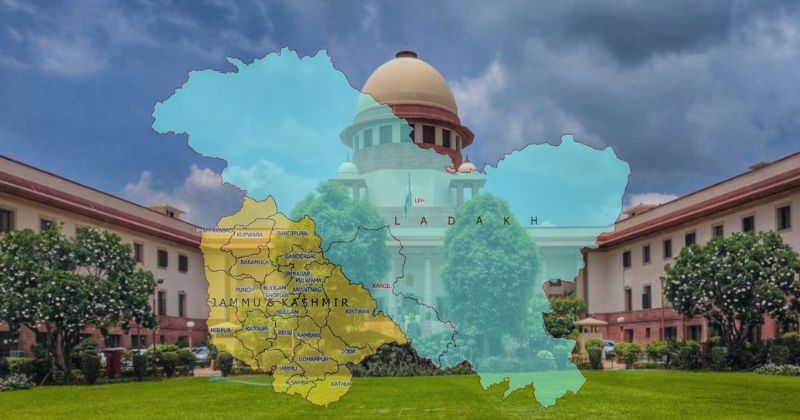
On August 5, 2019, the Government of India amended Article 370, scrapping J&K’s special status. The government further notified the Jammu and Kashmir Reorganisation Act, 2019, which divided the erstwhile state into two Union Territories – Jammu and Kashmir and Ladakh. The erstwhile J&K state was infamous for observing shutdowns, witnessing stone pelting and separatists delivering anti-national sermons.
The hearings against the amendment of Article 370 commenced before the Constitution Bench in December 2019, four months after the Government of India’s notification. One of the issues before the court concerned whether the matter should be referred to a seven-judge bench in light of the alleged divergence of opinion by two coordinate benches of the court.
However, on March 2, 2020, Constitution Bench held that there was no need to refer the matter to a larger bench. Of the last bench which heard the case, Justices NV Ramana and Subhash Reddy have retired. Chief Justice DY Chandrachud and Justice Sanjiv Khanna are the new members of the Constitution Bench.
Several petitions are moved before the Supreme Court, including those of private individuals, lawyers, activists and politicians and political parties challenging the Jammu & Kashmir Reorganisation Act, 2019, which splits Jammu & Kashmir into two Union Territories, Jammu & Kashmir, and Ladakh.