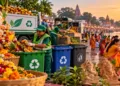
Tackling waste management has been an enduring challenge for the Nepalese government. Now, two local bodies in the Himalayan country have come forward with a mechanism to process the garbage, including both degradable and non-degradable, involving locals.
The Waling Municipality of Syangja and Tilottama Municipality of Rupandehi District have jointly pioneered the mechanism of managing the waste by turning it into a fortune. Both the local bodies have been earning millions of rupees processing different kinds of waste produced on a daily basis.
Tara Devi Subedi from Waling Municipality, about 240 kilometres from the capital Kathmandu, runs a small hotel in a local administrative division that has a population of about 50,000 people. Her hospitality business generates two buckets (about 10 litres) of garbage on a daily basis.
She said previously she would simply dump the waste in collection vehicles. However, over the last five years, she has embraced the new mechanism.
Innovative Mechanisms and New Techniques
“Previously, there were no such techniques for waste management. We used to throw the degradable and non-degradable waste into the collection vehicles. But now we are giving away the non-degradable waste, which is managed by the municipality using degradable waste as compost fertiliser. Things are different to what they used to be,” Subedi said as she brought segregated waste out from her hotel kitchen.
Once households and businesses like that of Subedi, in the administrative area, segregate and send non-degradable waste, it lands up at Waling Municipality Cleanliness Centre. Three trippers designated to collect the garbage as degradable and non-degradable take a round of the locality collecting the waste from business establishments as well as households.
Upon arrival at the site, the trippers unload the waste where four kinds of waste- plastic, glass, metallogeny and paper — are segregated and packed and sold to local factories that reuse or recycle it.
“On average, we earn anything between 8 million and 10 million annually from this management centre by selling off different kinds of waste. Excluding the money used to pay salaries to the management and staff, we save about 2 to 2.2 million rupees annually,” Krishna Khand, the mayor of Waling Municipality, said.
Classification of Waste
The local body has categorised the waste into three sections to make it easier for the locals to understand and make its management more effective. Out of the 8 to 10 tonnes of waste produced on a daily basis, it is classified as degradable, non-degradable and glass.
The share of degradable waste amongst those produced on a daily basis stands at about 90 per cent, which is mostly managed by locals back at their homes. Only 10 per cent makes its way to the cleanliness centre.
Further, at the cleanliness site, the non-degradable waste, especially plastic, is classified onto two sub-categories — recyclable and non-recyclable. The prices of glass bottles, which come under the non-degradable, are determined on the basis of their colour. It is the same for plastic as its price depends on its quality and colour.
The least regarded amongst plastic waste is Multi-layered Plastic (MLP) used in wrappers. However, it is used to make asphalt after shredding, 50 per cent of which is bio-degradable.
The local body has classified the plastic into three categories — PP1- Polypropylene, PP2 Polyethylene Terephthalate and High-Density Polyethylene, locally understood as “Gudiya” or doll for being subjected to hard layering. The municipality has been selling these plastics for 40, 45 and 60 rupees per Kilograms to the companies, which then recycle them to make different products.
Changing the notion of landfill or dumping site
When the municipality announced plans to set up the cleanliness centre and leased land for a government school on the riverside, the locals protested against it. However, now, the former landfill or dumping site has turned into a park as well as a picnic spot.
Two decades of planning and execution, which started more than a half-decade back, has given rise to lush greenery around the cleanliness centre, which is also equipped with walkways, a grass bed and vegetational habitat. This has been made possible under the ‘Participation of People’ model, whereby locals themselves make sure that classified waste is not mixed up while being taken out of houses or business establishments.
Involvement and Efforts of Local Populace
We have been putting the model of ‘participation of people into practice under the motto that we should clean our environment and should manage the waste on our own- it is the duty of every citizen, and it is the only belief that cleanliness can be seen only when the public participates.
“We made sure that every person participated in keeping the surroundings clean and paid for the charges that incur while maintaining the cleanliness drive; we kicked off this project with this thought,” Dilip Pratap Khand, former mayor of the municipality, also a member of the committee of the cleanliness centre said.
The cleanliness centre also runs a vermicompost plant (converting the biodegradable waste into organic manure utilizing the earthworms) using the facial waste in the vicinity of the cleanliness centre.
Setting up the facility for processing the faecal wastes, the municipality has appointed Waling Product Holding Multipurpose Cooperative, which has been involved in the sales as well as production of the vermicompost. Each Kilogram of these vermicompost costs Nrs. 25, which flies off the shelves of its exhibition centre very quickly.
Every household inside the municipality has been mandated to have its own septic tank to make sure the faecal waste is not dumped in the river. The local authorities have been charging these households Nrs. 5000 per session of cleaning, which is brought to the cleanliness centre, is separated into solid and liquid forms. The solid waste is turned into vermicompost, the liquid is turned into drinkable water, undergoing a series of steps.
The municipality has been treating the hospital wastes through recycling. As per the official, a total of 9 types of waste have been produced from the hospital, which has been dealt with separately.
“In the hospital, we have been classifying the wastes into nine classes and all of them are sterilized before they make their way out here (cleanliness centre).
None of the waste from the hospital goes out as waste, every waste is sold out, including the syringe needle (after sterilization), which is used as metallurgy. The remaining part of the syringe, which is plastic, is sold at quite a high price after sterilization. None of the waste is thrown out; it indeed is sold off,” Khand said.
Though the local municipality that lies in Gandaki Province has been segregating and selling off the waste, it is due to procure the machinery to recycle the waste on its own. Bidding to procure the machinery has been completed as the municipality plans to produce 24 different kinds of products from the waste it has been segregating in the present day.
Pioneering the waste management
About 105 Kilometers far from Waling Municipality in Gandaki Province, the Tilottama Municipality of Rupandehi District in Lumbini Province has practically been recycling some of its waste and making extra earnings.
With the slogan of “Green Tilottama: Clean Tilottama,” the municipality has set up its own waste processing and knowledge centre established in the former dumping site. In operation since 2017, after its establishment in the year 2013, the waste processing centre has directly given employment opportunities to about 50 people.
The Jana Sahabhagita Wash Swastha Sahakari, translated as Public Participation Wash Health Cooperative (PPWHC), has been operationalizing the waste management procedure in 11 wards out of the 17 that lie inside the municipality.
The Comprehensive Process
The cooperative mobilized a total of 9 tractors to collect all non-degradable wastes from the households and the industries. The Tilottama municipality has given the responsibility of managing the waste to the cooperative as a shareholder.
In the waste processing centre, the non-degradable wastes are separated, compressed and packed to sale it off to the highest bidder, while the degradable waste is turned into vermicompost.
“Non-degradable wastes are separated here at the processing centre that passes through a thermowell, pressure machine, shredder and brick machine. All these have been sold off at reasonable prices to various industries that lie inside the Rupandehi District as well as other districts throughout the nation,” Khem Gautam, the president of Wash cooperative, said
The waste processing centre has been selling about 35 different items, from plastic to metallurgies, glasses, and other itinerates. The price for these items varies from Nrs. 2 to 500 per kilogram, depending on the type and nature of the item.
“The slippers and shoes and the multi-layer plastic wrappers are sold up to Nrs. 6 per kilogram. The bottles (compressed) are sold for Nrs. 35 to 40, Clothes for Nrs. 2, Aluminium for Nrs. 150, Coppers and other kinds of metallurgies for Nrs. 500 per kilogram. The exceptional criteria set the price for the items, and the plastics that cannot be recycled or reused are sold to brick clink’s for Nrs. 6 per kilogram,” Gautam briefed.
The United Nations Development Program (UNDP) has been the key change-maker behind these models of managing solid waste. The half-a-decade program entitled PGRP (Promoting Green Recovery Project), which already has come to an end has brought a change in managing the waste, which both municipalities have aced.
The Tilottama Municipality, formed in 2016, has a population of 1,52,000, with 35,000 households has been earning Nrs. 6,00,000 on a monthly basis by selling off the waste materials. On average, 20 tons of waste are produced on a daily basis within the municipality.
“We have been working on reducing the production of waste from the source. If there is low production of waste, then the management of the waste will be much easier. The high volume of waste creates problems in its management; therefore, we have been asking people not to excessively use plastics.
We have banned the sales and distribution of tobacco items as it uses multi-layer plastics. We have such plans for other plastics because we know the lesser use of plastic would be further able to manage the wastes,” Bal Krishna Khand, Mayor of Tilottama Municipality in Rupandehi district, said
The municipality also has been making efforts to ensure every household takes the responsibility of segregating the wastes. Waste materials from the household are collected only after degradable and non-degradable are separated, if anyone refuses to follow it the house is penalized with the fine of Nrs. 500.
To ensure proper utilisation of degradable waste, the municipality, through cooperatives, has distributed compost bins to the households where manures are produced, used as well as sold in the market. The production of manures also has reduced the dependency on chemical fertilizers, which at seasons becomes scarce.
“From the source — households or businesses — we should segregate waste. We cannot segregate it later in the dumping sites. In Kathmandu (the capital), all the waste is kept in the same place, which only leaves the possibility other than dumping it in the landfill sites. For how long can the problem be solved by dumping all the waste? It is not practical.”
This would only create mountains of garbage we must reuse. It is a source of high income for us, we are ignoring the possibility of income from the waste. We can convert waste into money. Every waste obviously can be reused,” said Khand.