On July 14, the Law Commission of India issued a public notice extending the time period for submission of suggestions on the Uniform Civil Code (UCC) by two weeks. The public notice said, “In view of the overwhelming response from the public on the subject of Uniform Civil Code and numerous requests received from various quarters regarding the extension of time for submitting their comments, the Law Commission has decided to grant an extension of two weeks for the submission of views and suggestions by the concerned stakeholders.”
The commission further said, in its public notice, that it values the inputs of all stakeholders and aims to create an inclusive environment that encourages active engagement. The notice said that it encourages all interested parties to utilise the extended time period to contribute their ideas and expertise. Thus, now the interested individuals, institutions and organisations can furnish suggestions on the UCC till July 28, 2023.
The interested parties can mail their suggestions for the UCC to ‘[email protected]’ or submit them on the Law Commission of India’s website. Furthermore, submissions can also be sent to the commission through hard copies at the address “Member Secretary, Law Commission of India, 4th Floor, Lok Nayak Bhawan, Khan Market, New Delhi – 110 003.”
Law Commission Invites Suggestions on UCC
On June 14, the 22nd Law Commission of India issued a public notice soliciting the views and ideas of the general public and recognised religious organisations about the ‘Uniform Civil Code.’ The Law Commission of India is examining the subject matter in reference to the Ministry of Law and Justice’s reference dated June 17, 2016.
Earlier, the 21st Law Commission of India had examined the subject of the Uniform Civil Code and solicited views from stakeholders through an appeal and a questionnaire dated October 7, 2016, and further public notices in March and April 2018. Thereafter, the 21st Law Commission of India issued a Consultation Paper on “Reforms of Family Law” on August 31, 2018.
However, since more than three years have passed since the issuance of the Consultation Paper, the Law Commission of India has decided to deliberate afresh over the subject owing to the relevance and importance of the subject and various judicial orders on the subject.
Law Commission’s notice dated June 14 states, “Accordingly, the 22nd Law Commission of India decided again to solicit views and ideas of the public at large and recognized religious organizations about the Uniform Civil Code. Those who are interested and willing may present their views within a period of 30 days from the date of Notice through “click here” button or by Email at [email protected] to the Law Commission of India.”
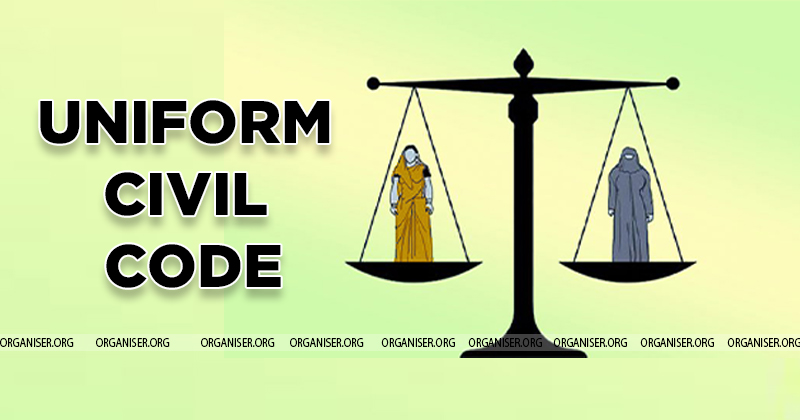
Uniform Civil Code resonates with the idea of ‘one country, one rule’ and finds its place in Article 44 of the Constitution of India. Enshrined in Part IV of the Constitution, Uniform Civil Code is a Directive Principle of State Policy (DPSP). However, while the DPSPs are basic principles included in the Constitution to provide instructions/guidelines for the governments while formulating laws, they are not enforceable. Article 44 of the Constitution of India states, “The State shall endeavour to secure for the citizens a uniform civil code throughout the territory of India.”
Shah Bano Case (1985)
A 73-year-old woman by the name of Shah Bano was divorced by her husband, using the now outlawed ‘triple talaq’ or Talaq-e-Biddat, where she was not granted proper maintenance under the same. As a result, she filed a case based on Section 125 of the All India Criminal Code, which pertains to the ‘Maintenance of wives, children, and parents.’
Based on the judgment resulting from this case, a union civil code was recommended, and after the verdict, there were agitations and protests. As a result, Parliament passed the Muslim Women’s (Right to Protection on Divorce) Act (MWA) in 1986, making Section 125 of the Criminal Procedural Code inapplicable to Muslim women.
Daniel Latifi Case (2001)
The Muslim Woman’s Act (MVA) was challenged on the grounds that it violated Articles 14 and 15 and Article 21 of the Indian Constitution. While declaring the aforementioned law Constitutional, the Apex Court provided provisions that it would complement Section 125 of the Indian Criminal Code. This would ensure that the amount received by a wife during her Iddat period was sufficient to sustain her during that time and to provide for her future.
John Vallamattom Case (2003)
A Keralite Priest, John Vallamottom had challenged the Constitutional validity of Section 118 of the Indian Succession Act, which applies to all non-Hindus in the Union of India. He challenged that Section 118 of the ISA, Act was discriminatory in nature against Christians as this particular section put unreasonable restrictions on the amount of donations and charitable that can be done by Christians, with their own free will. The bench struck down the relevant Section 118 as unconstitutional.
Shayara Bano Case (2017)
In October 2015, Rizwan Ahmed divorced Shayara Bano through the practice of ‘talaq-e-biddat,’ also known as instantaneous triple talaq, wherein the man can divorce the wife by saying ‘talaq’ thrice and without the wife’s consent. Bano filed a writ petition before the Supreme Court challenging the constitutionality of talaq-e-biddat, polygamy and nikah-halala, contending that these practices violate multiple fundamental rights and were not protected by the Right to Freedom of Religion.
On February 16, 2017, the Supreme Court directed the All India Muslim Personal Law Board (AIMPLB), the Government of India and certain women’s rights groups. Notably, the AIMPLB filed submissions against Bano, while others filed in her support. The AIMPLB claimed that the courts could not review the uncodified Muslim personal laws and that these practices were essential to Islam and protected under the Right to Freedom of Religion.
Supreme Court’s Constitution Bench heard the matter and delivered a split verdict in a 3:2 ratio. While the majority held that the practice of ‘talaq-e-biddat’ was manifestly arbitrary and unconstitutional, the minority comprising Chief Justice Khehar and Justice Nazeer, said that the practice was protected under the Right to Freedom of Religion.
The Government of India, in 2019, enacted legislation punishing the practice of ‘talaq-e-biddat’ with a maximum punishment of up to three years. Notably, Uniform Civil Code has been on Bharatiya Janata Party’s (BJP) agenda for a long time. The BJP has said that a secular set of laws would ensure gender equality. The BJP’s 2014 election manifesto said, “BJP believes that there cannot be gender equality till such time India adopts a uniform civil code, which protects the rights of all women, and the BJP reiterates its stand to draft a uniform civil code, drawing upon the best traditions and harmonizing them with the modern times,” the manifesto said.