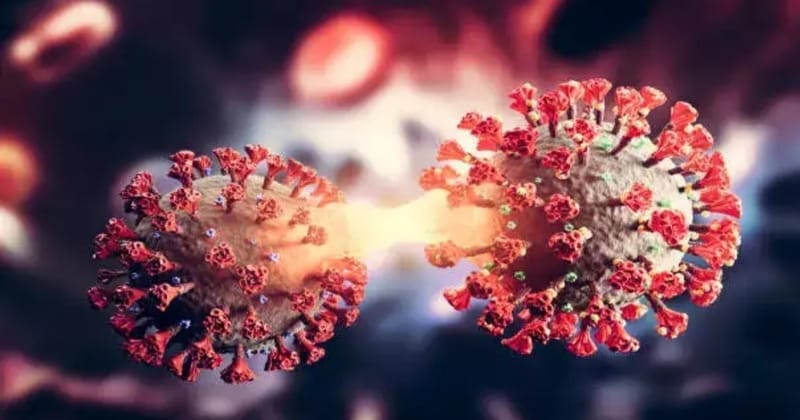
Air monitor can identify Covid-19 virus in five minutes
June 7, 2026
  • Read Ecopy
  • Circulation
  • Advertise
  • Careers
  • About Us
  • Contact Us
Android AppiPhone AppArattai
Organiser
  • ‌
  • Bharat
    • Assam
    • Bihar
    • Chhattisgarh
    • Jharkhand
    • Maharashtra
    • View All States
  • World
    • Asia
    • Europe
    • North America
    • South America
    • Africa
    • Australia
  • Editorial
  • International
  • Opinion
  • RSS @ 100
  • More
    • Op Sindoor
    • Analysis
    • Sports
    • Defence
    • Politics
    • Business
    • Economy
    • Culture
    • Special Report
    • Sci & Tech
    • Entertainment
    • G20
    • Azadi Ka Amrit Mahotsav
    • Vocal4Local
    • Web Stories
    • Education
    • Employment
    • Books
    • Interviews
    • Travel
    • Law
    • Health
    • Obituary
  • Subscribe
    • Subscribe Print Edition
    • Subscribe Ecopy
    • Read Ecopy
  • ‌
  • Bharat
    • Assam
    • Bihar
    • Chhattisgarh
    • Jharkhand
    • Maharashtra
    • View All States
  • World
    • Asia
    • Europe
    • North America
    • South America
    • Africa
    • Australia
  • Editorial
  • International
  • Opinion
  • RSS @ 100
  • More
    • Op Sindoor
    • Analysis
    • Sports
    • Defence
    • Politics
    • Business
    • Economy
    • Culture
    • Special Report
    • Sci & Tech
    • Entertainment
    • G20
    • Azadi Ka Amrit Mahotsav
    • Vocal4Local
    • Web Stories
    • Education
    • Employment
    • Books
    • Interviews
    • Travel
    • Law
    • Health
    • Obituary
  • Subscribe
    • Subscribe Print Edition
    • Subscribe Ecopy
    • Read Ecopy
Organiser
  • Home
  • Bharat
  • World
  • Operation Sindoor
  • Editorial
  • Analysis
  • Opinion
  • Culture
  • Defence
  • International Edition
  • RSS @ 100
  • Magazine
  • Read Ecopy
Home World

Air monitor can identify Covid-19 virus in five minutes

WEBDESKWEBDESK
Jul 11, 2023, 11:00 pm IST
in World, Health
Follow on Google News
FacebookTwitterWhatsAppTelegramEmail

Scientists are investigating techniques to monitor the indoor environment in real-time for viruses now that the Covid-19 pandemic’s emergency phase is over. Researchers at Washington University in St Louis have developed a real-time monitor that can identify any SARS-CoV-2 virus variant in a room in roughly 5 minutes by fusing recent advancements in aerosol sampling technology with an ultrasensitive biosensing method.

The inexpensive, proof-of-concept device could be used in hospitals and health care facilities, schools and public places to help detect CoV-2 and potentially monitor for other respiratory virus aerosols, such as influenza and respiratory syncytial virus (RSV). Results of their work on the monitor, which they say is the most sensitive detector available, are published July 10 in Nature Communications. The interdisciplinary team of researchers from the McKelvey School of Engineering and the School of Medicine consists of Rajan Chakrabarty, the Harold D. Jolley Career Development Associate Professor of energy, environmental & chemical engineering in McKelvey Engineering; Joseph Puthussery, a postdoctoral research associate in Chakrabarty’s lab; John Cirrito, a professor of neurology at the School of Medicine; and Carla Yuede, an associate professor of psychiatry at the School of Medicine.

“There is nothing at the moment that tells us how safe a room is,” Cirrito said. “If you are in a room with 100 people, you don’t want to find out five days later whether you could be sick or not. The idea with this device is that you can know essentially in real time, or every 5 minutes, if there is a live virus.”

Cirrito and Yuede had previously developed a micro-immunoelectrode (MIE) biosensor that detects amyloid beta as a biomarker for Alzheimer’s disease and wondered if it could be converted into a detector for SARS-CoV-2. They reached out to Chakrabarty, who assembled a team that included Puthussery, who had expertise in building real-time instruments to measure the toxicity of air.

To convert the biosensor from detecting amyloid beta to coronavirus, the researchers exchanged the antibody that recognizes amyloid beta for a nanobody from llamas that recognizes the spike protein from the SARS-CoV-2 virus. David Brody, MD, PhD, a former faculty member in the Department of Neurology at the School of Medicine and an author on the paper, developed the nanobody in his lab at the National Institutes of Health (NIH). The nanobody is small, easy to reproduce and modify and inexpensive to make, the researchers said.

“The nanobody-based electrochemical approach is faster at detecting the virus because it doesn’t need a reagent or a lot of processing steps,” Yuede said. “SARS-CoV-2 binds to the nanobodies on the surface, and we can induce oxidation of tyrosines on the surface of the virus using a technique called square wave voltammetry to get a measurement of the amount of virus in the sample.”

Chakrabarty and Puthussery integrated the biosensor into an air sampler that operates based on the wet cyclone technology. Air enters the sampler at very high velocities and gets mixed centrifugally with the fluid that lines the walls of the sampler to create a surface vortex, thereby trapping the virus aerosols. The wet cyclone sampler has an automated pump that collects the fluid and sends it to the biosensor for seamless detection of the virus using electrochemistry.

“The challenge with airborne aerosol detectors is that the level of virus in the indoor air is so diluted that it even pushes toward the limit of detection of polymerase chain reaction (PCR) and is like finding a needle in a haystack,” Chakrabarty said. “The high virus recovery by the wet cyclone can be attributed to its extremely high flow rate, which allows it to sample a larger volume of air over a 5-minute sample collection compared with commercially available samplers.”

Most commercial bioaerosol samplers operate at relatively low flow rates, Puthussery said, while the team’s monitor has a flow rate of about 1,000 liters per minute, making it one of the highest flow-rate devices available. It is also compact at about 1 foot wide and 10 inches tall and lights up when a virus is detected, alerting administrators to increase airflow or circulation in the room.

The team tested the monitor in the apartments of two COVID-positive patients. The real-time PCR results of air samples from the bedrooms were compared with air samples collected from a virus-free control room. The devices detected RNA of the virus in the air samples from the bedrooms but did not detect any in the control air samples.

In laboratory experiments that aerosolized SARS-CoV-2 into a room-sized chamber, the wet cyclone and biosensor were able to detect varying levels of airborne virus concentrations after only a few minutes of sampling.

“We are starting with SARS-CoV-2, but there are plans to also measure influenza, RSV, rhinovirus and other top pathogens that routinely infect people,” Cirrito said. “In a hospital setting, the monitor could be used to measure for staph or strep, which cause all kinds of complications for patients. This could really have a major impact on people’s health.”
The team is working to commercialize the air quality monitor.

(with inputs from ANI)



Topics: COVID-19EnvironmentVirusRespiratory syncytial virusAir monitorIndoor environmentAirborne virusAirborne aerosol detectors
ShareTweetSendShareSend
✮ Subscribe Organiser YouTube Channel. ✮
✮ Join Organiser's WhatsApp channel for Nationalist views beyond the news. ✮
Previous News

‘Ram and Ravan were both mad for Sita’s beauty’: Rajasthan Congress Minister’s derogatory statement stirs controversy

Next News

Study reveals forest may adapt to climate change, but not quickly enough

Related News

Moody’s Report Places India in ‘Best Position’ Among Emerging Markets (This is an AI generated image)

Moody’s report backs India as strongest emerging economy amid global turbulence

Representative Image

Navratri and sacred botany

An investigation is underway in Las Vegas after a possible biological laboratory was found inside a home

US: Las Vegas home under investigation after discovery of refrigerators containing COVID-19 & other biological samples

Rah-Veer Scheme: “The golden hour” sixty minutes that decide life and death

Reducing Environmental Pollution in India

The convergence of policy, leadership, intent and faith can make India pollution-free

Message of environmental harmony in Vande Mataram

Environmental harmony in the verses of Vande Mataram

Load More

Latest News

Visuals from the site of protest in Jantar Mantar

From ‘Azadi’ slogans to disrespect of national flag: Inside the Cockroach Janta Party protest at Jantar Mantar

Chairman of the Rastriya Swatantra Party of Nepal Rabi Lamichhane meets PM Modi in New Delhi

From the China Card to Development Diplomacy: Nepal opens a new chapter in its political reset with India

'Stand Up for Abhishek': Expelled TMC MLA Claims Party Was Asked to Applaud Mamata's Nephew After Crushing Election Defeat

West Bengal: Expelled TMC MLA Ritabrata claims party was asked to applaud Mamata’s nephew after crushing defeat

Forced to Remove the “Faith”: How Hindu students are targeted at exam centres

A representative image generated using AI

Gujarat: Parsi woman Married to a Muslim man cremated with Hindu rites after VHP’s intervention

She showed the "Made in Pakistan" label attached to the bedsheet

Made in Pakistan bedsheet sold at Pune religious fair? Viral video triggers investigation

India's first Prime Minister Jawahar Lal Nehru and India's current Prime Minister Narendra Modi

From ‘Ship to Mouth’ under Nehru to free rations for 80 crore under Modi: Inside India’s food security revolution

Picture from the site of protest

22 million followers, a few hundred on ground: Cockroach Janta Party faces its first reality check at Jantar Mantar

Uttar Pradesh CM Yogi Adityanath

From lawlessness to good governance: How Uttar Pradesh rewrote its law and order story under Yogi Adityanath

Govt mulls Budget press printing for NEET- UG RE-exam question papers (This is an AI generated image)

NEET-UG Re-Exam Security Overhaul: Government mulls budget press printing, IAF transportation to prevent paper leaks

Load More
  • Privacy
  • Terms
  • Cookie Policy
  • Refund and Cancellation
  • Delivery and Shipping

© Bharat Prakashan (Delhi) Limited.
Tech-enabled by Ananthapuri Technologies

  • Home
  • Search Organiser
  • Bharat
    • Assam
    • Bihar
    • Chhattisgarh
    • Jharkhand
    • Maharashtra
    • View All States
  • World
    • Asia
    • Africa
    • North America
    • South America
    • Europe
    • Australia
  • Editorial
  • Operation Sindoor
  • Opinion
  • Analysis
  • Defence
  • Culture
  • Sports
  • Business
  • RSS @ 100
  • Entertainment
  • More ..
    • Sci & Tech
    • Vocal4Local
    • Special Report
    • Education
    • Employment
    • Books
    • Interviews
    • Travel
    • Health
    • Politics
    • Law
    • Economy
    • Obituary
  • Subscribe Magazine
  • Read Ecopy
  • Advertise
  • Circulation
  • Careers
  • About Us
  • Contact Us
  • Policies & Terms
    • Privacy Policy
    • Cookie Policy
    • Refund and Cancellation
    • Terms of Use

© Bharat Prakashan (Delhi) Limited.
Tech-enabled by Ananthapuri Technologies