
On July 7, the Supreme Court adjourned Jammu and Kashmir National Panthers Party’s (JKNPP) plea seeking the conduction of elections in the Union Territory (UT) of J&K. The bench comprising Chief Justice DY Chandrachud, Justices PS Narsimha and Manoj Mishra stated that the case would be listed after directions are passed in a case concerning the challenge to the amendment of Article 370. The court said it would save a lot on “procedural formalities.”
The senior leaders of the JKNPP moved the Supreme Court seeking a direction to the Election Commission of India to conduct assembly elections for UT of J&K without further delay.
CJI DY Chandrachud said, “We will adjourn this matter. The 370 matter is listed for directions on 11th. So we will adjourn this till then.” However, the petitioner responded, “This is a different case. We have been disenfranchised.” The Chief Justice replied, “These matters are linked, they’re similar. Why don’t you give a copy to the centre? This will only save on procedural formalities.”
Constitution Bench To Hear Pleas Challenging Amendment of Article 370
A Constitution Bench of the Supreme Court is set to hear the petitions challenging the amendment of Article 370, which gave special status to Jammu and Kashmir (J&K). The Constitution Bench comprises Chief Justice DY Chandrachud, Justice SK Kaul, Justice Sanjiv Khanna, Justice BR Gavai, and Justice Surya Kant.
The cases were posted “for directions” on July 11 to complete the pre-hearing procedural formalities, such as filing documents and submissions. However, while hearing Teesta Setalvad’s bail plea in a Gujarat Riots case for fabrication of evidence, Justice BR Gavai revealed that the court would start hearing the pleas in August.
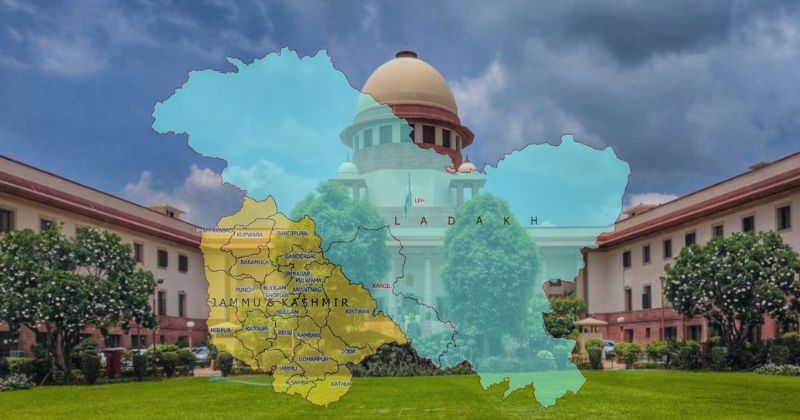
On August 5, 2019, the Government of India amended Article 370, scrapping J&K’s special status. The government further notified the Jammu and Kashmir Reorganisation Act, 2019, which divided the erstwhile state into two Union Territories – Jammu and Kashmir and Ladakh. The erstwhile J&K state was infamous for observing shutdowns, witnessing stone pelting and separatists delivering anti-national sermons.
The hearings against the amendment of Article 370 commenced before the Constitution Bench in December 2019, four months after the Government of India’s notification. One of the issues before the court concerned whether the matter should be referred to a seven-judge bench in light of the alleged divergence of opinion by two coordinate benches of the court.
However, on March 2, 2020, Constitution Bench held that there was no need to refer the matter to a larger bench. Of the last bench which heard the case, Justices NV Ramana and Subhash Reddy have retired. Chief Justice DY Chandrachud and Justice Sanjiv Khanna are the new members of the Constitution Bench.
Several petitions are moved before the Supreme Court, including those of private individuals, lawyers, activists and politicians and political parties challenging the Jammu & Kashmir Reorganisation Act, 2019, which splits Jammu & Kashmir into two Union Territories, Jammu & Kashmir, and Ladakh.
Notably, one of the petitioners, IAS officer Shah Faesal, has said that the matter now is a “thing of the past.” The bureaucrat said he had withdrawn his petition challenging the Presidential Order to scrap Article 370 a long time back. “I have withdrawn the petition in the Supreme Court challenging the Presidential Order to scrap Article 370 long ago,” IAS officer Shah Faesal said. The court would also hear whether Faesal’s petition can be withdrawn.
“370, for many Kashmiris like me, is a thing of the past. Jhelum and Ganga have merged in the great Indian Ocean for good. There is no going back. There is only marching forward,” Shah Faesal said in his tweet. The 2010 batch IAS officer, Shah Faesal, resigned from service in January 2019, floating his party – Jammu Kashmir People’s Movement – with Shehla Rashid. However, he resigned from his political outfit in August 2020, after which the Government of India reinstated him in service.