De-dollarisation: Dealing with the US monetary hegemony
October 3, 2026
  • Read Ecopy
  • Circulation
  • Advertise
  • Careers
  • About Us
  • Contact Us
Android AppiPhone AppArattai
Organiser
  • ‌
  • Bharat
    • Assam
    • Bihar
    • Chhattisgarh
    • Jharkhand
    • Maharashtra
    • View All States
  • World
    • Asia
    • Europe
    • North America
    • South America
    • Africa
    • Australia
  • Editorial
  • International
  • Opinion
  • RSS @ 100
  • More
    • World Hindu Congress 2026
    • Op Sindoor
    • Analysis
    • Sports
    • Defence
    • Politics
    • Business
    • Economy
    • Culture
    • Special Report
    • Sci & Tech
    • Entertainment
    • G20
    • Azadi Ka Amrit Mahotsav
    • Vocal4Local
    • Web Stories
    • Education
    • Employment
    • Books
    • Interviews
    • Travel
    • Law
    • Health
    • Obituary
  • Subscribe
    • Subscribe Print Edition
    • Subscribe Ecopy
    • Read Ecopy
  • ‌
  • Bharat
    • Assam
    • Bihar
    • Chhattisgarh
    • Jharkhand
    • Maharashtra
    • View All States
  • World
    • Asia
    • Europe
    • North America
    • South America
    • Africa
    • Australia
  • Editorial
  • International
  • Opinion
  • RSS @ 100
  • More
    • World Hindu Congress 2026
    • Op Sindoor
    • Analysis
    • Sports
    • Defence
    • Politics
    • Business
    • Economy
    • Culture
    • Special Report
    • Sci & Tech
    • Entertainment
    • G20
    • Azadi Ka Amrit Mahotsav
    • Vocal4Local
    • Web Stories
    • Education
    • Employment
    • Books
    • Interviews
    • Travel
    • Law
    • Health
    • Obituary
  • Subscribe
    • Subscribe Print Edition
    • Subscribe Ecopy
    • Read Ecopy
Organiser
  • Home
  • Bharat
  • World
  • Operation Sindoor
  • Editorial
  • Analysis
  • Opinion
  • Culture
  • Defence
  • International Edition
  • RSS @ 100
  • Magazine
  • Read Ecopy
Home World

De-dollarisation: Dealing with the US monetary hegemony

The dollar-led international monetary system has morphed over the years to accommodate the changing dynamics of globalisation. In this backdrop, it is a high time to deal with US monopoly over world currency

Ameya KulkarniAmeya Kulkarni
Jun 7, 2023, 07:00 pm IST
inUSA, North America, America, World, Opinion, International Edition
Follow on Google News
Facebook
Twitter
WhatsAppTelegramEmail

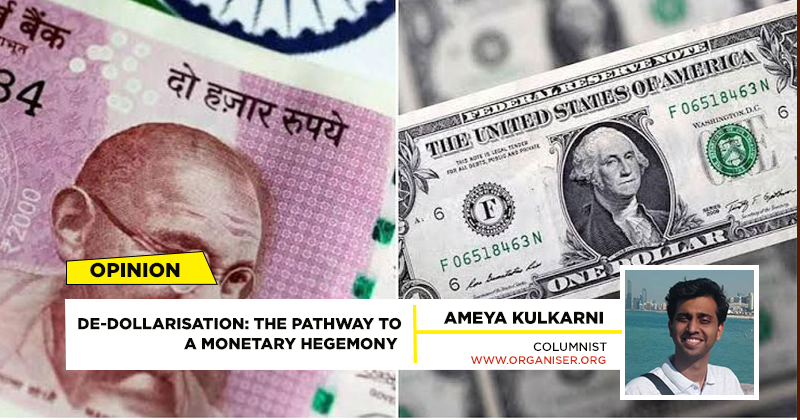
Over its 70-year reign, the US dollar has secured a role that far outsizes its parent nation. The United States (US) accounts for just over a tenth of global trade and contributes about 24 per cent of GDP to the world economy. The dollar, however, is involved in almost 90 per cent of global foreign exchange transactions, accounts for 59 per cent of forex reserves held by central banks and is the currency of choice for invoicing about 50 per cent of world trade. Undoubtedly, much of globalisation took place on the back of the dollar, and its use in trade and finance provided surety and ensured convenience. However, in an increasingly multipolar world, with the rising economic prowess of the Global South, the costs and benefits of a dominant currency regime must be reassessed.

While the dollar-led international monetary system has morphed over the years to accommodate the changing dynamics of globalisation, it continues to feed a cycle of inter-country inequality. It amplifies business cycle fluctuations in developing and emerging economies. Particularly during monetary tightening, currency values collapse against the greenback, and capital flees emerging economies’ shores. As a nation’s currency depreciates, standard economic thinking, very optimistically, indicates that although import costs rise, exports become relatively cheaper in the international market, increasing demand from foreign purchasers and boosting domestic growth.

Also Read: Is this a Second Cold War? Is De-Dollarisation inevitable?

Particularly true for emerging markets and developing economies, where pricing in dollars is more prevalent than in advanced economies, currency depreciation fails to make exports cheaper for foreign buyers, resulting in no incentive for them to increase demand. In the short run, therefore, exports do not receive a boost and domestic economies are further crippled by expensive imports, a phenomenon experienced by most of the Global South after the Federal Reserve began raising interest rates in 2022. In effect, this mutes a primary advantage of the flexible exchange rate regime, and gains to be made on the export side during a currency depreciation are lost.

The US also wields significant financial firepower through sanctions and restrictions on using the dollar. For instance, in the recent wave of sanctions against Russia, the US and its allies froze almost half of the Russian central bank’s foreign exchange reserves and barred major Russian banks from using the Society for Worldwide Interbank Financial Telecommunications (SWIFT). This interbank messaging system facilitates cross-border transactions. The threat of losing the ability to do business in an interconnected world has further pushed countries to consider a shift from the dollar and develop alternatives to US-controlled clearing and communication systems like the Clearing House Interbank Payments System (CHIPS) and SWIFT.

Also Read: Dedollarisation and its impact on global economy

For the US, controlling the world’s reserve currency means that it can borrow cheaply from around the world to fund a lifestyle beyond its means. Some groups of Americans, however, are not revelling in the dominance of the mighty dollar. While Wall Street and military establishments may have gained from the rule of the greenback, manufacturing and export-driven sectors have paid the price. High demand for the dollar all over the globe increases its value, making US exports relatively expensive. This, in turn, hurts sectors like manufacturing in areas such as the Rust Belt, where workers have been laid off, and jobs offshored.

The dollar’s role has seen some change recently, albeit small. For instance, the share of foreign exchange reserves held in US dollars by central banks worldwide has fallen from 71 per cent in 1999 to 59 per cent in 2021. This fall in the dollar share has been accompanied by an active diversification of central banks’ forex portfolios across the globe towards non-traditional reserve currencies, with historically dominant reserve currencies like the Euro, British Pound, and Japanese Yen taking a comparative back seat. A major attraction for central banks has been the rise in scale and liquidity of markets in smaller economies, coupled with comparatively higher returns when adjusted for volatility.

Also Read: Galvanising Indian Rupee for economic transactions: Is India setting a path towards De-Dollarisation?

Developing deep, liquid, and open domestic-currency asset markets across countries, along with electronic trading platforms and automated market making, has reduced the costs of trading directly in domestic currencies. Emerging economies’ contribution to global trade and capital market transactions has steadily risen, and commerce in emerging market currencies presently accounts for 25 per cent of global foreign exchange turnover, up from just 7 per cent in 2001.

Additionally, the BRICS—a multilateral grouping of Brazil, Russia, India, China and South Africa—declared the development of a reserve currency comprising a basket of member nations’ currencies. Although the idea of a BRICS reserve currency rests on shaky ground, given the group’s inherent heterogeneities and strategic conflicts, increased bilateral trade in domestic currencies between member nations could pave the way for diversification away from the dollar. Moreover, with oil exporters like Saudi Arabia keen to forge stronger ties with emerging and developing economies, domestic currencies could also enter the oil trade.

While geopolitical gears are certainly shifting, it would be naïve to declare the dollar’s demise. Historically, no single currency has been successful in dethroning the greenback. The euro failed despite being pitched by an economy comparable to the US in size, and the newer contender, the Chinese renminbi, is unlikely to be backed by markets flexible and transparent enough for it to rule.

A subtle but distinct shift away from the dollar is certainly underway. A shift that has the potential to rebalance the international system of trade and finance equitably, with the emerging and developing world establishing itself as a force to be reckoned with.

Topics: EconomyGlobalisationBRICSSociety for Worldwide Interbank Financial TelecommunicationsSWIFTgrowthUS DollarDe-dollarisationDollarUS hegemonyUnited Statesinternational monetary system
Share1
Tweet
SendShareSend
✮ Subscribe Organiser YouTube Channel. ✮
✮ Join Organiser's WhatsApp channel for Nationalist views beyond the news. ✮
Previous News

Modi Cabinet approves higher MSP for Kharif crops for 2023-24 marketing season

Next News

Damoh School Controversy: Distorted map of India in logo; illegal land encroachment for other businesses suspected

Related News

US President Donald Trump (Right)

US: Trump administration moves closer to sanctioning International Criminal Court over its investigations

Representative Image

Can BRICS change the global economic order?

Robert Spencer’s warning over the expanding reach of “stealth jihad” and political Islam in America and Europe

What Is ‘Stealth Jihad’? Robert Spencer exposes how America and Europe are being drawn into Sharia’s political web

India’s “Nalanda Approach” uses engagement with SCO, BRICS and the Quad to strengthen strategic autonomy in a fragmenting world

The Nalanda Approach: How India connects a fragmenting world through SCO, BRICS and strategic autonomy

BRICS New Delhi Declaration 2026

BRICS New Delhi Declaration 2026: Science, technology, energy & human capital for resilient global south

New Delhi, Sep 12 (ANI): Prime Minister Narendra Modi holds a bilateral meeting with Chinese President Xi Jinping on the sidelines of the BRICS Summit 2026, in New Delhi on Saturday. External Affairs Minister S. Jaishankar, NSA Ajit Doval and Principal Secretaries to the PM, Pramod Kumar Mishra and Shaktikanta Das also present. (@MEAIndia X/ANI Photo)

BRICS 2026: Why Putin, Xi and Pezeshkian meetings stand out in PM Modi’s diplomacy

Load More

Latest News

Kumkum Mohod scripted history by winning India’s first women’s individual recurve gold at the Asian Games

Asian Games 2026: 17-year-old Kumkum Mohod creates history, wins India’s first women’s individual recurve gold

Captain Smit Machchhar

Flydubai Attack: RSS praises Captain Smit Machchhar for courage, timely action in protecting 170 lives

Tamil Nadu: Madras HC forms 7-member Interim Board after Sowriraja Perumal Temple went without Board since 2004

Chinmaya Amrit Yatra meets Param Vir Chakra awardee Captain Bana Singh, highlighting his courage, simplicity and love for Bharat

Chinmaya Amrit Yatra: Captain Bana Singh recalls Siachen battle, his love for Jammu and message to youth

Hindu Mandir Vandalised in Ohio

US: Hindu mandir vandalised in Ohio; Community groups flag rising targeted attack, demand swift action from govt

Assam CM Himanta Biswa Sarma formally launched bamboo-made bicycles in Guwahati, marking a step towards sustainable transportation

Assam: CM Himanta Biswa Sarma launches bamboo-made bicycles, pushing sustainable transportation in the state

Hamam Al-Hammami’s extremist past and reported security concerns at Oman Air now under scrutiny after Flydubai cockpit attack

Omani-Syrian Hamam Al-Hammami identified as Flydubai co-pilot who attacked captain and tried to crash Tel Aviv flight

President Droupadi Murmu has given assent to the Gujarat UCC Bill, 2026, paving the way for its implementation in the state

Gujarat UCC Bill 2026 gets President Droupadi Murmu’s assent, legislation comes into effect across the state

SJTA plans dedicated darshan assistance for elderly and divyang devotees and restoration of 1.5 acres of temple land

Odisha: Shri Jagannath Mandir plans dedicated darshan assistance for elderly and divyang devotees

Representative image

Weekly Love Jihad Report: From fake names to fake social media accounts – Here’s how Islamists targeted Hindu women

Load More
  • Privacy
  • Terms
  • Cookie Policy
  • Refund and Cancellation
  • Delivery and Shipping

© Bharat Prakashan (Delhi) Limited.
Tech-enabled by Ananthapuri Technologies

  • Home
  • Search Organiser
  • Bharat
    • Assam
    • Bihar
    • Chhattisgarh
    • Jharkhand
    • Maharashtra
    • View All States
  • World
    • Asia
    • Africa
    • North America
    • South America
    • Europe
    • Australia
  • Editorial
  • Operation Sindoor
  • Opinion
  • Analysis
  • Defence
  • Culture
  • Sports
  • Business
  • RSS @ 100
  • Entertainment
  • More ..
    • Sci & Tech
    • Vocal4Local
    • Special Report
    • Education
    • Employment
    • Books
    • Interviews
    • Travel
    • Health
    • Politics
    • Law
    • Economy
    • Obituary
  • Subscribe Magazine
  • Read Ecopy
  • Advertise
  • Circulation
  • Careers
  • About Us
  • Contact Us
  • Policies & Terms
    • Privacy Policy
    • Cookie Policy
    • Refund and Cancellation
    • Terms of Use

© Bharat Prakashan (Delhi) Limited.
Tech-enabled by Ananthapuri Technologies