
Srinivasa Ramanujan and India's growth in Mathematics
June 23, 2026
  • Read Ecopy
  • Circulation
  • Advertise
  • Careers
  • About Us
  • Contact Us
Android AppiPhone AppArattai
Organiser
  • ‌
  • Bharat
    • Assam
    • Bihar
    • Chhattisgarh
    • Jharkhand
    • Maharashtra
    • View All States
  • World
    • Asia
    • Europe
    • North America
    • South America
    • Africa
    • Australia
  • Editorial
  • International
  • Opinion
  • RSS @ 100
  • More
    • Op Sindoor
    • Analysis
    • Sports
    • Defence
    • Politics
    • Business
    • Economy
    • Culture
    • Special Report
    • Sci & Tech
    • Entertainment
    • G20
    • Azadi Ka Amrit Mahotsav
    • Vocal4Local
    • Web Stories
    • Education
    • Employment
    • Books
    • Interviews
    • Travel
    • Law
    • Health
    • Obituary
  • Subscribe
    • Subscribe Print Edition
    • Subscribe Ecopy
    • Read Ecopy
  • ‌
  • Bharat
    • Assam
    • Bihar
    • Chhattisgarh
    • Jharkhand
    • Maharashtra
    • View All States
  • World
    • Asia
    • Europe
    • North America
    • South America
    • Africa
    • Australia
  • Editorial
  • International
  • Opinion
  • RSS @ 100
  • More
    • Op Sindoor
    • Analysis
    • Sports
    • Defence
    • Politics
    • Business
    • Economy
    • Culture
    • Special Report
    • Sci & Tech
    • Entertainment
    • G20
    • Azadi Ka Amrit Mahotsav
    • Vocal4Local
    • Web Stories
    • Education
    • Employment
    • Books
    • Interviews
    • Travel
    • Law
    • Health
    • Obituary
  • Subscribe
    • Subscribe Print Edition
    • Subscribe Ecopy
    • Read Ecopy
Organiser
  • Home
  • Bharat
  • World
  • Operation Sindoor
  • Editorial
  • Analysis
  • Opinion
  • Culture
  • Defence
  • International Edition
  • RSS @ 100
  • Magazine
  • Read Ecopy
Home Bharat

Srinivasa Ramanujan and India’s growth in Mathematics

Dr Pankaj Jagannath JayswalDr Pankaj Jagannath Jayswal
Apr 26, 2023, 09:00 am IST
in Bharat, Opinion, Delhi
Follow on Google News
FacebookTwitterWhatsAppTelegramEmail

From 1200 BCE to the end of the 18th century, Indian mathematics flourished on the Indian subcontinent. Scholars such as Aryabhata, Brahmagupta, Bhaskara II, and Varhamihira made significant contributions to Indian mathematics during the classical period (400 CE to 1200 CE). The modern decimal number system was first recorded in Indian mathematics. Indian mathematicians made important early contributions to the study of zero as a number, negative numbers, arithmetic, and algebra. Furthermore, trigonometry was advanced in India, and the modern definitions of sine and cosine were developed there. These mathematical concepts were transmitted to the Middle East, China, and Europe, where they spawned further developments that now serve as the foundations for many areas of mathematics.

Ancient and mediaeval Indian mathematical works, all written in Sanskrit, typically included a section of sutras in which a set of rules or problems were stated in verse with great economy to aid memorization by a student. This was followed by a prose commentary (sometimes multiple commentaries by different scholars) that explained the problem in greater detail and provided justification for the solution. The form (and thus its memorization) was not as important in the prose section as the ideas involved. Until around 500 BCE, all mathematical works were transmitted orally; after that, they were transmitted both orally and in manuscript form. The birch bark Bakhshali Manuscript, discovered in 1881 in the village of Bakhshali, near Peshawar (modern-day Pakistan), is the oldest extant mathematical document produced on the Indian subcontinent. It is most likely from the 7th century CE.

We do know that the Harappans used a consistent system of weights and measures. An examination of the discovered weights reveals that they belong to two decimal series, with each decimal number multiplied and divided by two, yielding the main series ratios of 0.05, 0.1, 0.2, 0.5, 1, 2, 5, 10, 20, 50, 100, 200, and 500. Several length measuring scales were also discovered during excavations. The first was a decimal scale based on a unit of measurement of 1.32 inches (3.35 centimetres), known as the “Indus inch.” Of course, ten units equals 13.2 inches, which is a reasonable measurement for a “foot.” Other parts of Asia and beyond use a similar measure based on the length of a foot. Another scale was discovered when a bronze rod was discovered with lengths marked in 0.367 inch increments. The precision with which these scales are marked is certainly surprising. Now, 100 units of this measurement equals 36.7 inches, which is the length of a stride. Measurements of the excavated ruins of buildings show that the Harappans used these units of length accurately in construction.

On the occasion of his birth anniversary, let us remember the great contribution of Late Shrinivasa Ramanujan.

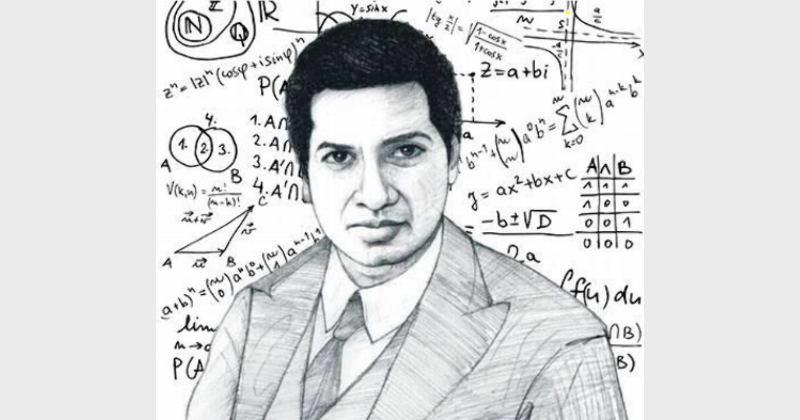
Srinivasa Ramanujan FRS (born 22 December 1887 as Srinivasa Ramanujan Aiyangar and died 26 April 1920) was an Indian mathematician who lived during British rule in India. Despite having almost no formal training in pure mathematics, he made significant contributions to mathematical analysis, number theory, infinite series, and continued fractions, including solutions to previously unsolvable mathematical problems. According to Hans Eysenck, Ramanujan initially developed his own mathematical research in isolation: “He tried to interest the leading professional mathematicians in his work, but failed for the most part.” What he had to show them was too novel, too unfamiliar, and presented in unusual ways for them to be bothered.” In 1913, he began a postal correspondence with the English mathematician G. H. Hardy at the University of Cambridge, England, in search of mathematicians who could better understand his work. Hardy arranged for Ramanujan to visit Cambridge because he thought his work was extraordinary. Hardy noted in his notes that Ramanujan had produced ground-breaking new theorems, including some that “completely defeated me; I had never seen anything in the least like them before,” as well as some recently proven but highly advanced results. Ramanujan independently compiled nearly 3,900 results during his brief life (mostly identities and equations).

Many of his original and highly unconventional results, such as the Ramanujan prime, the Ramanujan theta function, partition formulae, and mock theta functions, have opened up entirely new areas of work and inspired a vast amount of additional research. Except for a dozen or two, all of his thousands of results have now been proven correct. The Ramanujan Journal, a scientific journal, was founded to publish work in all areas of mathematics influenced by Ramanujan, and his notebooks—which contain summaries of his published and unpublished results—have been analysed and studied as a source of new mathematical ideas for decades since his death.

By the age of 11, he had exhausted the mathematical knowledge of two college students who stayed at his house. Later, he was given a book on advanced trigonometry written by S. L. Loney. By the age of 13, he had mastered this while independently discovering sophisticated theorems.  By the age of 14, he had received merit certificates and academic awards that he had continued to receive throughout his school career, and he had helped the school with the logistics of assigning its 1,200 students (each with different needs) to its approximately 35 teachers. 27 He completed mathematical exams in half the time allotted and demonstrated knowledge of geometry and infinite series. (Source : Wikipedia)

Ramanujan, a deeply religious Hindu, attributed his significant mathematical abilities to divinity, claiming that the mathematical knowledge he displayed was revealed to him by his family goddess Namagiri Thayar. “An equation has no meaning for me unless it expresses a thought of God,” he once said.

Salute to this great mathematician!!

Topics: IndiamathematicsSrinivasa RamanujanIndian mathematicianmathsmathematician
ShareTweetSendShareSend
✮ Subscribe Organiser YouTube Channel. ✮
✮ Join Organiser's WhatsApp channel for Nationalist views beyond the news. ✮
Previous News

Same Sex Marriage: The Truth Behind Trans Activism

Next News

Rajasthan: Hundreds of homes, mostly of Pakistani Hindu refugees bulldozed by Ashok Gehlot Govt in Jodhpur

Related News

UAE President Sheikh Mohamed bin Zayed Al Nahyan and Prime Minister Narendra Modi(File Photo)

UAE to buy BrahMos & Akashteer: Big win for India’s defence ecosystem to seal regional security amid West Asia crisis

United States Trade Representative Jamieson Greer and Union Commerce and Industry Minister Piyush Goyal

India-US Trade Agreement: Historic deal enters final stretch as USTR Jamieson Greer heads to New Delhi

Universities Adopt ‘Bharat’ on Degrees and Certificates

Madhya Pradesh: ‘Bharat’ replaces ‘India’ on degrees as academic institutions reclaim ancient identity

Representative Image

Europe’s Supremacy: A manufactured narrative imposed via colonial power is counterd by India’s civilizational memory

Yoga Day celebrations in Shanghai, China

International Yoga Day: Global celebrations echo the message of health, well-being and timeless ancient Indian wisdom

The Alchemy of Autarky: How India rewrote its economic destiny

Load More

Latest News

Quetta court awards life imprisonment to Dr Mahrang

Balochistan: Quetta court awards life imprisonment to Dr Mahrang; BYC calls it Pakistan’s hatred towards Baloch masses

(Left) Site of fire at the coaching centre in Lucknow (Right) Trishank Krishna and Virdendra Shukla arrested

Lucknow Coaching Centre Fire: 4 officials suspended, building owners arrested; Regulatory lapses exposed

UAE President Sheikh Mohamed bin Zayed Al Nahyan and Prime Minister Narendra Modi(File Photo)

UAE to buy BrahMos & Akashteer: Big win for India’s defence ecosystem to seal regional security amid West Asia crisis

West Bengal’s First Budget Under New Government Focuses on Jobs, Welfare and Balanced Growth

West Bengal Budget 2026: Employment, social security and regional development take centre stage

Families besiege Quetta’s Huda Jail over alleged secret trial of Dr Mahrang Baloch

Pakistan’s ‘Faceless Trial’: Families besiege Quetta’s Huda jail over alleged secret trial of Dr Mahrang Baloch

Qatar Gas Hub Blaze Leaves 13 Dead, Indians Among Victims

Qatar Gas Plant Explosion: 13 dead, 66 injured; Indians among victims, embassy activates helpline number

Lucknow, Jun 22 (ANI): Firefighters conducting rescue and relief operations at a coaching centre in Aliganj area where a fire broke out, in Lucknow on Monday. Uttar Pradesh Deputy Chief Minister Brajesh Pathak also present. (ANI Photo)

Lucknow Coaching Centre Fire: Death toll rises to 15; CM Yogi meets victims’ families, orders high-level probe

Book Review | Swayamsevak: Insightful accounts to decipher RSS

Another Vande Mataram moment for Bengal

“Mamata Banerjee has been in denial mode on crime against women from 2012 itself”: Sukhendu Sekhar Roy, former TMC MP

Load More
  • Privacy
  • Terms
  • Cookie Policy
  • Refund and Cancellation
  • Delivery and Shipping

© Bharat Prakashan (Delhi) Limited.
Tech-enabled by Ananthapuri Technologies

  • Home
  • Search Organiser
  • Bharat
    • Assam
    • Bihar
    • Chhattisgarh
    • Jharkhand
    • Maharashtra
    • View All States
  • World
    • Asia
    • Africa
    • North America
    • South America
    • Europe
    • Australia
  • Editorial
  • Operation Sindoor
  • Opinion
  • Analysis
  • Defence
  • Culture
  • Sports
  • Business
  • RSS @ 100
  • Entertainment
  • More ..
    • Sci & Tech
    • Vocal4Local
    • Special Report
    • Education
    • Employment
    • Books
    • Interviews
    • Travel
    • Health
    • Politics
    • Law
    • Economy
    • Obituary
  • Subscribe Magazine
  • Read Ecopy
  • Advertise
  • Circulation
  • Careers
  • About Us
  • Contact Us
  • Policies & Terms
    • Privacy Policy
    • Cookie Policy
    • Refund and Cancellation
    • Terms of Use

© Bharat Prakashan (Delhi) Limited.
Tech-enabled by Ananthapuri Technologies