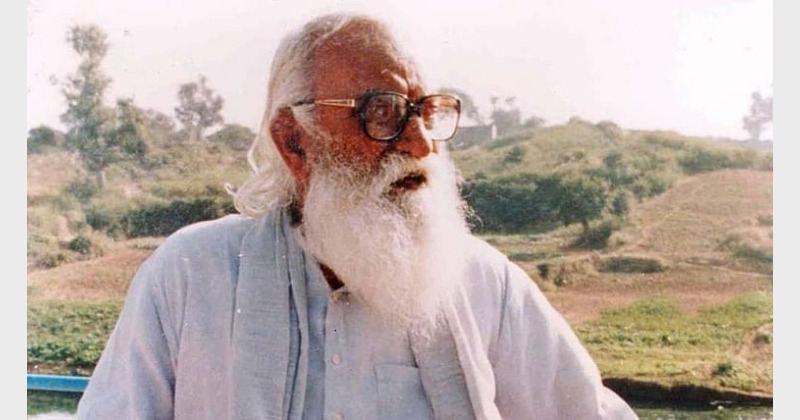
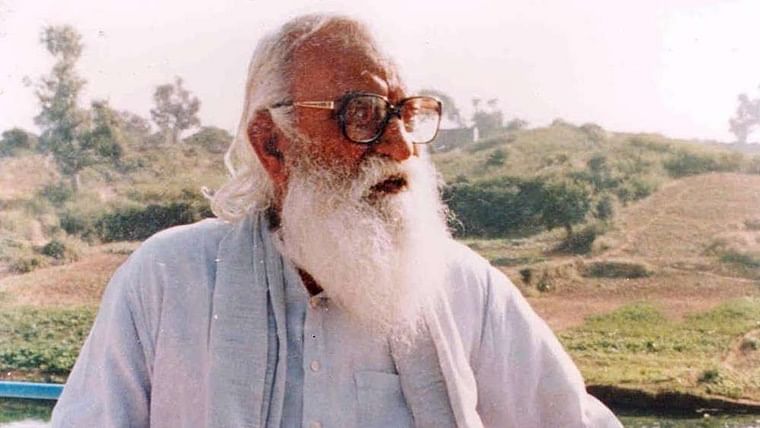
We are not for ourselves but for those who are exploited and vulnerable.” Nanaji Deshmukh said and lived his entire life by this motto. Today marks the 11th death anniversary of Nanaji who was an able organiser, thinker, revolutionary and social architect (Samaj Shilpi). He made successful efforts to implement the ideas of Gandhi’s Gram Swaraj, Deendayal’s Antyoday and JP’s Sarvodaya through Gramodaya.
Born in Maharashtra he devoted his entire life to the Rashtriya Swayamsevak Sangh (RSS) making Uttar Pradesh his area of working as an RSS pracharak. He was based in Gorakhpur and expanded the RSS work in Eastern Uttar Pradesh. In 1950, he opened the first Saraswati Shishu Mandir in Gorakhpur, which has now bloomed into over 18,000 branches across the length and breadth of the country. He worked closely with Deendayal Upadhyay, whom he treated like his senior even though they were of the same age. When the magazines ‘Panchjanya’ and ‘Rashtra Dharma’ were published from Lucknow, Nanaji Deshmukh was made its Managing Editor with Atal Behari Vajpayee as its Editor.
In 1951, the RSS loaned a team of committed swayamsewaks under the leadership of Deendayal Upadhyay to Dr SP Mookerjee to work in the newly launched Bharatiya Jan Sangh (BJS). Nanaji was one of the committed swayamsewaks, and he was given the work of Uttar Pradesh where he devoted the next 25 years of his life, taking BJS to new heights. He established sub-divisional, district and state unit of BJS over the next five-six years. The credit for the expansion of BJS in Uttar Pradesh should be given to the organisational skills of Nanaji Deshmukh along with the remarkable oratory skills of Atal Behari Vajpayee and the able navigation of Deendayal Upadhyay. Nanaji also developed cordial relations with opposition leaders like Charan Singh and Ram Manohar Lohia. In fact, Nanaji had even brought Ram Manohar Lohia to Jan Sangh which helped the latter to study the organisation closely. After the mysterious death of Deendayalji, Vajpayee was given the reins of the party and Nanaji became part of his team along with LK Advani and others.
As corruption and chaos reigned under the Indira Gandhi regime in the 1970s, students and youth took to the streets across the country. Jayprakash Narayan (JP) was requested to provide direction and leadership to the movement. It was due to the efforts of Nanaji that JP agreed to steer the agitation. Nanaji was very close to JP. Nanaji in an event with JP had made his famous declaration that politicians should give up politics at the age of 60 and work for the society. Nanaji later implemented this on himself. Though he had won the 1977 Lok Sabha election from Balrampur and he could have become a minister in the government, he chose to renounce politics.
In order to give shape to Deendayalji’s Antoydaya and philosophy of Integral Humanism, Nanaji had set up Deendayal Research Institute (DRI) in 1968. For this, he received the support of RSS second Sarsanghchalak Guru Golwalkar. Nanaji turned to rural India to provide an alternative development model to the villages and set up Jai Prabha Gram in Gonda where thousands of drought-stricken villages were provided bamboo-pipe tube wells. Jai Prabha Gram was named after JP and his wife Prabha Devi who was a long-time associate of Mahatma Gandhi.
Projects were also started in Beed and Nagpur areas of Maharashtra. In the drought-hit Beed, Nanaji got check dams built in large numbers. In the 1980s, he decided to work in the Chitrakoot region that stretched across parts of Uttar Pradesh and Madhya Pradesh that suffered from acute poverty and backwardness. He built his Ashram in Chitrakoot along the banks of Mandakini river and called it Siyaram Kuteer. He began the task of Gramodaya with 500 villages spread in an area of 50km around this point and urged young couples to work as social architects (samaj Shilpi) for Gramodaya. Hundreds of young people responded to his call and started working with him.
While Nanaji brought local villagers into his project he also managed to explain his vision to industrial houses like Tata, Vadia, Mahindra, Goenka, Thapar and many others. As a result, they provided support and many times even visited the project sites at Nanaji’s request. Late President APJ Abdul Kalam often mentioned PURA (Providing Urban Utilities to Rural Areas) as a tool to check problems of migration and development. Dr. Kalam said that the idea of PURA came to his mind after visiting Nanaji’s Chitrakoot project in which villages were organised into clusters where efforts were made to provide all civic amenities.
Under Nanaji’s guidance a Gramodaya song was composed with the lines – ‘Har haath ko denge kaam, har khet ko paani, fir se dharti sajegi, jaise dulhan rani (Every hand will get work, every field will get water, the earth will bloom again, like a royal bride)’. Nanaji was convinced that the upliftment of the village would make villagers independent and with a change in the condition of the village and villagers, the administration and politics will also change. Hence he inspired people to become self-reliant and emphasised minimum dependence on government. He believed that no economic growth is possible without becoming independent.
He talked about making villages fully independent units where the emphasis would be on agriculture, water resources, health, education, employment as well as character building. He felt that this was possible only when local traditional knowledge and technology is used along with the efforts of the villagers to create a system.
To make agriculture profitable, Nanaji first built check dams for water conservation. He established Kirishi Vigyan Kendra, where research could be done to make loss-making cultivations profitable. On the one hand he started the project ‘Nanhi Duniya’ for the education of children, and on the other, he set up Mahatma Gandhi Gramodaya Vishvavidyalaya for higher education. This was the first university that had been set up with rural development as its focus. To provide health services to villagers, Aarogya Dham was set up where arrangements were made for medical facilities of international standards and where Ayurveda, Yoga and Naturopathy were used. As he laid great stress on self-reliance, he also ensured the establishment of Udyamita Vidyapeeth (Entrepreneurship Training Centre) where people could be trained in skills to create low-investment jobs with high returns.
Taking a look at his work in the field of social ervice, the Government nominated him to the Upper House. For his experiments in development and self-reliance of villages, he was also conferred the Padma Vibhushan in 1999.
After the announcement of Nanaji’s name for the Bharat Ratna in 2020, PM Modi had said, “Nanaji Deshmukh’s stellar contribution towards rural development showed the way for empowering those living in our villages. He personifies humility, compassion and service to the downtrodden. He is a Bharat Ratna, in the truest sense.”
Not only did he understand the ideas of Gandhi, Deendayal and JP, he also made them relevant to our times and manifested them on the ground. Hence a postal stamp in 2017 to mark the birth centenary of Nanaji thus summarised the essence of his ideas and vision – Gramodaya will be possible only with the feeling of cooperation in our society.