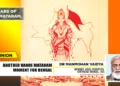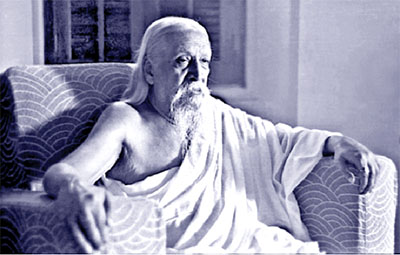
In Anandamath, Bankim imagines motherland through the figure of Kali and suggests that the real purpose of the institution of sanyas—ascetic renunciation of worldly life—is not individual salvation. A sanyasi’s truest calling lies in serving the motherland. Echoing Bankim, Aurobindo suggested that there was ‘no political object of worship except divinity in our Motherland.’ His exhortations to the youth of Bharat to become a veritable vehicle of God and execute the divine plan for the salvation of Motherland garnered much currency. In no time, he caught the fancy and imagination of the revolutionaries and became the leading beacon of the armed struggle for freedom, particularly in those parts of the country where Shakti Puja was an integral part of the local tradition.
The anvil of spiritual conviction
It is often alleged, more so by Marxist and liberal thinkers, that those who draw upon religion for socio-political ends merely play to the gallery. And that an appeal for mobilisation which is ensconced in religious terminology may deliver immediate results, but precipitates lasting hazardous side-effects. However, Marxist approach to reading social movements fails to account for the profound history of the spiritualism in Bharat; straitjacketed by the imperatives of capital and class-struggle, it blatantly disregards religion’s shaping impact on our national life. It also fails to acknowledge the centrality of faith in our collective consciousness and its crucial role in both national integration as well as periodic social rejuvenation. Indian spirituality is not just for the edification of soul or for the fulfillment of our otherworldly pursuits. It has a strong socio-political dimension that controls all aspects of our national life—from politics to economy. Swami Vivekanand went as far as challenging the skeptics to “show one single period of her national life when India was lacking in spiritual giants capable of moving the world.”
For him, all aspects of Bharat’s political life were to be governed by one overriding concern—freedom from foreign yoke. This central quest rendered all other considerations peripheral
Our country is complex, multi-layered and resists a simple-straightforward reduction to Western paradigms. Unlike the Western societies that remain hinged to the notion of social-contract, our social structure is pulled together by our spirituality; its core is animated by faith. Aurobindo’s religiosity was borne out of this realisation. It was neither simple populism, nor opportunism driven by political expediencies. It was rooted in a thoughtful politico-religious philosophy of which Aurobindo himself was the principle prophet, if not the sole proponent. In other words, unlike social theories like Marxism and liberalism that originated in the West, Aurobindo’s philosophy was organic to Indian reality.
Citing his absolute devotion to Bharat Mata, some thinkers call him a ‘Matrist.’ Others see him as the precursor to Gandhi’s political style which often invoked religion and religious terminologies in anti-colonial discourses. However, one notices a crucial difference between him and Gandhi. While others debated methods and consequences, he had his eyes set on the goal. Gandhi’s mind appears tortured by the quest for a method as sagacious as the end it serves. However, unlike Gandhi, Aurobindo was a realist. For him, the choice between violence and non-violence had little significance beyond the means which it could serve. For him, all aspects of Bharat’s political life were to be governed by one overriding concern—freedom from foreign yoke. This central quest rendered all other considerations peripheral.
In the name of Kali
As MK Haldar argues, “it was possibly his identification of Mother India with Shakti which allowed him to sidetrack the problem of the relationship between means and ends.” This deification of nation as Kali was rooted in local practices and socio-religious values. Naturally, his use of Shakta symbols struck a chord with the masses. The revolutionaries of Bengal were quick to utilise Shakta symbols in their activities. The newspaper Jugantar, which was often seen as the mouthpiece of revolutionary ideology and enjoyed a circulation in excess of 20,000, often invoked Kali to rally the masses to the support of the revolutionaries. With an editorial board that comprised the likes of Barindra Ghosh and Bhupendranath Datta—brothers of Aurobindo and Vivekanand respectively—Jugantar championed the strategy of projecting Kali as the embodiment of India. In Jugantar articles, as Barabara Southard argues, “Kali in her destructive aspects black with skulls around her neck, was said to represent the degradation of India under foreign rule, the death and famine due to British exploitation.” Besides, the Goddess was also regarded as the symbol of violence necessary to destroy British shackles and ensure India’s rebirth as a free country. In the same spirit, violent deeds of the revolutionaries were seen as the divine play of Kali. They were urged upon to sacrifice their lives on the altar of the Mother, were she to be redeemed from shameful bondage and shackles of slavery.
Soon, Kali temples became important sites for political mobilisation. People started taking vows at the local Kali temple to abstain from foreign goods. Kali Puja was used to reinforce the identification of motherland with the Goddess. As Shri Aurobindo’s politico-religious conceptualization swept through all of Bengal, even the adherents of Chaitanaya Mahaprabhu and devotees of Radha-Krishna were charmed by the pull of Bharat Mata seen as Kali. For example, someone like Bipin Pal, who was associated with the reformist Brahma Samaj and was an adherent of the Vaishnava creed, appeared convinced by the power of Shakta symbols in Bengal. Throughout the anti-partition agitation (Bengal, 1905-08) he often invoked Kali and Shakta symbols to galvanise the masses. Speaking in Calcutta in May 1907, he urged “the organisation of Kali Puja in every important village, every new moon day. It cannot be the ordinary Kali Puja. For these pujas have no sanction except on special ceremonial days or for specific purposes. But we have a tradition of Kali worship whenever there are epidemics and troubles in the country.”
In the Western narratives, India’s religiosity was often equated with backwardness and vacuity of political wisdom. It was Sri Aurobindo’s genius that recast our spirituality and symbols of faith into an elaborate anti-colonial discourse, turning it into a potent political tool that was to, in a few decades, topple the mighty British Empire.