Sankalp Diwas: Resolve to reclaim Pak Occupied Jammu & Kashmir
June 6, 2026
  • Read Ecopy
  • Circulation
  • Advertise
  • Careers
  • About Us
  • Contact Us
Android AppiPhone AppArattai
Organiser
  • ‌
  • Bharat
    • Assam
    • Bihar
    • Chhattisgarh
    • Jharkhand
    • Maharashtra
    • View All States
  • World
    • Asia
    • Europe
    • North America
    • South America
    • Africa
    • Australia
  • Editorial
  • International
  • Opinion
  • RSS @ 100
  • More
    • Op Sindoor
    • Analysis
    • Sports
    • Defence
    • Politics
    • Business
    • Economy
    • Culture
    • Special Report
    • Sci & Tech
    • Entertainment
    • G20
    • Azadi Ka Amrit Mahotsav
    • Vocal4Local
    • Web Stories
    • Education
    • Employment
    • Books
    • Interviews
    • Travel
    • Law
    • Health
    • Obituary
  • Subscribe
    • Subscribe Print Edition
    • Subscribe Ecopy
    • Read Ecopy
  • ‌
  • Bharat
    • Assam
    • Bihar
    • Chhattisgarh
    • Jharkhand
    • Maharashtra
    • View All States
  • World
    • Asia
    • Europe
    • North America
    • South America
    • Africa
    • Australia
  • Editorial
  • International
  • Opinion
  • RSS @ 100
  • More
    • Op Sindoor
    • Analysis
    • Sports
    • Defence
    • Politics
    • Business
    • Economy
    • Culture
    • Special Report
    • Sci & Tech
    • Entertainment
    • G20
    • Azadi Ka Amrit Mahotsav
    • Vocal4Local
    • Web Stories
    • Education
    • Employment
    • Books
    • Interviews
    • Travel
    • Law
    • Health
    • Obituary
  • Subscribe
    • Subscribe Print Edition
    • Subscribe Ecopy
    • Read Ecopy
Organiser
  • Home
  • Bharat
  • World
  • Operation Sindoor
  • Editorial
  • Analysis
  • Opinion
  • Culture
  • Defence
  • International Edition
  • RSS @ 100
  • Magazine
  • Read Ecopy
Home Bharat

Sankalp Diwas: Resolve to reclaim Pak Occupied Jammu & Kashmir

February 22 is marked as the Sankalp Diwas (Resolution day). It reminds us of the resolve the people of India, through their representatives in Parliament, took to reclaim the territories that were occupied through aggression in 1948

NIDHI BAHUGUNANIDHI BAHUGUNA
Feb 22, 2023, 06:00 pm IST
in Bharat, Analysis
Follow on Google News
FacebookTwitterWhatsAppTelegramEmail

On February 22, 1994, both Houses of the Indian Parliament passed a resolution unanimously, stating that Pakistan has been occupying areas of India in Jammu and Kashmir and the Indian Government is committed to take back the occupied areas. It also stated that Pakistan was using the occupied territories to train and launch terrorists in India and asked Pakistan to desist from terror supporting activities. The resolution reiterated that the State of Jammu & Kashmir is an integral part of India and demanded that Pakistan vacates its occupied areas. It advised Pakistan against violating the Shimla Agreement by trying to internationalise The Kashmir issue. Two more cause of concern related to the abysmal human right violations and conditions of people living in Pakistan-occupied areas of Jammu and Kashmir, were also part of the resolution.

AREAS UNDER OCCUPATION

Post independence and Partition of India, the Princely States had the right to decide whether to accede to the dominion of India or Pakistan, depending upon geographical congruity. On the night of October 22/23, 1947, Pakistani army attacked the princely State of Jammu & Kashmir with the intention of attaching it by force. On October 26, 1947, Maharaja Hari Singh formally acceded to the dominion of India and the Indian army came into action. Prime Minister Jawaharlal Nehru took the matter of Pakistani aggression to the United Nations. The Kashmir war lasted till a UN-mandated ceasefire came into effect from midnight on December 31, 1948, to January 1, 1949. Pakistan has been in illegal occupation of these territories since the ceasefire.

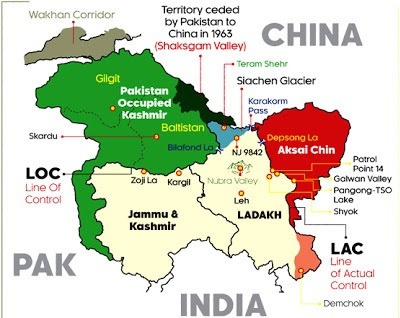
The occupied territories of the (erstwhile) State of Jammu and Kashmir consist of Mirpur-Muzzafarabad areas (14,000 sq km approx), termed as PoJK (Pakistan-occupied Jammu and Kashmir) by India and euphemistically termed ‘Azad Jammu Kashmir’ by Pakistan. This area is part of the present day Union Territory of Jammu and Kashmir. Additionally, about 75,000 sq km territory of Gilgit and Baltistan is occupied by Pakistan, which is part of the present day Union Territory of Ladakh, a part of Leh district.

China occupied about 35,000 sq km of Eastern Ladakh called Aksai Chin in 1962, post Indo-China war from October 22 to November 21, 1962. Additionally, Pakistan ceded approx 5,100 sq km of Shaksgam Valley illegally to China in March 1963 under a Sino-Pak boundary agreement.

WHY THE RESOLUTION?

Why was the parliamentary resolution passed on February 22, 1994? To understand the significance and context, the geopolitical background has to be studied. From 1989 onwards, terror activities increased in Kashmir, leading to the exodus of Kashmiri Hindus. The Afghanistan situation had invested Pakistan with a geopolitical importance with it emerging as a key ally of the USA. Pakistan constantly tried to internationalise the Kashmir issue, and was shrill in advocating plebiscite in Jammu and Kashmir, conveniently blacking out the UN resolution which had asked Pakistan to vacate the occupied areas as a pre-condition to plebiscite. In February 1990, under Benazir Bhutto, the National Assembly of Pakistan passed a resolution rejecting J&K’s accession to India. The USA took a pro-Pakistan stand on this issue during that period. It should be noted that the Instrument of Accession was not open to international jurisdiction.

USA’s stand emboldened Pakistan, which declared its intent of tabling a resolution at the United Nation Human Rights conference in Geneva in March 1994. Pakistan had already been building a narrative of ‘human rights violations’ by India in Kashmir. Had the resolution been tabled and passed, it would have opened possibilities of UNSC sanctions against India and interference by the international community. On February 22, 1994, by passing a unanimous resolution, the Indian Parliament countered the US-led international pressure on India. It countered Pakistan claims and reiterated India’s legal claim on J&K. By March 7, 1994, the Indian team led by Leader of Opposition Atal Bihari Vajpayee garnered enough support of countries in Geneva not to back Pakistani resolution. Iran backed out and on March 9, 1994 Pakistan withdrew its proposed resolution.

Focus on Pak Occupied Kashmir

Post victory at Geneva and the subsequent softening of US’s stand, the Parliamentary Resolution along with issue of PoJK was put in cold storage. On August 15, 2016, the then newly elected Prime Minister Narendra Modi spoke about Pakistan-occupied Kashmir and Gilgit Baltistan in his speech at the Red Fort, and brought the focus back on the Pakistan occupied territories. On August 5, 2019, Article 370 was abrogated and the state of J&K was reorganised into Union Territories of J&K and Ladakh. On August 7, 2019, Home Minister Amit Shah invoked the Parliamentary Resolution of 1994, stressing that Jammu-Kashmir is an integral part of India and Parliament is committed to reclaiming both Pakistan-occupied areas and Aksai Chin.

Post 2019, both Home and Defence ministries have often invoked the Parliamentary Resolution and underlined that talks with Pakistan will be only on Pakistan vacating the occupied territories. On October 27, 2022 on the occasion of Shaurya Divas, Defence Minister Rajnath Singh stated that India is committed to reclaim PoJK and Gilgit Baltistan as stated in the Parliamentary Resolution of February 22, 1994. This was followed by Indian Army Chief stating that the Indian Army is totally prepared to reclaim the Pakistan occupied areas. The parliamentary resolution of February 22 is an important milestone in India’s parliamentary history. It laid the foundation for reclaiming occupied territories, and countered Pakistani propaganda on human rights in Kashmir, bringing focus on the dismal state of affairs in Pakistani occupied areas. It further laid to rest any doubts on the legality of the Instrument of Accession, while upholding the Shimla Agreement clauses as the only recourse.

Post reorganisation of Jammu Kashmir, the occupied areas of Jammu Kashmir have been, for the first time, represented as districts of Mirpur and Muzzafarabad in the map of the Union territory of Jammu &Kashmir. Gilgit and Baltistan have been represented as part of the Leh district of the Union Territory of Ladakh, with the boundary corresponding to the boundary as it existed pre 1901. This is the first time that occupied territories have been represented as parts of existing districts. To conclude, it is very important to revisit the parliamentary resolution every year on February 22 till we actually reclaim our territories. It is for the people to remind the Indian Parliament of its commitment and the unfinished task of reclaiming the occupied territories. Territories are not lost by occupation, but are lost only when a nation and its people forget them.

Topics: Pakistan against violating the Shimla AgreementParliamentary ResolutionSankalp DiwasPak Occupied KashmirUnion Territory of LadakhPakistanJammu & Kashmir
Share2TweetSendShareSend
✮ Subscribe Organiser YouTube Channel. ✮
✮ Join Organiser's WhatsApp channel for Nationalist views beyond the news. ✮
Previous News

Gujarat: Vedanta-Foxconn Joint venture selects Dholera SIR for first semiconductor facility in India

Next News

Jharkhand: Aurangzeb slashed 80-year-old woman 11 times, Naushad helped him flee; a year after, HC grants bail

Related News

India’s Permanent Representative to the United Nations Ambassador Harish Parvathaneni

India slams Pakistan at UNSC for peddling false narratives on Jammu & Kashmir

Jameer Khan and Alla Bhakshu arrested in Pakistan-linked terror probe

Karnataka: Digital jihad trail exposed: Jameer Khan and Alla Bhakshu arrested, links traced to Pakistan

India slams Pakistan’s bid to hold elections in Gilgit-Baltistan, demands end to illegal occupation

As Khalistani networks seek new platforms beyond the West, Azerbaijan has emerged as a key venue for conferences, campaigns and narratives aligned with the Pakistan-Turkey axis against India.

Khalistan’s New Grazing Ground: Azerbaijan emerges as new hub for Turkey-Pakistan backed anti-India networks

Bangladesh’s reported JF-17 push has triggered fresh scrutiny after India’s Ops Sindoor exposed the vulnerabilities of Pakistani-Chinese defence systems and precision strike capabilities

Shadows of Operation Sindoor: Questions loom over Bangladesh’s JF-17 ambitions amid Sino-Pakistani tech vulnerabilities

Kawagoe Mosque Row: Pakistan faces embarrassment as Japan orders demolition of illegally built mosque

Load More

Latest News

Police in AAP-Ruled state of Punjab lathi charge sit-in protesters

Punjab: ITI candidates seeking jobs lathi-charged outside PSPCL HQ; opposition slams AAP Govt over police action

From constables to DGP, India's police system follows a structured chain of command that governs law enforcement across the country

From Constable to DGP: Understanding India’s police hierarchy, powers & recruitment system

The terracotta dice that challenges historical assumptions and highlights India's millennia-old civilisational heritage

How a 4,500-year-old terracotta dice is reviving the debate on India’s civilisational continuity & Vedic heritage

The Porumamilla inscription and the ancient science behind a reservoir that survived 650 years

India’s 655-Year-Old Water Policy: The Porumamilla inscription that turned stone into a manual of hydrology

India’s Permanent Representative to the United Nations Ambassador Harish Parvathaneni

India slams Pakistan at UNSC for peddling false narratives on Jammu & Kashmir

Keralam: Pathanamthitta temple property occupied beyond lease period reclaimed by devotees

A series of high-level engagements signals New Delhi's growing focus on building interoperable security networks across the Indo-Pacific

India strengthens Indo-Pacific security architecture with new defence and maritime partnerships

Prime Minister Narendra Modi

“Makes every Indian proud”: PM Modi hails India’s 7.7 per cent GDP growth in FY 2025-26

Once known for maoist violence, Minpa now leads healthcare revolution with telemedicine services in Sukma

From Maoist Stronghold to Healthcare Hub: How Chhattisgarh’s Minpa is transforming through telemedicine & development

Dr Surendra Jain, Joint General secretary, VHP

VHP Demands Audit of Waqf Properties Amid Encroachment Claims: “Land should go to rightful owner,” says Surendra Jain

Load More
  • Privacy
  • Terms
  • Cookie Policy
  • Refund and Cancellation
  • Delivery and Shipping

© Bharat Prakashan (Delhi) Limited.
Tech-enabled by Ananthapuri Technologies

  • Home
  • Search Organiser
  • Bharat
    • Assam
    • Bihar
    • Chhattisgarh
    • Jharkhand
    • Maharashtra
    • View All States
  • World
    • Asia
    • Africa
    • North America
    • South America
    • Europe
    • Australia
  • Editorial
  • Operation Sindoor
  • Opinion
  • Analysis
  • Defence
  • Culture
  • Sports
  • Business
  • RSS @ 100
  • Entertainment
  • More ..
    • Sci & Tech
    • Vocal4Local
    • Special Report
    • Education
    • Employment
    • Books
    • Interviews
    • Travel
    • Health
    • Politics
    • Law
    • Economy
    • Obituary
  • Subscribe Magazine
  • Read Ecopy
  • Advertise
  • Circulation
  • Careers
  • About Us
  • Contact Us
  • Policies & Terms
    • Privacy Policy
    • Cookie Policy
    • Refund and Cancellation
    • Terms of Use

© Bharat Prakashan (Delhi) Limited.
Tech-enabled by Ananthapuri Technologies