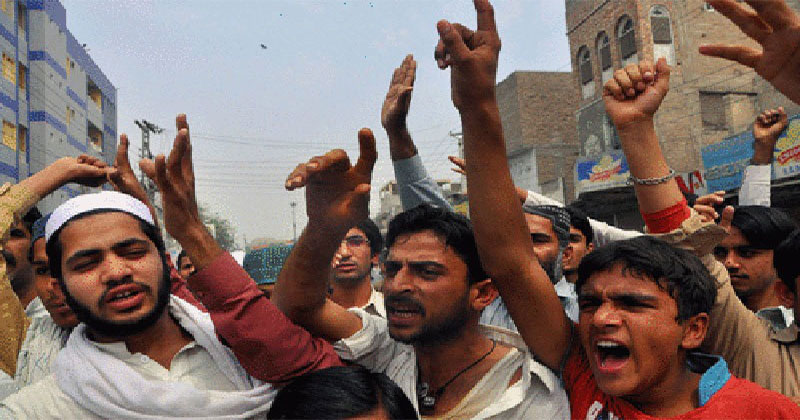
The lynching of a young Christian man Muhammad Warris in Pakistan last week was a tragic and horrific event that took place in the holy city of Nankana Sahib in Punjab. Warris was lynched by a mob on mere suspicion of blasphemy, a crime that carries a severe punishment under Pakistani law.
Horrific incidents of mob justice burning of the hapless man are, however totally within the framework of law in societies dominated by monotheistic religions.
In monotheistic religions, blasphemy is often defined as the act of speaking, writing, or otherwise communicating in a disrespectful or irreverent manner about God, religious figures, or holy scriptures. In Islam, blasphemy is considered to be one of the gravest sins and is punishable by severe consequences, both in this life and in the afterlife.
The Arabic word for blasphemy is “sabb” or “shatm,” which literally means “to insult.” In Islam, blasphemy is seen as a direct insult to the honour and majesty of God and is considered a grave offence because it undermines the very foundations of the faith.
In many Islamic societies, blasphemy laws have been enacted to prevent individuals from committing acts of blasphemy. These laws vary in severity and enforcement but can include imprisonment, fines, or even death. Aside from the legal implications, blasphemy also has a significant impact on the social and cultural fabric of Islamic societies.
In monotheistic religions, blasphemy is often seen as a direct challenge to the authority and sovereignty of God. It is considered to be an act of disobedience and an expression of disbelief, which can lead to severe consequences both in this life and in the afterlife
In many cases, accusations of blasphemy have led to social ostracism, discrimination, and persecution of individuals and communities. This has been particularly damaging to religious minorities, who are often seen as easy targets for accusations of blasphemy.
In monotheistic religions, blasphemy is often seen as a direct challenge to the authority and sovereignty of God. It is considered to be an act of disobedience and an expression of disbelief, which can lead to severe consequences both in this life and in the afterlife. In Judaism, for example, blasphemy is considered a serious sin and is punished by ex-communication, banishment, or death in some cases.
In Christianity, blasphemy is often defined as denying the divinity of Jesus Christ or speaking against the Holy Spirit. In the past, accusations of blasphemy were used as a pretext for religious persecution and the punishment of dissenters, leading to instances of violence and bloodshed. However, in most modern Christian societies, blasphemy is not considered a crime, and individuals are free to express their opinions and beliefs, even if they are critical of religious beliefs and practices.
God in Monotheistic Religions
The concept of God in Monotheism refers to the belief in a single, supreme deity who is considered to be the creator and ruler of the universe. In monotheistic religions, God is often seen as an all-powerful, all-knowing who is the source of all morality and ethics.
In Judaism, God is seen as the creator of the universe and the one true God who has a special covenant with the Jewish people. Yahweh, the God of Judaism, is considered to be a personal God who is involved in the lives of individuals and is concerned with their welfare. In Christianity, God is seen as the Father of Jesus Christ and the creator of the universe. Christians believe in the Holy Trinity, which consists of the Father, the Son (Jesus), and the Holy Spirit. Christians view God as a personal God who is loving and compassionate and who sent his son to die for the sins of humanity so that people could be saved and reconciled to Him.
In Islam, God is seen as the one true God and the creator of the universe. Allah, the God of Islam, is considered to be an all-powerful, all-knowing, and just being who governs the world according to a divine plan. Muslims view God as a personal God who is merciful and compassionate but who will also judge each person according to their deeds on the Day of Judgment. In each of these monotheistic religions, the concept of God is central to their beliefs.
Why Dharma does not recognise a Supreme Monothiestic God or Blasphemy
In Dharma, there is no concept of an all-pervading fearful God who is beyond criticism. This is because Dharma is largely defined by Monoism, which is the belief in the existence of one ultimate reality or principle that encompasses everything in the universe, including both matter and spirit. According to this belief, everything in the universe is essentially one, and there is no duality or separation between the material and spiritual realms. In this sense, monism can be seen as a form of philosophical pantheism, where the universe is considered to be identical to God or the ultimate reality.
On the other hand, Monotheism (which is the framework of Judaism, Islam and Christianity, as well as Sufism) is the belief in the existence of one God, who is the creator of the universe and the source of all moral and spiritual authority. Monotheistic religions hold that there is only one God who is separate from the universe and distinct from all other entities. Monotheists worship only one God and reject the existence of other gods or divine beings. Monoism holds that everything is one, while Monotheism believes in the existence of only one God.
In fact, Dharma has never been concerned with theism of any sort and there is no word in Sanskrit that equates to it. What the sages of the Vedas and Upanishads were investigating is the nature and causes of suffering (Dukha) and its solution. The sages investigated the interconnectedness of all phenomena and their underlying cause. The big question for them was, “What is that, knowing which, everything becomes known?” It was not – which God created the world and what did he want from us, and what’s our obligation and duty to him?” These questions never entered their minds. That Parabrahma ground of being or unified field was called TAT (that), SAT (Being), BRAHMAN (the Immensity), and they defined it as Brahman or that from which all existence arises, in which it abides and into which it ultimately dissolves. This Parabrahma is not God.
Because there is no fearful God in Dharma, there is no Blasphemy. Each creature of existence, animal, human and even inanimate object, is an extension of the Parabrahma. Thus the defining dynamic of Dharma is nurturing and the code of not harming living things. Dharma is thus all-embracing, nurturing and centred on compassion. These core principles are also subject to debate, discussion and re-interpretation. Thus no higher power or code is greater than the living intelligence of sentient beings.
Unfortunate tyranny
In Pakistan, blasphemy is considered a criminal offence under the country’s Penal Code. Section 295-C of the Penal Code states that “use of derogatory remarks, etc., in respect of the Holy Prophet” is punishable by death or life imprisonment. Section 298-A of the Penal Code criminalises “activities directed against a particular religion or its adherents.”
These laws have been criticised for being used to suppress free speech, punish religious minorities, and settle personal scores. There have been numerous cases in Pakistan where individuals have been falsely accused of blasphemy, leading to their arrest, detention, and even death. In some cases, the accused have been attacked or killed by mobs before they could be brought to trial.
It is important to note that the blasphemy laws in Pakistan have been controversial, with some arguing that it violates the country’s constitution and international human rights treaties. Despite this, the laws remain in place and continue to be used to prosecute individuals accused of blasphemy while society lynches them all together in the most horrible and inhumane ways.
(Parts of this article are based upon https://www.cpsglobal.org/content/monotheism-oneness-god and other readings on the same website)