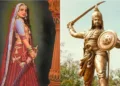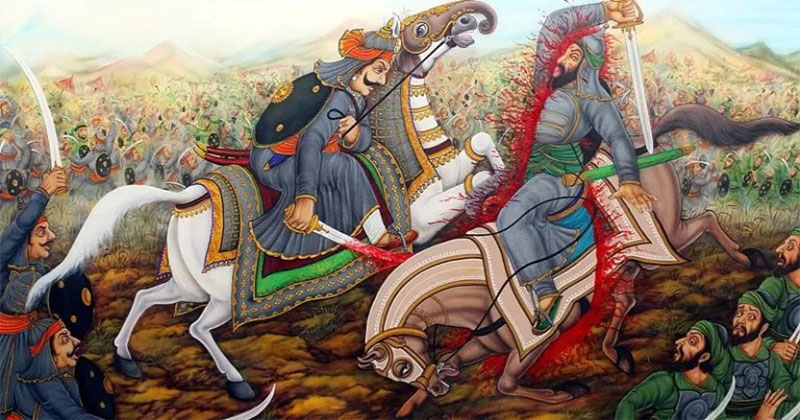
Maharana Pratap was born on May 9, 1540, in Kumbhalgarh, Rajasthan. His mother was Rani Jeevant Kanwar, while his father was Maharana Udai Singh II. Mewar was ruled by Maharana Udai Singh II, based at Chittor. Maharana Pratap was awarded the title of Crown Prince and was the eldest of 25 sons. He was meant to succeed the Sisodiya Rajputs as the 54th monarch of Mewar.
When Crown Prince Pratap Singh was 27, Chittor was besieged by Akbar’s Mughal army in 1567. Instead of surrendering to the Mughals, Maharana Udai Singh II chose to depart Chittor and relocate his family to Gogunda. The elders intervened and persuaded the young Pratap Singh to leave Chittor, despite wishing to stay and fight the Mughals. They were unaware that their decision to leave Chittor would change history.
Maharana Pratap governed in a state of relative calm for the final ten years of his life, eventually freeing most of Mewar, including Udaipur and Kumbhalgarh but not Chittor. Maharana Pratap Singh was referred to be the “light and life” of the Hindu community
Maharana Udai Singh II established a provisional administration of the kingdom of Mewar in Gogunda with the help of his nobles. The Maharana died in 1572, opening the door for Crown Prince Pratap Singh to succeed him as the Maharana.
Pratap Singh left Chittor in 1567 and was recently crowned the Maharana of Mewar. Chittor was under Akbar’s rule, but not the Mewar kingdom. Akbar despatched six diplomatic missions to Mewar in 1573 to persuade Rana Pratap to accept the latter’s suzerainty, but Rana Pratap rejected them. Raja Man Singh led the final of these trips. Maharana Pratap was incensed that a Rajput fellow supported someone who had coerced the Rajputs into subjection and refused to dine with Raja Man Singh. Akbar saw that Maharana Pratap would never submit and that he would have to unleash his forces against Mewar. The battle lines had been set.
Akbar cut off Mewar from the outside world in 1573 when attempts to negotiate a peace pact failed. He alienated some of Maharana Pratap’s relatives and other Mewar’s long-time allies. Then Akbar attempted to turn the populace of the crucial Chittor district against their monarch to prevent them from aiding Pratap. Maharana changed his government system to prepare for the upcoming conflict with the Mughals. His birthplace of Kumbhalgarh became his new capital.
The Mewar army was accustomed to fighting in mountainous terrain, but the Mughals were not; therefore, he ordered his subjects to head for the Aravalli highlands and leave nothing behind for the approaching enemy. The fact that the people complied with the young king’s orders and fled for the mountains is evidence of their respect for him. He had all of the Bhils of the Aravallis in his rear.
The army of Mewar plundered Mughal merchant caravans travelling from Delhi to Surat. A portion of his force defended only the crucial Haldighati Pass, the sole route into Udaipur from the North. Maharana Pratap underwent several penances, not because his finances required it but rather so that he and his subjects would be reminded of the reason they were suffering in the first place: to regain their freedom and the right to live as they pleased. He vowed not to shave, eat off of leaves plates, and sleep on the floor. The Maharana lived in mud houses built of mud and bamboo amid his self-inflicted poverty.
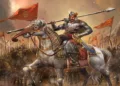
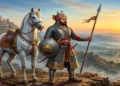
In the well-known battle of Haldighati, fought in 1576, 20,000 Rajput soldiers engaged an 80,000-man Mughal army under the command of Raja Man Singh. Despite its indecisiveness, the Mughal army was surprised by how intense the competition was. Although Maharana Pratap’s army was not routed, he was besieged by Mughal troops. Suddenly, Rana’s estranged brother Shakti Singh showed up there and saved his life. Chetak, the well-known and devoted horse of Maharana Pratap, lost his life in this conflict while attempting to save his Maharana. There were numerous casualties in this conflict on both sides. Akbar’s ultimate goal in the war of 1576 was to indulge his pride.
The leading cause of Akbar’s animosity was Pratap’s decision to resist joining the Mughal Empire. While Pratap was prepared to die for independence, liberty, and self-respect, Akbar wanted Mewar to be ruled by the Mughal Empire. Al Badauni further documents that in the face of such destruction, Mehtar Khan stepped out of Chandrawal and used drummers to announce Akbar’s arrival with a new army to hold back the abandoning of soldiers. Excited Elephants from both sides locked their heads.
Akbar’s extraordinary Elephant fought bravely with Pratap’s special Elephant named Ramprasad. However, when Ramprasad’s rider got pierced with an arrow and fell off, Akbar’s rider swiftly sat on Ramprasad, thus capturing him. According to Badauni, both sides fought so heroically that they reduced the value of human life and increased the value of respect.
Following this conflict, Akbar made repeated unsuccessful attempts to seize control of Mewar. Maharana Pratap continued to pursue his goal of returning to Chittor. However, the Mughal army’s constant raids had worn out his force, and he needed more money to maintain it. An army of 25,000 men could have been supported for 12 years by Maharana Pratap at this point, thanks to Bhama Shah, one of his ministers, who arrived and offered him all this wealth. It is stated that before this kind gift from Bhama Shah, the Maharana was losing heart in his war against Akbar due to his sadness over the condition of his subjects.
After 1587, Akbar gave up his relentless hunt for Maharana Pratap and moved his wars towards Punjab and the Northwest Frontier of India. Maharana Pratap governed in a state of relative calm for the final ten years of his life, eventually freeing most of Mewar, including Udaipur and Kumbhalgarh but not Chittor. Maharana Pratap Singh was referred to be the “light and life” of the Hindu community, according to Bhagwat Singh Mewar. He occasionally consumed bread made from the grass with his family and kids. Maharana Pratap started to support the arts.
The Padmavat Charita and Dursa Ahada’s poems were composed under his rule. His passion for architecture is evident in the palaces at Ubheshwar, Kamal Nath, and Chavand. These structures had walls decorated with military-style architecture, and they were constructed in the forested hills. But as he grew older, Pratap’s broken spirit took control of him. When he swore his successor, Crown Prince Amar Singh, to perpetual struggle against the enemies of his country’s independence, he provided an apt commentary on his life. Maharana Pratap never succeeded in regaining Chittor, yet he continued trying.
The greatest hero of Mewar, Rana Pratap Singh I, suffered severe injuries in a hunting mishap in January 1597. He died in Chavand on January 19, 1597, at 56. He sacrificed his life to serve his country, people, and—most importantly, Swaraj.