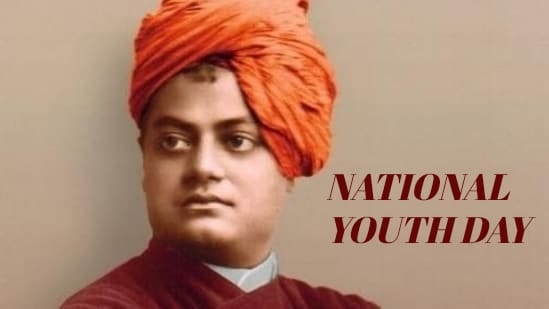
“Arise, awake and stop not till the goal is reached.” If ten words can capture the essence of Swami Vivekananda’s meteoric life, these would be it. In a life span of mere 39 years, he travelled across the country and the world rousing the consciousness of people towards spiritual growth and liberation. The goal for Swami Vivekananda was both individual liberation and freedom of the country from oppressive colonial rule.
Born on January 12, 1863, on the auspicious day of Makarasankranti, to Viswanath Datta and his wife, Bhuvaneswari Devi, he was first named Vireswara (after Bhagwan Shiv, to whom his mother had prayed). Later, he was named Narendranath.
As a young boy, he learned Sanskrit and verses from the Ramayan and Mahabharat. Vivekananda used to read books on history, European and Indian philosophy and literature, devoured newspapers and attended public meetings, where he met notable scholars and intellectuals for discussions. He realised what the Bhagavad Gita professed, that all service to humanity was a service indirectly dedicated to the divine.
Narendranath’s journey on the path of spirituality and discovering the divine began when he had his first spiritual experience during travels through Central Provinces on a bullock cart. Later in 1881, when he had his first meeting with Ramakrishna Paramhansa, the saintly priest of Dakshineswara Temple, at a devotee’s home, he came face to face with divinity. Ramakrishna was impressed by the devotion and melody in Narendranath’s voice and invited him to visit him. It took only three meetings with the Saint before the young Narendranath accepted him as his Guru. He kept questioning the Guru about his worship of the Divine mother in Dakshineswar. When he asked him if he had seen God, he got a reply, which was made famous, “Yes, I see God. See him as concretely as I see you.” In 1882, the young disciple experienced Ramakrishna’s strange power when everything vanished before his eyes when the Guru put his foot on the disciple’s chest. The tussle between reason and revelation was over: Narendranath Datta realised what the Holy Scriptures meant.
Following the Guru’s demise in August 1886, Swami Vivekanand founded the Shri Ramakrishna Mission at Baranagore, midway between Calcutta and Dakshineswar, with the help of Surendranath Mitra, a householder-disciple. The Mission vowed to live up to the teaching of the Guru that jiva (the created being) is indeed Shiva (the Spirit supreme).
From 1888 to 1891, Swami Vivekananda and his companions began their journeys across India: staying at the holy sites in cities like Varanasi, Ayodhya, Lucknow, Agra, Vrindaban, and Hathras.
In 1891, Swami Vivekananda travelled through Rajasthan, Gujarat, Bombay and then Mysore, Travancore, and finally reaching Madras. He met heads of religious institutions and temples at Dwarka, Girnar and Mount Abu. In Pune, he met and stayed with Bal Gangadhar Tilak. Swami Vivekananda, and accompanying Swamis, through these journeys, were to ascertain the aspirations of the Motherland and determine how spirituality could play a crucial role in the regeneration of India.
By 1893, Swami Vivekananda had been invited to the Parliament of Religions in Chicago to celebrate the 400th anniversary of the discovery of America. Funds for his US tour were collected publicly in Madras and Bombay, from where he left on May 31. His presence and personality, his thoughts and oratory made the West hail him as a ‘Messenger of Indian wisdom to the Western world’. In his speech, for which he received a standing ovation
After the Parliament, Swami Vivekananda spent the next three years spreading the message of Vedanta as lived and taught by Sri Ramakrishna, mostly in the USA and also in London. In Detroit, he met an Irish lady Margaret Noble who became his disciple, taking on the name of Sister Nivedita. There were others like Sister Christine, JJ Goodwin, the Sanborn family, Prof. Wright, and Mrs Hale and her family who were overawed by Swami Vivekananda’s personality and teachings and became life-long associates.
In his lectures, he explained the Upanishads and taught Gyan and Raja yoga. He wrote the book ‘Raja Yoga’ for the benefit of new audiences. In New York and then in London in 1895, his lectures and private classes on Karma Yoga were significant landmarks in his spiritual growth.
To Western audiences, he explained religion as a universal experience of transcendent Reality common to all humanity. He met the challenge of modern science by showing that religion is as scientific as science itself; religion is the ‘science of consciousness’. In more ways than one, Swami Vivekananda built bridges between Indian and Western cultures.
On January 15, 1897, Vivekananda returned to India from Colombo to Madras. In Madras, Swami Vivekananda gave four public lectures: ‘My Plan of Campaign,’ ‘The Sages of India,’ ‘Vedanta in Its Application to Indian Life,’ and ‘The Future of India.’ These lectures reminded Indians of both their greatness and their weakness and urged them to be proud of their past and hopeful for their future. He yearned to awaken the masses of India from the slumber of ages, rouse their religious consciousness and creates pride in them for their cultural heritage. Moreover, he wanted educated and privileged people to focus attention on the plight of the downtrodden as part of Vedantic principles.
On May 1, 1897, Swami Vivekananda founded the Ramakrishna Mission at Belur Math near Calcutta. The goals of the Ramakrishna Mission were based on the ideals of Karma Yoga, with the primary objective of serving the poor, distressed population of the country. Ramakrishna Mission undertook various forms of social service, establishing and running schools, colleges and hospitals, propagation of practical tenets of Vedanta through conferences, seminars and workshops, and initiating relief and rehabilitation work across the country.
Swami Vivekananda gave up thoughts of nation-building through political organisations. His idea of re-energising India was through her spiritual fervour and to uplift all human beings regardless of caste, creed, religion or gender. By 1899, the Ramakrishna Mission opened its new building in Belur.
Swami Vivekananda inspired the setting up of organisations like the Vivekananda Kendra, which developed his ideas of a spiritually inspired nationalism. Serving the nation was paramount for him, with the need to educate women and the poor. He wrote about the importance of scientific and material advancement in India. When Jamsedji Tata, the rich industrialist, offered to fund a monastic organisation for him, he instead requested Tata to fund an institute for scientific research and training. His proposal materialised at the Indian Institute of Science (IISc) in Bengaluru.
In June 1899, he went to the West again, now touring the west coast of the USA. He returned to Belur Math in December 1900 to spend the next few years inspiring and guiding people.
Incessant work, writing, lecturing and travelling began to take a toll on his health. He passed away on July 4 1902. In his vast writings that cover nine volumes, he said: “It may be that I shall find it good to get outside my body, to cast it off like a worn-out garment. But I shall not cease to work. I shall inspire men everywhere until the whole world shall know that it is One with God.”