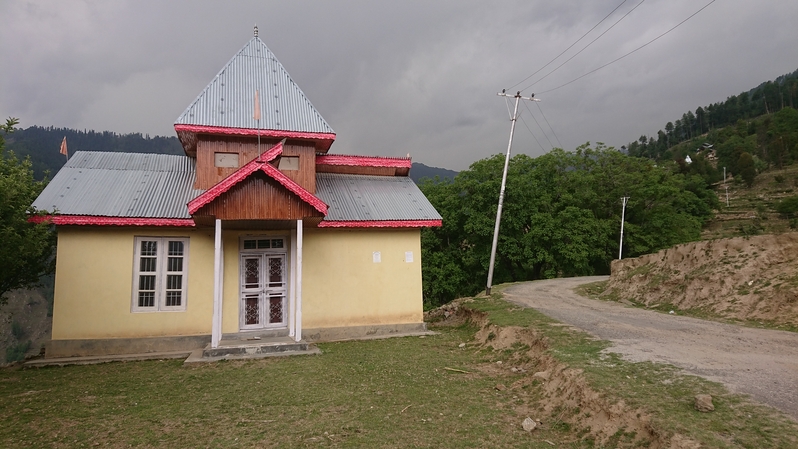
A student of class 2 in the primary school of village Thawa in Kulhand (Doda), Sapna had celebrated her 7th birthday 58 days ago. The power supply in her village was typically erratic during the day but remained uninterrupted after 6:00 PM. The night of April 30, 2006, was unlike any other though. There was no electricity in the village even after 6:00 PM. The Hindu families living in her village had not suspected the ominous events waiting to unfold that night. After all, this village is perched atop one of the remote and lofty mountains 30 km away from Dodd City and almost 200 km from the winter capital, Jammu. The terrain is tough, with meagre facilities. The government was invisible, and the governance was unexpected. The Muslims, comprising 30% of the population, had reminded the villagers of a meeting to be held soon to settle a certain dispute regarding a piece of forest land in the village. The ‘soon’ turned out to be seven days, and ‘the meeting’ was called at 12:30 AM. Sapna had been asleep for a little over four hours after what would become her last supper with her brother, Sumit (3 years) and her elder sisters Indra, Sumna and Ranju. Her younger brother, Amit (3 months), had not started the solid food yet and would get to sleep close to his parents, Gillo Devi and Jagdish Raj Bhagat. The sky over Kulhand had been clouded since the evening that day, and there was lightning too. It was very cold for that time of the year, so the family decided to sleep in the kitchen.
At 12:30 AM, the process of convening ‘the meeting’ began in the village, Thawa. Three Muslim men, armed with AK 47s, wearing army fatigues and sporting long beards, started going around the village, knocking at the door of every Hindu family and asking the young and able men to assemble at Jagdish Raj’s house for ‘a meeting’. The presence of terrorists had stopped evoking shock in Kulhand for a while. As long as you did their bidding and did not seem to have anything to do with the army, they would not give you too much trouble. They might enter your courtyard to ask for a glass of water or to wait while your women did their laundry or cooked food for them. Occasionally, they would call a meeting to give instructions and warnings. The menfolk, therefore, assumed that this would be just another meeting in which the armed terrorists would make a speech and issue fresh instructions. So, they left their homes and started walking unsuspectingly towards Jagdish’s. However, a few women had succeeded in persuading the terrorists that their men were not home. A few others had succeeded in persuading their menfolk against stepping outside.
A total of 13 men, including her husband, had assembled in the room adjacent to Gillo Devi’s kitchen. The terrorists asked her to bring them water. She handed them a tumbler each and poured water into them from a jug. As soon as she turned around to go back to her children in the kitchen, one follower of Allah opened fire at her while the other two showered bursts at the men sitting in the adjacent room. A deafening shriek escaped Jagdish’s old mother’s mouth. She came rushing out of the kitchen to find her daughter-in-law lying in a pool of blood on the floor. Possessed with rage, the old woman hurled herself upon one of the killers and snatched his AK-47. Before she could do them any harm, the three terrorists had overpowered the old woman. Unmoved by her wails, they headed for the six children in the kitchen and sprayed them with bullets too. In the absence of electricity and in the name of Allah, they had emptied three magazines on the 13 men, the six children and Gillo Devi. Sapna died that night. So did her doting father, Jagdish Raj Bhagat, and eight other men in the adjacent room. Bullets had shredded Gillo Devi’s right foot and her daughter Sumna’s leg. Three of the men assembled in her house had received injuries but survived. Sumit has been mentally unwell ever since but smiles easily when you greet him. Indra and Ranju are married now and keep checking on their partially paralysed mother and brothers from time to time. Sumna, who had a rod fitted into her broken leg, was abducted away by a Muslim boy of the same village when she turned 15. The boy’s family says that the two are living ‘happily’ somewhere in Kashmir. Amit is 16 years and three months old now and does not like to be around when someone visits the family to discuss that night. If you ask Gillo Devi about what happened to her family in ‘the meeting’ that night, she replies, ‘two dead, two injured’. Mechanically, without a tear in her eyes.
There was another ‘meeting’ happening at the exact same time in the neighbouring hamlet, called Punchhara. Three armed men had caught hold of Thakkar Rana and taken him to all the Hindu houses. With the gun pointed at Rana’s head, they made him knock at each door and ask the men of the family to assemble at the Nambardar Gopi Chand’s residence for a ‘meeting’. Fourteen men had assembled at the Nambardar’s house. One of the men, Bodh Raj Sharma, was asked to light an earthen diya so that the believers could see the kafirs, and kafirs the believers. Gopi Chand, the host, was standing while everyone else was sitting, waiting for the terrorists to begin their ‘speech’. He grabbed the diya from Bodh Raj and held it higher. The ‘meeting’ began. With the very first burst, the host Namardar Gopi Chand Sharma collapsed, and the diya fell off his raised hand. In the absence of light and in the name of Allah, three magazines were exhausted. Ten men died, and four were injured. Bodh Raj was one of them.
The meetings in the two villages were synchronised. The knocking at the doors had begun around midnight. ‘The meeting’ started at 2:30 AM and culminated a few minutes after emptying three magazines each at Gillo Devi’s house and at the Namardaar’s house. The two groups of terrorists disappeared from the villages together after hanging around for some time. Gopi Chand’s wife was not home that day. The perpetrators had locked his four daughters and two sons up in a separate room. They broke the door open somehow, raised the alarm, and gave water to the dying and injured. The families started coming out looking for their men at the sites of the carnage, but no one from the Muslim community stepped outside. Ratan Singh was one of the three Hindu families living in the Muslim cluster. His aunt and other women went around knocking at the doors of the Muslims, begging for help while their men were being taken out. No one responded to their pleas. Before dawn, twenty dead bodies of Hindus were placed along the edge of a narrow sidewalk near where there is a memorial now. Babu Ram Sharma saw his 68-year-old father, Prem Nath Sharma, amongst the dead. He became numb and quiet and started walking downhill thoughtlessly. Somebody brought him back the next afternoon from Doda city. He had walked 30 km in that state of shock.
The memorial of Kulhand martyrs, the dead bodies of Shish Ram Sharma (60), Satish Kumar Sharma (28), Gori Lal Sharma (67), Prem Nath Sharma (68), Kunj Lal Sharma (62), Gopi Chand Sharma (45), Mager Singh (46), Ram Raj (42), Pritam Singh (33), Balwant Singh (34), Rumal Singh (27), Sadhu Ram Sharma (60), Saroop Ram Sharma (43), Kumwar Singh (57), Sundar Singh (50), Ramesh Kumar (27), Jagdish Raj Bhagat (36), Panchhi Ra Gaddi (30), Bal Krishan Sharma (45) and Sapna Devi (7) were laid down on the sidewalk seen here.
19 innocent men and little Sapna had lost their lives in what is now remembered as the Kulhand Massacre. In its aftermath, the BJP government at the centre offered .303 Rifles to the Hindus for their self-defence. The Hindus faced two choices – either accepting the Rifles or fleeing the village. Babu Ram Sharma and 123 other villagers decided to accept the Rifles. No Hindu family migrated from Kulhand, much to the chagrin of those who had provided the logistic support to the terrorists. This was their way of declaring their resolve to stay back and fight. This was their way of paying homage to the 19 men and little Sapna.