The naval war for Ukraine has received little attention in the media.
Exceptions include the story on the Snake Island Defenders and occasional reports of Russian ships shelling the Black Sea coast. The lion’s share of analysis focuses on the Russian Army’s stalled campaign in northern Ukraine, now shifted to Eastern Ukraine.
The Ukraine coastline is 2,700 km long and includes the northern and western shores of the Black Sea and the Sea of Azov.
On 14 April, Moskva, the flagship of Russia’s Black Sea Fleet, sank off the coast of Ukraine in the Black Sea. The Russians attributed the loss to an accidental fire on board, while Ukraine claimed that two of its Neptune Missiles had struck the vessel. The U.S. has backed Ukraine’s claims. Losing Moskva is a psychological blow to Russia’s navy.
Control of Bosphorus and Dardanelles Straits
Russia has geographic disadvantages because of restricted access to the Black Sea. Turkey controls the access under the Montreux Convention of 1936, which gives Turkey rights to limit transit during wartime through the Bosphorus and Dardanelles Straits that connect the Black Sea to the Mediterranean, with an exemption for naval ships returning to their home bases.
In March, Turkey called for all sides to respect the Convention. It puts Russia at a disadvantage because it cannot provide a replacement for the Moskva. Therefore, its Black Sea naval capability will stand impaired till the war ends.
The loss of an important surface naval ship to cruise missiles starts a global debate about surface battleships vs missiles, which are much cheaper. The debate is also on the survivability of large aircraft carriers due to their vulnerability to precision-guided munitions like cruise missiles/hypersonic missiles. It is a debate relevant to the Indian Armed Forces.
Russian Naval Deployment
Warships from all four of Russia’s geographic fleets converged on the Eastern Mediterranean and the Black Sea in January 2022. They were executing traditional naval roles of power projection and sea control. The Russian Navy’s tasks supporting Putin’s strategic objectives include resupply of ground troops, precision fires to support military operations along the coastline and deep inside Ukraine, and maintaining sea control of the maritime passage of all concerned parties.
Before hostilities began, the Russian Federation Navy assembled two powerful naval task forces in the Black Sea and the Mediterranean. Russia bolstered its Black Sea Fleet with six Landing Ship Tanks from the Northern and Baltic Sea Fleets while positioning its most powerful surface combatants in the Eastern Mediterranean. In keeping with the Russian doctrine of deterrence by the defence, the Russian task force in the Mediterranean continues to deter NATO, protecting Russia’s access to its Syrian bases and discouraging intervention.
The Black Sea is the primary naval theatre of the war, with the Russians exercising effective sea control over the Northern Black Sea. The Russian Navy has effectively blockaded all Ukrainian ports and controls the entire Sea of Azov coastline, except for Mariupol. Closing these ports reduces Ukrainian resupply and potential evacuation efforts for civilians fleeing the Russian army. Russia has concentrated its most potent surface combatants and advanced diesel-electric submarines in the eastern Mediterranean to countervail NATO.
Ukraine Navy
Ukraine navy consists of 6,500 personnel, two landing craft, one minesweeper, nine patrol boats, four security ships, 91 special purpose RIB boats, 44 auxiliary vessels, and 23+ aircraft. On 04-Mar-2022 — the Ukrainian defence minister announced that they scuttled the frigate Hetman Sahaidachny so that Russia couldn’t capture it. This small coastal navy is mainly used for defensive operations and sneak raids.
Operations at sea
During the opening stages of the war in the Black Sea, the Russian Navy damaged or sank Romanian, Panamanian, Estonian, and Bangladeshi ships at anchor and underway. Estonia is a NATO member, so sinking its freighter was an exceptionally provocative act and demonstrated the risks of unintended escalation.
As the war progressed, Russia established an effective blockade of the Ukrainian Black Sea coast and declared Notice to Mariners (NOTAMs) for most of the Northern Black Sea.
Turkey, a NATO member, implemented a partial closure of the Bosporus Straits. This mile-wide strait provides the sole connection between the Black Sea and the Mediterranean, and the world’s oceans. The Turks did so under the 1936 Montreux Convention, thereby restricting the passage of Ukrainian and Russian warships into the Black Sea and effectively trapping Russian naval units.
Conduct Of War In Maritime Domain
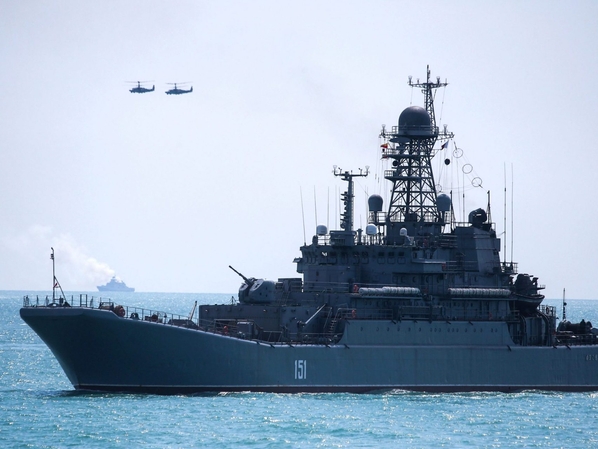
The Russian navy has operated roughly 12 to 24 ships in the Black Sea since the invasion, 11 of which are around the same size as the Moskva.
Russia’s navy has played a relatively minor role in the war and has been used primarily as an additional source of cruise missile launchers to attack targets across Ukraine. The Moskva didn’t have those, but it did carry anti-ship missiles that made it a spearhead for use against U.S. carrier fleets during the Cold War. Sealift–the use of ships to deliver assistance and material such as defensive weaponry to Ukraine is unlikely because of the status of the Turkish straits for the Russians. Also, encountering Russian warships, strategically positioned along the access routes to Ukrainian ports, makes any supplies from NATO and USA impossible from the sea.
Russian weapons have already hit commercial ships in the Black Sea. What action will Nato countries take if their civilian ships are attacked?
Russian Navy operations include clearing merchant ships from the Ukrainian Black Sea coast, supporting troops ashore with precision strikes from SS-N-30 Kalibr land-attack cruise missiles and naval gunfire, and providing resupply to Russian ground forces advancing along the Sea of Azov coast toward Mariupol. The Russian Navy conducted several amphibious feints in the direction of Odesa in conjunction with ground assaults against the southern Ukrainian city of Mykolaiv.
Russia lost an Alligator Class LST while pier-side in occupied Berdyansk, Ukraine, possibly to a Ukrainian short-range ballistic missile strike. Two additional Russian Ropucha class LSTs were on fire and possibly damaged, leaving the port following the strike. The sinking of this ship by the Ukrainian military represents a historic use of a ballistic missile against a naval target. The immediate effect may be denying Russia access to its only secured port on the Ukrainian coast of the Sea of Azov, further disrupting an already strained logistics system. The longer-term impact will be heightened concerns about Naval vulnerability to high-speed ballistic missiles worldwide.
Future Maritime Operations
Recent intelligence indicates that Russia has a fleet of warships ready to launch an amphibious assault on Odesa, the last major Ukrainian seaport not in Russian hands.
It is vital for Ukraine not to lose what remains of its Black Sea coastline. Will NATO protect the Ukraine coastline?
Lessons For India
Technological advancements in surveillance capabilities that are networked with missiles based on air, land, and sea platforms have certainly increased the vulnerability of surface naval assets. Accuracy is improved by using Global Positioning Signals, laser guidance and inertial navigation systems.
All three configurations can be mobile; land-based missiles have to compete with the potential reach conferred by the mobility of sea and air-based platforms. Striking a balance between the three requires a Joint-Services approach availability of budgetary and technological support.
It is important to be ready to face a war on the Chinese border. Large carriers like Russia’s flagship Moskva are vulnerable to cruise missiles in the sea.
Should India produce large warships after the sinking of Russia’s Moskva? Many smaller mobile, autonomous offensive military platforms may be way ahead.
All countries are developing long-range cruise and ballistic missiles.
Examples are China’s ballistic missiles, Russia’s Kaliber anti-ship cruise missile, and the U.S.’ Tomahawk cruise missiles.
Peninsular India into the Indian Ocean allows us to use 7600 km of coastline and island territories Andaman and Nicobar in the East and Lakshadweep in the West to provide missile bases that can cover important areas of the Indo Pacific Ocean region.
Developing long-range missiles is one solution. India should develop ballistic missiles, cruise missiles, and hypersonic missiles capable of both conventional and nuclear warheads.
India’s BrahMos missile, which has been co-developed with Russia, is currently the mainstay of its indigenous cruise missile capability based on land, sea and air platforms.
Progress in the indigenous development of cruise missiles is ahead of progress in air and sea-based platforms like aircraft and ships.
We should prioritise and expedite the production of cruise missiles and their deployment on island territories supported by surveillance capabilities. It would cost much less than fighter aircraft.
As regards the big battleships, till alternative platforms replace the functions performed by them, the enhanced risk to the existing assets will have to be accepted, and measures are to be taken to mitigate it.
We require a balanced mix of surface and sub-surface capability, surface ships and submarines. Platform size, form and numbers may change.
The Ukrainians exploited the vulnerabilities of Russian weapon systems with assistance from the U.S. and NATO. A similar model would be of great relevance in our context in blunting Chinese offensive actions. We should take a fresh look at all facets of maritime security given the Russia Ukraine war.
It appears that Russia made little effort to gain intelligence about the Ukrainian forces, their weapons, staying power, and warfighting tactics. Taking Crimea as a template, Russia underestimated the resistance of its adversary and the scale of operations required — a clear case of imitation of success despite the changed circumstances. Even a limited war has to be planned in terms of total national resources, factoring in the contingency of escalation to total war.
Unified military commands and the conduct of joint operations within the military are important. The lack of unified command and control and conduct of operations by the separate services has resulted in Russia’s disaster. We need to analyse the command control set-up of Russia for the perceived failure and draw the right lessons in the Indian context.