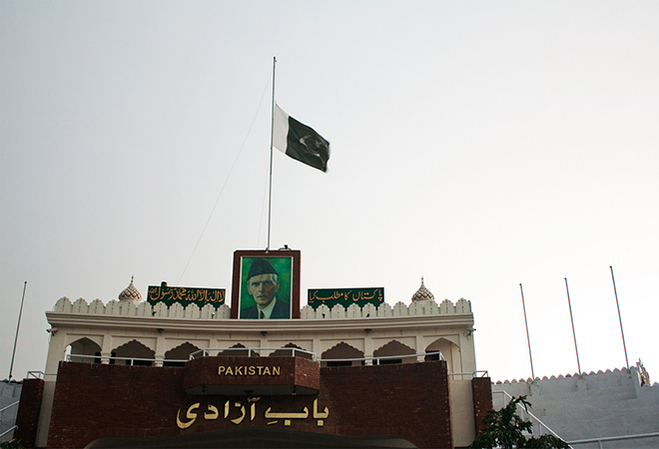
Pakistan’s current political crisis is neither the first one nor the last. The cast and the characters have been changing in Pakistan since its inception, but the script remains the same. Pakistan’s short history as a country has been very turbulent.
The indications of this colossal failure of the idea of Pakistan were evident since it came into existence in 1947. After Independence, while India had adopted its Constitution in 1949 and implemented it in 1950, Pakistan could only adopt its Constitution in 1956, and within two years, it was dumped when the first Martial Law was imposed in 1958.
There are three pillars on whom rests the idea of Pakistan. They were consciously chosen by the founders and initial rulers of Pakistan. These three pillars are Islamisation, confrontation with India, and an alliance with the West or other influencers to weaponise its forces.
Pakistan has seen a transition back and forth between military rule to democracy, but not stable enough to reduce the army’s influence in the political paradigm. Pakistan’s military has been consistently responsible for destabilising democracy. Democracy has never been in Pakistan’s roots, hence it certainly has no space in Pakistan’s political ecosystem (more like an echo system).
A Timeline of Democracy being crushed in Pakistan
Pakistan has set a new record for having not a single Prime Minister in office since its inception and has completed the 5-year tenure! From 2002 to 2022, Pakistan had at least 7 PMs coming and going into the office. If this is not puppet government’s work and endangers the democratic setup at stake, then wonder what is? Calling the democratic throne a jinx is like throwing off the scent from oneself.
Pakistan has faced several political upheavals, leading to dissolved governments. Here’s a look at how some popular and democratically elected leaders in the neighbouring country have been deposed:
Zulfikar Ali Bhutto
Following Pakistan’s defeat against India in the 1971 war, which led to the creation of a new nation-state — Bangladesh, Zulfikar Ali Bhutto took over the role of president. After the Constitution was passed under a special arrangement in 1973, he resigned from the post and became the prime minister of Pakistan.
On the night of 4 July 1977, General Zia-ul-Haq orchestrated Operation Fairplay and deposed Bhutto from power. On that fateful night, the Pakistani general ordered the arrest of Bhutto, his ministers and other leaders of both the Pakistan People’s Party and the Pakistan National Alliance.
In a nationally televised address, General Zia announced that the National Assembly and all provincial assemblies were dissolved and that the Constitution of Pakistan was suspended. Bhutto was subsequently executed, in a judicial assassination, on the orders of the military junta.
Zia-ul-Haq remained in power for 11 years as a dictator. He later died in a plane crash.
Benazir Bhutto
After General Zia-ul-Haq died in a plane crash in 1988, Zulfikar Ali Bhutto’s daughter Benazir became the prime minister of Pakistan in 1988. Her elevation made her not only the first female prime minister of Pakistan but also the head of its first civilian government since the dissolution of her father’s government in 1977.
Her rule didn’t last long, as then-President Ghulam Ishaq Khan dismissed her government on corruption and other malfeasance charges and called for new elections.
In 1993, she once again took the reins of the country. However, despite making headway in Pakistan’s relations abroad, attracting foreign investment in the country, and implementing social programs, Bhutto continued to face internal troubles, and those came to a head in November 1996 when then-President Farooq Leghari dismissed her government. She was also assassinated merely after months of assuming control.
Nawaz Sharif
Nawaz Sharif is no stranger to being deposed from his seat of power. He served as Pakistan’s prime minister on three occasions and was toppled twice from the position.
The first time occurred after he was elected as prime minister in 1990, following Benazir Bhutto’s removal. In 1993, Sharif too was dismissed on grounds similar to those for which Bhutto had been ushered out of office. He was reinstated by the Supreme Court but then resigned under pressure.
Sharif was once again voted to power in 1997. Soon after taking over for the second time, he forced the elimination of the constitutional provision that had enabled his previous dismissal from office. His second term wasn’t without troubles; the country was facing near bankruptcy, and he found himself in conflict with his new army commander, General Pervez Musharraf.
On 12 October 1999, Pervez Musharraf, the country’s then-army chief, overthrew Prime Minister Nawaz Sharif’s administration and took over the reins of power.
“Your armed forces have never, and shall never, let you down,” Musharraf told Pakistanis in a televised address late that night. “We shall preserve the integrity and sovereignty of our country to the last drop of our blood,” he added. “I request you all to remain calm and support your armed forces in the reestablishment of order to pave the way for a prosperous future for Pakistan.”
Nawaz Sharif romped to power for the third time in the 2013 elections. But fate played a cruel game with Sharif, and he was disqualified in his last year of power due to his involvement in the Panama papers offshore accounts case. He stepped down on 28 July 2018.
Imran Khan
In the ensuing elections, Imran Khan, the leader of Pakistan Tehreek-i-Insaaf, won and became the prime minister. His term, too, has been full of allegations of corruption, with the Opposition moving a no-confidence motion seeking his ouster, largely on accusations of economic mismanagement.
The bid to oust him reached a high when a government ally, the Muttahida Qaumi Movement (MQM-P), switched allegiance and quit the coalition government.
Imran Khan delivered his own googly when he called for snap elections. In a short address to the nation, Imran Khan asked the people of Pakistan to “Get ready for elections”. The no-trust motion against him was also dismissed by the Deputy Speaker, who termed it against the Constitution and rules of Pakistan.
Imran Khan recently disclosed that the country’s ‘establishment’ (army) gave him three options to end the ongoing political turmoil:
- Face the no-confidence motion in parliament.
- Hold fresh elections.
- Step down from the post of PM.
This explicitly displays the vice-like grip of the army in the political system of Pakistan.
The matter has now reached the Supreme Court of the country. As per a report published by PTI, Chief Justice Umar Ata Bandial, after taking a suo moto cognisance of the current political situation in the country, said that all orders and actions initiated by the prime minister and the president regarding the dissolution of the National Assembly will be subject to the court’s order as he adjourned for one day the hearing of the high-profile case. Imran Khan will continue as PM till the appointment of a caretaker PM under Article 224 A of the Pakistan Constitution.
Concluding Remarks
This political fiasco has multi-faceted reasons like corruption, harbouring terrorism, dynasticism and patronage, incumbency disadvantage, weakened democracy, rigged elections and false political competition killing the spirit of democracy, directionless leadership, fading faith of the public in the leadership, power tussles between military and political leadership is evident, military’s intervention and the toppling of the elected governments in Pakistan has augmented the attack on democracy.
Pakistan, as a nation, has walked a long way from where it was 74-75 years ago with far too little success, whether in terms of development and growth or stabilising democracy and its values. It is stuck in the swamp, making it a hopeless case unless it actually radically changes its modus operandi, which seems a far-fetched goal.
Today, this failed state has not only seen its irrelevance in the global context but has seen another breakdown episode on its own turf. The Pakistan that Jinnah dreamt of has ebbed, leaving the ruins.