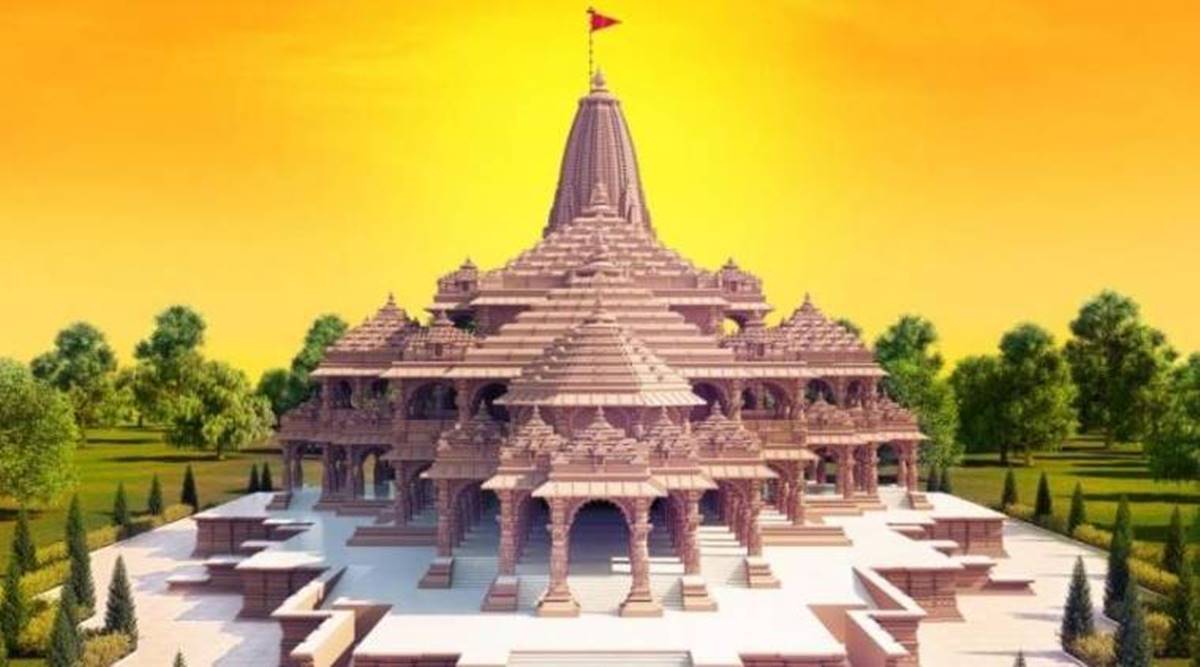
The Ayodhya verdict is landmark since it encompasses several aspects and answers several questions that have been a part of the Indian society even beyond the temple issue
Niranjan Marjani
November 9, 2020, marks one year of the Ayodhya verdict which paved the way for the construction of Shri Ram temple. With this verdict, the waiting period of more than 500 years was over. The construction of Shri Ram temple at Ayodhya, the birthplace of Shri Ram, is not just a fulfilment of the wish of millions of Indians, but the process that was followed in reaching there is reflected in India’s approach to domestic and international issues. Further, the same could be applied as a solution to the conflicts that are currently witnessed the world over. It is important to consider which issues have the Ayodya verdict has addressed.
Faith and Constitution-based mechanism
The most contested point in the Ayodhya issue has been that of the supremacy of Constitution over individual faith. Right through the Ayodhya case the Muslims, especially their political and religious leaders have been opposing the construction of Shri Ram temple. The argument they presented was that construction of Shri Ram temple was against the secular tenets of India’s Constitution. Besides, there was a lot of opposition to construct a temple where a mosque once existed. The Muslim leaders conveniently neglected the fact that the mosque was constructed by destroying the temple which originally existed at that site.
While the final settlement of the dispute was about the ownership of the land, it started as the dispute between two faiths. Although the Muslims kept reiterating their views about secularism and Constitution-based mechanism, the Hindus have been more loyal to both the concepts in letter and spirit. The Ayodhya dispute started with the destruction of Shri Ram temple at the hands of Islamic invaders more than 500 years ago. It implies that the beginnings of this dispute date back to the time when the current political and legal systems were not in existence. Also, the destruction had implied undermining of one faith by the other faith. So Hindus had every right to feel aggrieved since their place of worship was desecrated and destroyed.
Despite this, the Hindus have followed the Constitutional system to settle the dispute. The dispute had also come down to ownership issue in the final stages of the resolution. Essentially the dispute has lasted over not just different time periods but also different political systems. But Hindus conformed to the current legal system in order to reach the resolution of the dispute. However, the talk from the Muslims about Constitutional mechanism has faded after the judgement and the start of construction of the temple. On the occasion of the groundbreaking ceremony of Shri Ram temple, the All India Muslim Personal Law Board expressed its threat saying that it does not accept the temple and once a mosque is always a mosque. The duality about secular credentials and adherence to Constitutions on the part of Muslims has been exposed with this verdict while the Hindus won the case through the legal mechanism.
With the rise in conflicts in different parts of the world, the need for strong institutions stands more pronounced. In India, the Ayodhya issue, which has essentially been a clash of civilizations, was settled after a long but fruitful legal process
The myth versus reality debate
The Ram temple issue had also raised the debate about the myth versus reality. Over the years, the existence of Shri Ram temple or for that matter Shri Ram himself has been disputed. Any existence of temple was denied. Similarly, Shri Ram was considered as an imaginary person and not a real person. All this while, the sensitivities of Hindus were never considered. Hindus revere and worship Shri Ram. Also, Ramayan and Mahabharat have always been called mythological epics. These are histories of India and not mythologies. This factor has never been considered despite proof about the existence of personalities and events of the two available.
The Ayodhya dispute only accorded an opportunity to the Hindus to prove the existence of Shri Ram temple. Although a matter of faith, the Hindus presented historical and archaeological evidence of the existence of the temple. These were also corroborated with religious texts which were otherwise called a work of fiction. These pieces of evidence spanned across various centuries. But ultimately the existence of the temple was proved in the most scientific manner.
Reflections at international level
India’s foreign policy in the past few years has been revolving principally around the geopolitics of the Indo-Pacific Region. China’s strategic assertion has been a major concern for India as well as other regional and extra-regional powers with interests in the region. Prime Minister Narendra Modi’s conduct of foreign policy has been one of a vocal proposition of freedom of navigation and rules-based order in the Indo-Pacific Region. At the same time, he has been calling for multilateralism whereby interests of all the powers are protected.
Further India’s policy has been the one that advocates democratization and strengthening of international institutional mechanism. While delivering the speech at this year’s United Nations General Assembly, Modi had emphasized on this very point. He called for more efficiency in the functioning of an organization such as the United Nations. It is important to have a strong mechanism in place so as to effectively deal with crises such as the ongoing COVID-19.
The verdict on Shri Ram temple has been the result of an institutional mechanism in place. While the issue has been a highly contested one, the Hindus who are in majority, had put faith in the legal process and had shown readiness to accept the verdict. The ruling party, BJP, has had in its manifesto the construction of Shri Ram temple at Ayodhya as one of its goals. In the last two general elections, in 2014 and 2019, the BJP won with an absolute majority. But the party and the government chose to follow the legal process to resolve the issue. There were even attempts to resolve the issue through dialogue and deliberation. When the resolution was not found through these methods, ultimately the legal method was relied upon.
With the rise in conflicts in different parts of the world, the need for strong institutions stands more pronounced. In India, the Ayodhya issue, which has essentially been a clash of civilizations, was settled after a long but fruitful legal process. The Ayodhya verdict has brought a long-standing dispute to a conclusion. A historical wrong has been corrected with this decision and the start of the construction of Shri Ram temple. This verdict is landmark since it encompasses several aspects and answers several questions that have been a part of the Indian society even beyond the temple issue.
(The writer is a Political Analyst and Researcher)