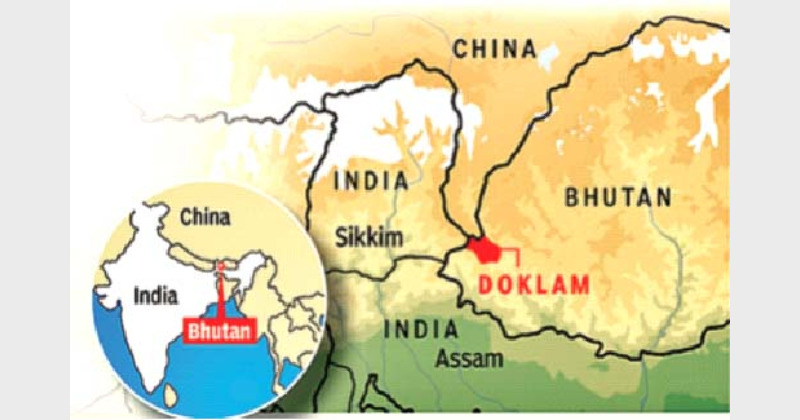
 Bharat has turned a new leaf in diplomacy by diffusing the standoff with China, though the Communist neighbour had its internal compulsions too
The Chinese have been fond of using a phrase ‘mutual win-win’ in their diplomatic engagements and announcements. The standoff that lasted for more than two months, had drawn too much ‘media rhetoric’ from both sides, but given the ‘considerable restraint’ shown by Indian diplomacy and leadership, the end of standoff goes as a ‘positive feat’ for the present Government and its diplomacy led by Prime Minister Narendra Modi.
The diplomatic resolution of dispute not only bestows mutual ‘faith in diplomacy’ for management of such disputes but also adds to India’s stature as a mature and responsible status quo power. Quite reasonably, the end of dispute reflects best possible mechanism in relation to China but also created a template for other countries as well. The success of diplomatic maneuvering towards ‘expeditious disengagement’ between both sides on Doklam
cannot be downplayed but a peaceful resolution of this standoff necessitates further examination of related factors at large.
Historic bonds
Historically, India-China bilateral relations have seen good shades of engagement much like Kotnis medical Mission to China, Tagore’s visit to China (1924), reflection of Afro Asian solidarity at Bandung (1955), Sino India rapprochement (1989), shared vision for the twenty first century (2008), celebration of sixty years of Panchasheel Declaration (2014) and Asian Century (2015). Despite these developments, the mutual relation has seen subject to ‘high level of trust deficit’ and has witnessed a sense of unpredictability, due to competing national interests and regional power politics amidst the rhetoric of ‘mutual space’ for growth from both sides.
However, marking a shift in its China policy, India under Modi government agreed to develop “a closer developmental partnership” that will be a ‘core competent’ of their relations. As envisioned, the idea of ‘Asian century’ under Modi’s regime was to be build based on ‘peer partnership and equity’ with China. Reasonably, based on the premise of “engaging and managing China”, the new policy shift noted pragmatic policy consideration towards China in terms of making strategic tie-ups, act east policy, peripheral engagement, pushing Indo-US ties, defense preparedness, widening India’s global engagement and practicing de-hypanisation in terms of India’s foreign policy management.
All this has contributed to India’s greater strength and ability to stand up to Chinese belligerence in Doklam. The peaceful resolution of Doklam was a reflection of our ‘gainful pragmatic policy’ under Modi government in terms of managing China.
If the Chinese state councilor Yang Jiechi asked Indian NSA Ajit Doval whether Doklam belonged to India, Doval, according to sources shot back, “does every disputed territory belong to China by default?” One can easily sense the clarity and reason of Indian argument to China. Earlier, in case of BRI summit in China, India had denied its participation citing sovereignty issues on CPEC.
The upcoming BRICS summit in Xiamen (2017) is being held after its successful Goa edition hosted by India last year. India has participated in all its preparatory meetings but given any pullout from India towards BRICS summit 2017, China would not have afforded to appear as a belligerent member of the BRICS. Earlier also during G20 meeting in July 2017 Prime Minister Modi has said that he “appreciated” momentum in the BRICS bloc under the Chinese chairmanship and extended full cooperation for the grouping. Much of the success of BRICS forum Indian leadership has kept its words and policy consistent and dependable.
China Churning
The domestic situation in China also played a determinant role in the peaceful resolution of the standoff. Amidst media rhetoric on the Doklam, the core of the problems lies with rising dissidence voices within the party given economic downturn, the feasibility of new normal, job losses, aging population, problems of price rise, factory closures, unpaid wages, anti graft campaign and political fixation in China. All these issue face up to Chinese leadership led by President Xi Jinping in run-up to next Party Congress in China. Given these issues, the continuation of Doklam standoff would have certainly drawn questions from Chinese leadership. Much to their unease the doctrine of ‘peaceful rise’ of China would have faced further shrink of space given continuation of a standoff with India.
Since the beginning of standoff, India had consistently maintained for ‘restoration of status quo’ and show of ‘strategic maturity’ by China. While China ruled out any scope for ‘meaningful dialogue’ given India’s unilateral withdrawal from Doklam, the end of standoff based on mutual disengagement is a success for Indian position and leadership. India also managed to defend an ally making a calculated move based on mutually agreed principles of India Bhutan Treaty (1949 revised in 2007) in time necessity.
Doklam standoff also offered an opportunity to look into the historically- made claims of China being a dominant power in Asia for centuries and is now claiming its ‘lost status’ under rejuvenation of Chinese nationalism. This myth build on distorted history proved its limitations given the examples when in a larger civilizational sense, it is India that “dominated” China rather than the reverse. This goes more than Buddhism and silk trade routes, even beyond China, so as to include even Southeast Asia, drawing on the Indian civilizational, cultural and ethnic influences.
Global Position
On the global front too, China was not able to draw much support for its position on Doklam against India. The US and the UK categorically asked China to resolve the matter diplomatically and bilaterally with India. Later, Japan was more upfront in saying that it was China, which violated the international law at Doklam. In terms of adherence to international law, China records seem to be less convincing given its outright rejection of South China Sea (SCS) award with Vietnam.
In sum, as the standoff resolves peacefully both the countries proves the fact that at the times of global uncertainties, India and China relations are a force of stability. After the successful conclusion of BRICS 2017, the next move could be the possible opening of Kailash Mansarovar yatra between both, which would certainly offer a new source of cultural synergy and confidence in bilateral relations between India and China. Both countries must try to build more clarity and agreement on issues like One India policy, global terrorism, and UNSC reforms, strengthening multilateralism under BRICS and India’s membership in NSG. No doubt the ‘power gap’ between both has to be well understood and must not to be overplayed but the effort must be to move on with mutual advantages and aspirations. China must understand that with great power comes great responsibility. It is the time we pick it from here seeking inspiration from great Chinese philosopher Confucius, “Our greatest glory is not in never falling, but in rising every time we fall”.
(The writer is a scholar at the Centre for Asian Studies,JNU)