 India and Myanmar today stand at new crossroads. It is time that both sides step-up work hand-in-hand strategically to realise the potential of empowering relationships, and engaging at multiple-layers to revive the intrinsic depth in relations
Sriharsha Masabathula
Across a plethora of dimensions, including and certainly not limited to geography, religion, politics, and culture, India and Myanmar share immense common-ground. From time immemorial, both the cultures have constantly been engaged with each other, and have exchanged much knowledge and resources. Even in today’s popular culture, it is not uncommon to hop on a taxi in Myanmar, and be asked about whether you have visited Bodh Gaya, the place where Lord Buddha gained enlightenment in Bihar. Likewise, in India, many towns and cities, especially in South India, have a “Burma colony” or “Burma Bazaar” brimming with past-memoirs. But apart from these promising pockets of mutual-empathy, the relationship is not perceived to carry a “mass” fervor across various levels of engagement, which is often counter-intuitive, and needs to be perused further!
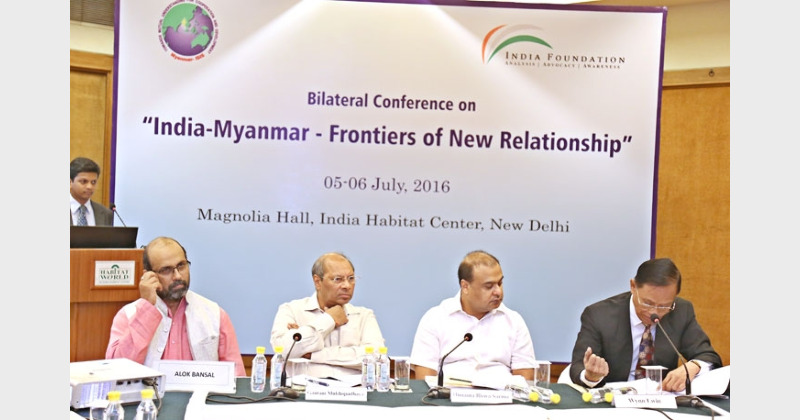
Why then is the relationship between India and Myanmar only cordial, and not intimate? During the recent bilateral conference organised by India Foundation in partnership with the Myanmar Institute of Strategic and International Studies (MISIS) on “India and Myanmar: Frontiers of New Relationship” on 5-6 July 2016 in New Delhi, some pointers to address this important issue came to the forefront.
Drawing from popular discourse and also in track-2 dialogues, it seems to be a dominant view that China is much more pervasive in Myanmar, than compared to India, not least due to China’s aggressive foreign policy. The visiting Myanmar delegation reiterated that China is perceived to be fast, and has often provided assistance to Myanmar in times of need, albeit it was noted that the engagement has mostly been at a military and government-to-government (G2G) level. While China has invested much time and effort in Myanmar for strategic reasons, it is important to note that China’s aggressive foreign policy or its massive economic investment in Myanmar does not automatically reflect an across-the-board positive perception of China among the people of Myanmar. Rather, having spent time in Myanmar, the pulse on-the-ground seems to be different, which must be recognised.
While Indian economic and political investments in Myanmar may not match China, it is important to note that India shares a deep people-to-people (P2P) relationship with Myanmar, and India enjoys a natural affinity with the people of Myanmar. India is automatically close to the people of Myanmar, be it through Buddhism, or in the past through a shared colonial history. In recent times, as Myanmar pursued a closed foreign policy during the Ne Win era, India and Myanmar have drifted apart, and the current younger generation has seemingly lost the sensitivity and affection, but it is shared by the older generation who have witnessed the pre-Ne Win era. Nevertheless, the underlying message is essential: In a close-relationship, especially among neighbours with deep ties, there may be ups and downs, but the affection and mutual-understanding is well-ingrained on both sides, but at times needs revival and nurturing.
RN Ravi, Chairman of Joint Intelligence Committee delivering the valedictory address at the conference, noted that following the Mongol invasions in the Indian sub-continent, both the countries which were earlier under the same contiguous geographic, political, economic and cultural framework drifted apart. The repercussions of the impact seem to be felt even today. During the British rule a few centuries later, though India and Myanmar were under the same administration, Myanmar played a major role in protecting then eastern Indian sub-continent, and was plagued by constant attacks from the Japanese during WW-II. This led to a constant flux of various communities in and out of Myanmar, which in many ways furthered the distance between present-day India and Myanmar, initially instigated by the Mongol invasions. Furthermore, Prafulla Ketkar, editor, Organiser noted that today, both the countries are lacking in each other’s “popular psyche” which is perhaps an underlying reason as to why the younger generation of both the countries do not seem to have the same curiosity and engagement with each other as earlier.
The issue, then, is multi-layered and needs to be addressed at various levels – more specifically, by engaging with various layers of people and communities. In addition to G2G engagement, P2P cooperation needs to be strengthened, and promoted at various levels using tools effective for each community. For instance, if Bollywood is popular among the youth of Myanmar, it must be promoted to enhance cooperation in popular culture, and if learning about our common history dating back to 2000 years is of interest in academic networks, literature that caters accordingly must be made accessible to study and pursue further research. Much literature and past-records of cooperation between both the civilisations have gotten buried in Myanmar and India due to lack of adequate engagement between both the countries during the past few decades, but a consolidated effort to revive and bring it out can be made now.
In terms of present day cultural ties, a coordinated effort to make the pilgrimage to Bodh Gaya for Myanmar citizens easily accessible and economically feasible for large sections of Myanmar population is necessary. While many undertake the pilgrimage to Bodh Gaya today, there is potential for more, and a “Buddhist-circuit” starting from Bodh Gaya in India and stretching all the way to South-east Asia beyond Myanmar, needs to be developed by addressing the limited air-connectivity and other logistical impediments. In other words, India and Myanmar are working together, but the energy on both sides must be made more evidently visible for civil society in both India and Myanmar to capture and build upon.
An under-explored area of cooperation for strengthening ties, is tapping the memories, literature and stories of Indian-origin communities in Myanmar, as well as of communities which relate themselves to Myanmar in India. These must be researched and made widely available through books and other technological media, including social media. Most importantly, popular culture such as film and music would draw a huge audience which would help generate an interest in unleashing the wealth embedded in Indo-Myanmar relations. For instance, Subash Chandra Bose’s partnership with General Aung San during the WW-II, or the outflux of Indian-origin communities during the onset of the Ne Win era and the subsequent records of painful separation between friends and families of Indian and Myanmar communities, or the ancient cultural history of Myanmar emanating as a larger part of the Indian sub-continent and South-Asia, such as the history of the Pyu Ancient Cities, are topics which would ring a tune in the heart of the people of both countries, and re-ignite the passion to further work together on both sides.
India and Myanmar today stand at new crossroads, with India itself rediscovering its role in the world, and Myanmar opening up to a new political era with Daw Aung San Suu Kyi’s party, National League for Democracy (NLD) forming the government. It is time that both sides step-up work hand-in-hand strategically to realise the potential of empowering P2P relationships, and engaging at multiple-layers to revive the intrinsic depth in Indo-Myanmar relations.
(The writer is a Researcher who spent 2 years in Myanmar)