| Vol. 1, No. 30. Delhi: Thursday, Paush Shukla 11, 2004, January 22, 1948, Four Annas |
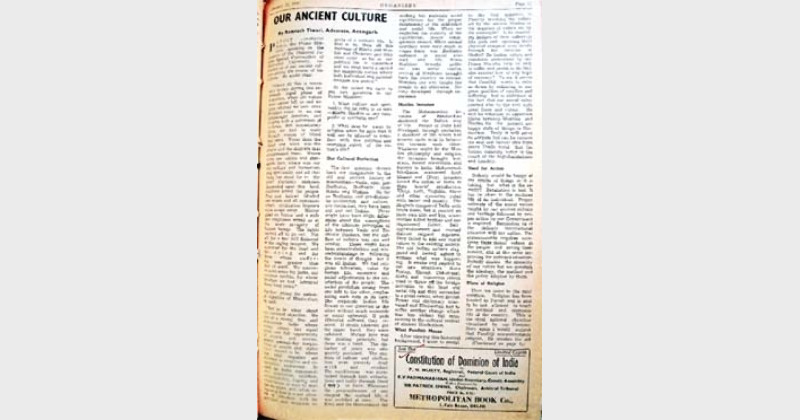
Pandit Jawaharlal Nehru, the Prime Minister, speaking on the occasion of the Diamond Jubilee Special Convocation of Allahabad University, reminded us of our ancient culture .. He spoke thus: “Above all this is necessary to-day, during this extremely rapid phase of transition, when old values have almost left us and we have adopted no new ones..”
Further, giving the national objective of Hindusthan, he said: “Let us be clear about our national objective. We aim at a strong, free and democratic India where every citizen has equal place and full opportunity of growth and service, where present-day inequalities in wealth and status have ceased to be, where our vital impulses are directed to creative and cooperative endeavour. …while religion is free it is not allowed to interfere with the political and economic aspects of a nation’s life.”
At the outset we have to put two questions to our Prime Minister:
- What culture and spirituality did he refer to as ours — Hindu, Muslim or any composite or synthetic one?
- What does he mean by religion when he says that it will not be allowed to interfere with the political and economic aspect of the nation’s life?
Our Cultural Perfection
The first question throws back our imagination to the old and ancient history of Hindusthan—Vedic, epic, pre-Budhistic, Budhistic, later Hindu and Muslim. So far as Budhistic and pre-Budhistic civilisation and culture are concerned, they have been out and out Indian. We had religious toleration, value for human life, economic and social adjustments to the satisfaction of the people. Mutual love was the guiding principle, but there was a limit. The enemies of culture and civilisation were securely dealt with and crushed. When animal sacrifices were very much in vogue there was Budhistic outburst in social conduct and life. When Buddhism brought political and social inertia, revival of Hinduism brought back the country to normal. Society developed through experience.
Muslim Invasion
The Mohammedan invasion of Hindusthan shattered the Indian way of life. Whatever might be the Muslim philosophy and religion, the invaders brought loot, arson, forced conversion and bigotry to India. They failed to add any moral values to the existing society. Rana Pratap, Shivaji, Chhatrasal, Sikhs, and numerous others tried to throw off the foreign intrusion and they succeeded to a great extent, when British Power and diplomacy intervened and Hindusthan had to suffer another change which was less violent but more ruinous to the cultural revival of ancient Hindusthan.
What Panditji Means
After viewing this historical background, I want to revert to the first question. Is Panditji invoking the values set by the ancient Hindus or the negation of values set by the onslaught? To me it seems that Panditji wants to calm us down by referring to our great qualities of sacrifice and suffering but is oblivious of the fact that our moral value reacted also to the evil with great force and vigour.
Need for Action
Nobody would be happy at the course of things as it is taking, but what is the remedy? Retaliation is bad. It has no place in the civilised life of an individual. Proper estimate of the moral values taught by our ancient culture and heritage followed by Proper action by our Government is required. Nobody doubts the sincerity of our rulers but we question the ideology, the method and the policy adopted by them.
Place of Religion
Then we come to the next question. Religion has been treated as Pariah and is said to be not allowed to touch the political and economic life of the country. Here again I would suggest that Panditji misunderstands religion. He invokes the aid of culture, spirituality and values but forgets that religion is nothing but all these. .. Instead of finding out the true principle of religion, to take for granted that all religions are basically good has been the constant source of troubles in the world. Religious toleration is laudable, but you should also create the conditions for the growth of such toleration.
In the end I would say that had anybody else uttered those sentences which Panditji said at the convocation we would not have minded it. But as the Prime Minister of India, in whose hands lies the destiny of the nation, spoke like that, we feel a little disturbed about our future. We are reaping the consequences of our past ‘Apatreshu daya’ Principle.
-By Ramnath Tiwari, Advocate, Azamgarh