Intro: Leaders deliver harangues on subjects like ‘Unity in Diversity’ but secretly invest more in diversity than in unity. When will Indian political leaders appreciate and imbibe the superior quality leadership style from the Indian Army?
The Republic Day Parade in India is a grand spectacle that mirrors India's military might, culture and progress. On January 26, India marches on Rajpath in the form of military contingents, tableaux and youth troupes—all overflowing with elegance and jubilant gaiety. This year the awesome spectacle had yet another attraction: President Barack Obama of the USA sitting alongside President Pranab Mukherjee and Prime Minister Narendra Modi to witness India on the move at Rajpath.
Every Republic Day Parade starts with a solemn and poignant ceremony where the President awards the highest gallantry award—Param Vir Chakra for actions of most conspicuous bravery, exceptional daring or pre-eminent valour in the face of the enemy or Ashok Chakra if such conspicuous performance of exceptional order was noted in anti-terrorist or counter insurgency operations. In 2015, Ashok Chakra was awarded to Major Mukund Vardarajan and Naik Neeraj Kumar Singh, both of whom made the supreme sacrifice while fighting terrorists in Kashmir in different operations in April and August 2014, respectively. The solemnity of the occasion was much heightened when the young widows of these martyrs received the awards in muted succession. For a moment, the rain stopped and silence possessed the audience as the tales of the heroic acts of these martyrs were read out.
Although not many in the country might be aware, the Republic Day Parade is preceded by the Army Day Parade on January 15 every year. The Chief of the Army Staff reviews the parade on this day and he also awards Sena Medal for distinguished acts and professional excellence. Both these festive events in the month of January each year provide the nation an opportunity to have a closer look at their military vis-à-vis the coming challenges.
Army's Role in Social Care
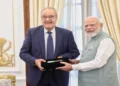
In a laudatory gesture this year, the Army Chief, General Dalbir Singh presented a cheque of Rs 100 crore to PM Modi as the Army’s voluntary contribution to the PM's Relief Fund during an impressive at the traditional “At Home” at Army House on the occasion of the 67th Army Day. in New Delhi on January 15, this year. Every soldier has contributed one day's salary to raise this amount. Such a gesture only intensifies the chivalrous ethos of the Indian Army: “Kadam kadam badhaye jaa… Ye zindagi hai quam ki, tu quam pe lutaye jaa”. It is not the first time that the Armed Forces are making such benevolent contribution for the national cause. Earlier too, the Army had contributed one day's salary of all army personnel in the wake of Tsunami devastation in 2005. There is no doubt that the Armed Forces have been somewhat unhappy as they feel the Pay Commissions and the Government have given them short shrift. Yet, soldiers have never flinched at the suggestion of foregoing a day's pay for a national cause.
The Indian Army runs a number of civil welfare projects in the areas where units are operationally deployed. Projects like ‘Op Sahayata’, ‘Op Sadbhavana’ and a number of other regional projects are ongoing missions that address specific problems of villages where the civil administrationmakes only seasonal appearances leaving people to fend for themselves. Army units have adopted villages and opened school facilities, vocational training centres, sports facilities, medical aid posts, childcare, Health and Hygiene programmes and so on.
Creepy Rise of 'Fifth Column'
As the era of conventional warfare is fading, new threats are already looming through cyber space, chemical-biological-nuclear misuse and different forms of proxy war. An even more dangerous threat that seems to have passed unnoticed thus far is the creepy rise of Fifth Columnist elementswithin the Armed Forces and outside. The aim of these elements will be to “break the soldiers’ will to fight” by infiltrating into the units and establishments through whispering campaigns, gossip and rumour mongering. The spread of communication network makes it easier for them to reach larger audience across larger areas faster than ever before. The rising incidents of insubordination, quarrels, mutinous conduct and suicides might have other causes too, but there must be tangible evidence to rule out insidiously planned subversion.
In the high-tech high-speed modern age it is, however, easy for an odd disgruntled man to inject virus of the fifth column pedigree which can soon proliferate through the medium of Internet, social media and smart phones. Currently, for instance, a whispering campaign is doing rounds on Facebook and Whatsapp. “The deduction of one day's salary of all ranks is arbitrary and illegal. Firstly, the Government and the Pay Commissions have degraded our status as compared to those Babus who not only have risk-free cushy jobs but also make an extra buck by hook or crook. Secondly, they cut my pay. Can they do so with civilian employees? Our generals don't take a stand. They will go to any length to please these politicians to get a post-retirement job. No, let's us refuse. At least I am going to represent…” All these messages are either anonymous or pseudonymous. That the aim of the message is to whip up an anti-organisation sentiment is clear from the fact that the authors of such provocative outbursts are pushing out only half-truths. They are either not aware or they deliberately suppress the relevant rules and provisions of military law. Army Act Section 25 (read with Army Rule 205 (b)) authorises the Army authorities to make compulsory deductionsfrom the pay of army personnel to meet contribution to a Fund approved by the Central Government. Therefore, the compulsory deduction of one day's pay to raise the contribution of Rs 100 crore to the PM's Relief Fund is absolutely legal besides being a highly graceful gesture of benevolence from all ranks of the Indian Army.
A few superseded disgruntled officers and subordinates with perceived grievances come handy to the enemy agents as tools of the fifth column for spreading the disease of mistrust and suspicion in command. Military authorities must deliberate over it and institutionalise effective mechanism to combat the sporadic disease before it assumes epidemicproportions.
Secular Homogeneity
It is the irony of the modern multi-channel media today that only what hyped looks enormous is whereas the enormity of the mega services provided silently by the Army to the society pass without much hoopla and publicity. Media coverage of relief operations and aid to civil authorities ebbs just as the military effort surmounts the crisis and restores normalcy. There is a lot in our military customs and traditions that carry valuable lessons and wholesome ideology, which could foster and reinforce cohesive relationships amongthe divergentsegments of our heterogeneous society. Regiments have conventions to baptise newly commissioned officers joining units from different regions, castes and religions. And soon enough these mavericks are effortlessly moulded into die hard faithful of their respective regiments. They imbibe regimental values and soon adopt the regimental culture.The regimental insignia on their shoulders becomes their identity and source of inspiration, eg, Jat, Rajput, Sikh, Madras, Bihar and so on. It is common to find people of all faiths inter-mingling in religious functions and celebrating festivals with the same gusto as members of the same family. You will find Muslims participating in Mandir functions, Hindus in Masjid, Sikhs in Church or Christians in Gurudwara with unmitigated reverence.
Now contrast this with how secular democracy is practised in our civil governance. Leaders deliver harangues on subjects like ‘Unity in Diversity’ but secretly invest more in diversity than in unity. When will our political leaders appreciate and imbibe the superior quality leadership style from the Army?
Karan Kharb (The writer is the author of 4-Star bestsellers in
‘Indiatimes Rating of International Bestsellers’ books on
leadership and a social worker)