A must read, to know reality?
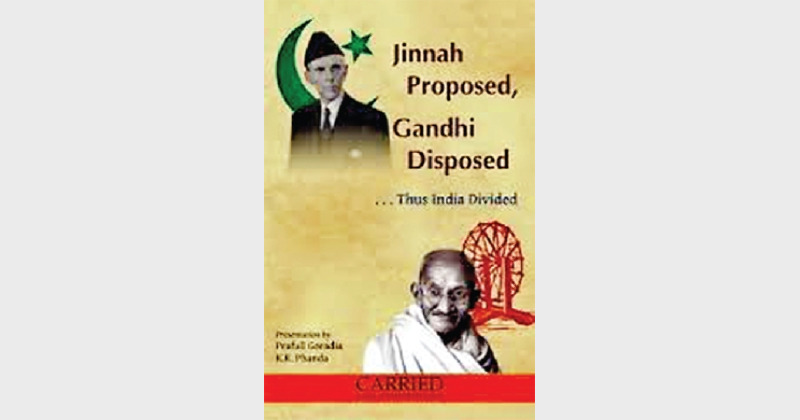
| Jinnah Proposed, Gandhi Disposed..Thus India Divided; Prafull Goradia, K.R. Phanda; Carried, a unit of Samarth; Pp 269; Rs 600.00?? |
Intro: The book contends that it was the indifferent and callous attitude of the Muslim League and the Congress which led to the Partition of the country and created certain unpleasant issues like Kashmir, a perpetual bone of contention between the two countries.?
 Though the division of India into two nations took place nearly seven decades ago, memories of its holocaust still linger in the minds of the people who were witness to it or were affected by it.
This book contends that it was the indifferent and callous attitude of the Muslim League led by Mohammed Ali Jinnah and the Congress by Mahatma Gandhi that led to the Partition of the country.
The writer Prafull Goradia argues that certain unpleasant issues like Kashmir, a perpetual bone of contention between the two countries, could have been avoided if the two leaders had adopted a pragmatic approach to the issue of Partition. To substantiate his views, Prafull quotes the views expressed by Jinnah through his various letters to Gandhi. Both the writers Prafull and Phanda feel that Gandhi’s role did not help in preventing Partition and what they consider worse is that Gandhi managed not only to coerce the Nehru government of free India to pay up Rs 55 crore to Pakistan “but also disregard the Muslim League’s repeated demand for an exchange of population.”
In this book, which is a compilation of not only Jinnah’s letters to Gandhi but also excerpts from B R Ambedkar’s book, Pakistan or the Partition, from Rajendra Prasad’s book entitled India Divided and from G D Khosla’s Stern Reckoning, Prafull and Phanda point out that Jinnah was impartial towards the Hindus and Muslims before 1930 when he departed for England but subsequently, he began to feel out manoeuvred by Gandhi and isolated from the people as Gandhi had developed a mass following within and without the country. Jinnah returned to India and the Muslim League offered him the presidentship of the party despite knowing that he was an Ismaili Khoja who had switched over to Asnashi Shia so that none could challenge him for not being a true Muslim.
The book also highlights the fact that Jinnah wanted to be known as Qaid-e-Azam and this couldn’t be so in India where there were many competitors for leadership against him; so he demanded a separate state. He whipped up a mass hysteria among the Muslims for creation of a separate Muslim state and got adequate support from the Aligarh Muslim University which was the epicentre for demanding such politics. The educated Muslims, especially the Habib clan of Bombay, feared that they would be outnumbered in the event of elections. Anyhow Jinnah was certain that the Muslims would gather in their exclusive homeland and non-Muslims would migrate to India. The writers Prafull and Phanda say that neither Jawahar Lal Nehru nor Mahatma Gandhi “understood the Muslim mind” and Nehru deluded himself to be acceptable as a leader of Muslims while Gandhi was obsessed with seeking Muslim cooperation in driving out the British from India.
In his presidential address to the Muslim League, in March 1940 at Lahore, Jinnah criticised Gandhi for suggesting the setting up of a tribunal to attend to the grievances of the Muslims who had been facing difficulties since January 1939 as he feared that Muslims would be one against three. So Jinnah countered this by saying that Muslims were not a minority but occupied large parts of the country. He went to the extent of saying that Hindus and Muslims can never “evolve a common nationality…The Hindus and Muslims have different religious philosophies, social customs and literatures. They neither inter-marry not inter-dine and indeed, they belong to two different civilisations which are based mainly on conflicting ideas and conceptions.” He added, “If Hindus and Muslims are brought together under a democratic system, forced upon the minorities, it can only mean Hindu Raj.”
Prafull and Phanda then quote B R Ambedkar, the father of Indian Constitution, who said, “The Muslim areas are an anomalous excrescence on Hindustan and Hindustan is an anomalous excrescence on them. Tied together, they will make India the sick man of Asia.” He felt that India had failed to realise two things – the first thing was that “there is difference between appeasement and settlement, and that the difference is an essential one. Appeasement means buying off the aggressor by conniving at his acts of murder, rape, arson and loot against innocent persons who happen for the moment to be the victims of his displeasure. On the other hand, settlement means laying down the bounds which neither party to it can transgress. Appeasement sets no limits to the demand and aspirations of the aggressor. Settlement does.” The second thing according to him, was that the “Congress has failed to realise that the policy of concession has increased Muslim aggressiveness and what is worse, Muslims interpret these concerns as a sign of defeatism on the part of the Hindus and the absence of the will to resist.” Ambedkar considered “settlement” as a proposition against appeasement. He preferred “the Partitioning of India into Muslim India and non-Muslim India as the surest and safest method of providing for the defence of both” and therefore concluded that “if the Musalaman will not yield on the issue of Pakistan, then Pakistan must come.”
A considerable portion of the book is devoted to Jinnah offering clarifications to Gandhi on questions put up by the latter regarding the Lahore resolution and its principles.
Even G D Khosla, ICS, is quoted and who said that the Muslim League’s demand for Pakistan was based on the hypothesis that Hindus and Muslims constituted two separate nations, each entitled to a separate homeland where they would be free to develop their culture, tradition, religion and polity. He added, “But the Two-nation theory brought the problem of minorities into greater prominence than ever before and Partition, instead of offering a solution, made it even more difficult and complicated…No matter where the lines of demarcation were drawn, there would be Hindus, Muslims and Sikhs on either die of it, in a majority or in a substantial minority.”
Here is a book to be read to get a picture of the reality that prevailed before Independence.
-Manju Gupta? (The reviewer is former Editor of NBT)
?