Special on Guru Poornima:Symbol of Divine Trust
Sadashivsmaarambhaam Shankaracharyamadhyaam | Asmadaacharyaparyartantaam Vande Guru Parampara || |
Intro: India has been following Guru Shishya Parampara since Vedic times. This legacy is spreading all around the globe by several Gurus (Spiritual Teachers) and their Shishyas (Devotees) in modern times.
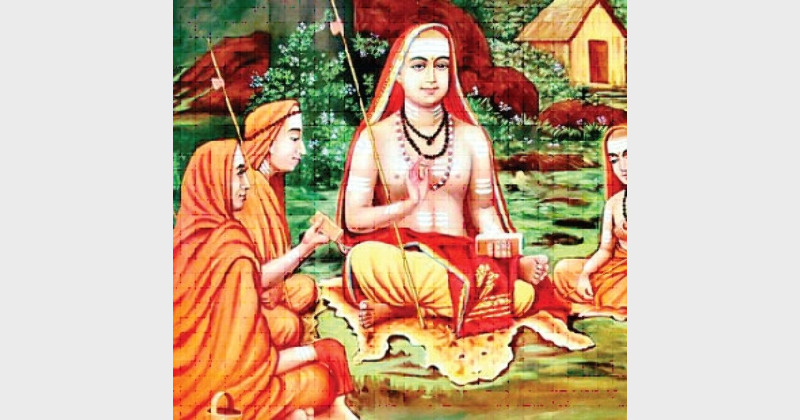
Ashada masa of Hindi calendar marks the beginning of monsoon in India. In the spiritual field this corresponds to the purifying shower of divine grace. The history of the day holds the Legend. It was Adi Shankaracharya who re-established Guru Shishya Parampara in 9th century.
In Hinduism the Guru, the spiritual mentor ranks in stature second to God. In fact in many traditions Guru is valued even more than God. It is the Guru who introduces a common and ordinary man to God.
Guru is a human form through which the power and grace of divine can manifest. The one divine teacher, called Ishwara who speaks through innumerable human Gurus. The intensity of devotion many Hindus feel towards their Guru is extraordinary and considered him as a face next to God with special powers earned through saadhna (Meditation). In the Hindu tradition Gurus don’t just transfer information they also awaken the students’ intuitive powers for them to find answers. The Gurus like, Adi Shankaracharya, Swami Vivekananda, Ramakrishna Paramhansa, Swami Sivananda, Dayananda Saraswati, Tadatatmananda are acknowledged pan globe even after they are not physically present because of their teachings. However, Gurus like Sri Sri Ravishankar, Baba Ramdev who are still present to enlighten the lives of people.

Guru means Teacher. The letter ‘gu’ stands for darkness and ‘ru’ stands for that which removes darkness. ‘Guru’ implies one who removes darkness of ignorance. The Guru has a commitment to continue teaching till the students gain knowledge.
Teachers of spiritual divinity are Gurus; Shishya is from the root ‘sas’ instruct or discipline. One who has desire for knowledge is jijnasu. The shishya should have shradhha (Trust) and bhakti (Devotion) towards the teacher and, also have the will to give everything, even though, Guru does not want.
In India, Guru Shishya Parampara has been followed from ancient and Either Abdu Rabb edic times. The beginning of oral traditions of Upanishads (c.2000 BCE), upa means near and ni means down and shad means to sit.
So it means sitting down near a spiritual teacher to receive instruction. The best example of Guru Shishya Parampara can be seen in Bhagwat-Gita where Shree Krishna advises Arjuna to perform his duty honestly. .
Adi Shankaracharya
Shankara was born in the year 805 AD. He was raised under the loving care of his mother. From his childhood he turned out to be a prodigy. When he was only one year old he learnt Sanskrit. When he was five years old he was sent to nearby Gurukula.
 After completing his education at the Gurukula, Shankara returned home. Here he was serving his mother who was ill and also teaching some pupils. Shankara wanted to take up sanyasa but his mother was unwilling to let her only son take up sanyasa. Since the purpose of Shankara's life was much greater than taking care of his mother, a miracle happened.
 When Shankara was taking bath in the Purna River, a crocodile caught hold of his leg and started to drag him into the river.
 Shankara felt that his life would soon come to an e soon come to an end. He loudly called out to his mother. Aryaamba rushed to the scene. Since, every Hindu is supposed to enter the phase of Sanyasa before his or her death; Shankara requested the permission of his mother to become a Sanyasin. Seeing her son's plight, Aryaamba gave her consent. The crocodile let go of his leg and swam away.
He established Maths in four places:
• Vimala Pitha at Puri with which Aranyas and Vanas are associated with the mantra 'prajnanambrahman'.
• Kalika Pitha in Dwarika, associated with Tirthas and Ashramas, with the mantra 'tattvamasi.'
• Sarada Pitha in Sringeri, associated with Bharatis, Puris and Sarasvatis with the mantra 'ahambrahmaasmi.'
• Jyoti Math in Badrinath associated with Giri, Parvata and Sagara and the mantra 'ayamatman brahman.'
Shankara founded the dasanami order of sanyasis. It is divided into ten groups namely Aranya, Ashrama, Bharati, Giri, Parvata, Puri, Sarasvati, Sagara, Tirtha and Vana. He became one with the Linga in his thirty-second year in 820 A.D.
Swami Chinmayananda
Swami Chinmayananda was born as Balakrishna Menon on May 8, 1916 in Ernakulam, Kerala. He was a Hindu spiritual leader and teacher who inspired the formation of Chinmaya Mission, a worldwide nonprofit organisation, to spread the knowledge of Advaita Vedanta, the non dual system of thought found in the Upanishads, which epitomize the philosophical teachings of the Vedas.
Swami Chinmayananda is renowned for teaching Bhagavad-Gita the Upanishads, and other ancient Hindu scriptures in a logical and scientific manner. From 1951 onward, he spearheaded a global Hindu spiritual and cultural renaissance that popularised the religion’s esoteric scriptural texts, teaching them in English all across India and abroad. His wit and erudition made him a dynamic orator, captivating crowds of up to several thousand in free discourses twice a day for nearly 40 years.
Swami Chinmayananda inspired the formation of Chinmaya Mission in 1953. Founded by his disciples and led by him, Chinmaya Mission is a spiritual, educational, and charitable nonprofit organisation that encompasses more than 300 centers in India and internationally. Mission is administered by the apex body of Central Chinmaya Mission Trust, in Mumbai, India, now under the leadership of Swami Chinmayananda’s successor, Swami Tejomayananda, the present head of Chinmaya Mission worldwide.
Swami Chinmayananda authored 95 publications in his lifetime, including commentaries on the major Upanishads and Bhagavad-Gita. He served several American and Asian universities as a visiting professor of Indian philosophy and conducted university lecture tours in many countries. Through his Vedantic teachings, publications, centers, ashrams, temples, and social service projects around the globe, his work continues to provide cultural and spiritual instruction to members of the Hindu diaspora. He died on August 3, 1993 which his followers mark as the occasion when he attained Mahasamadhi.
Swami Vidyananda
Born in a pious and religious family in Kerala in the year 1914, he was known as Ramanathan, the second son of a big family consisting of 2 sons and five daughters. The influence of the mother over the boy was very profound in creating spiritual Samskaras in him. At the age of eight, his mother took both her sons on a long pilgrimage for three years, all over India, during which period the young boy had the opportunity of receiving the blessings of many Siddha-purushas and holy saints. After an unsuccessful business-career, he went to Chidambaram, in Tamilnadu, where he came in contact with his music Guru, Sri P. Srinivasa Iyer, who was himself a Naishthika Brahmachari and a saintly soul. He taught him Veena for 12 days after which he asked him to practice on his own, but the Guru's power and grace was such that he soon not only mastered the subtle art but also could connect music with Vedantic thoughts. In order to help his student support his large family, Sri Srinivas Iyer put him in the Cinema field, in which Sri Ramanathan worked for nearly 25 years, in Bombay and Madras. Sivananda asked him to stay here permanently and said that he had been praying to Goddess Saraswati to send a person who could play on the Veena.
However, he had to go back to Madras to complete his contracts and other pending works, and joined the Sivananda Ashram in 1956. On the holy Guru Purnima of the same year, Sivananda gave him Sanyasa and named him Swami Vidyananda. His feelingful Bhajans and mastery in Veena have endeared him to countless visitors, who make an annual visit to the Ashram, primarily to recharge themselves with the divine vibrations in his Bhajan-class. His Bhajans are a treat to the souls and many are the foreign students who were enchanted by his soulful songs that wished to take him to their countries. It is not unusual to see him go into a trance while singing Bhajans and Kirtans.
Maharishi Mahesh Yogi
Maharishi Mahesh Yogi was born on January 12, 1918 in Jabalpur, Madhya Pradesh as Mahesh Prasad Varma and obtained the honorific Maharishi (meaning “Great Seer”) and Yogi as an adult. He developed the Transcendental Meditation technique and was the leader and guru of aworldwide organization that has been characterized in multiple ways including as a new religious movement and as non-religious.
Maharishi Mahesh Yogi became a disciple and assistant of Swami Brahmananda Saraswati, the Shankaracharya (spiritual leader) of Jyotirmath in the Indian Himalayas. The Maharishi credits Brahmananda Saraswati with inspiring his teachings. In 1955, the Maharishi began to introduce his Transcendental Deep Meditation (later renamed Transcendental Meditation) to India and the world. His first global tour began in 1958. His devotees referred to him as His Holiness, and because he often laughed in TV interviews he was sometimes referred to as the “giggling guru”.
Organisations round |
In the late 1960s and early 1970s, the Maharishi achieved fame as the guru to the Beatles, The Beach Boys and other celebrities. He started the TM-Sidhi programme, in the late 1970s that claimed to offer practitioners the ability to levitate and to create world peace. The Maharishi’s Natural was founded in 1992, and ran campaigns in dozens of countries. In 2008, the Maharishi announced his retirement from all administrative activities and went into silence until his death three weeks later. Maharishi died on February 5, 2008 in Vlodrop, Netherlands.
-Monica Sangwan