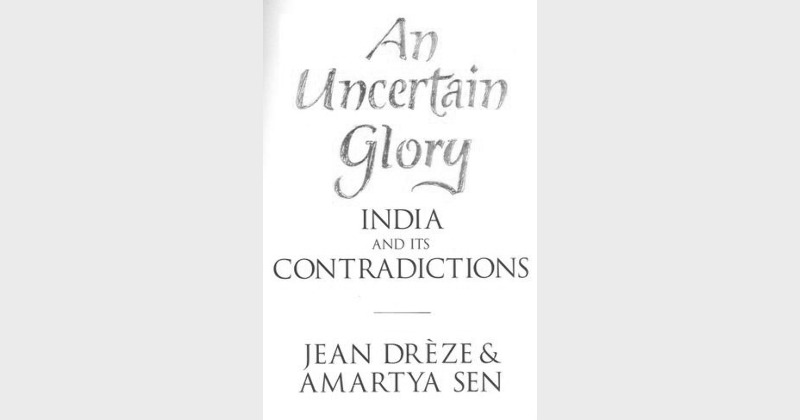
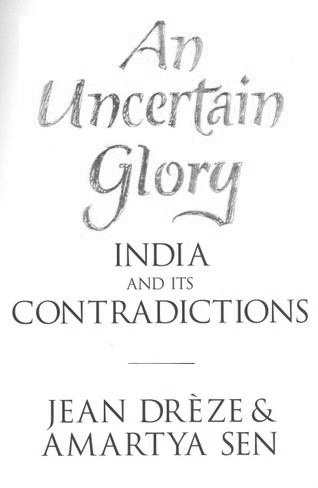
 An Uncertain Glory: India and its contradictions by Jean Dreze & Amartya Sen; Allen Lane, an imprint of Penguin Books, Pp 464; £20
MV Kamath
The first thing that one notices in going through this book, is the total discardance of Gujarat as a progressive State. It is mentioned only in statistical studies and only in matters where Gujarat does not stand at the top of the ranks. This is petty-minded in the extreme and will reflect badly even in a study made by a post-graduate student; fancy how poorly it will reflect on a distinguished professor of Economics not to say of a Nobel Laureate! In such circumstances, can we take the findings of Messers Dreze and Sen seriously?
High praise is given to Kerala, and even to Bangladesh suggesting Sen’s leanings towards the Left and his Bengla origins. It is sad. It does not behove a professional economist. So then, does it mean that we cannot – and should not – take this work seriously? No way. Only, at every step, one must remember that Sen probably have his own axe to grind. That said, one can then proceed to discover this work, which is ably argued and as the authors say whose only desire “is to present suggestions on how to work hard to retain and even expand India’s glory by going more than half way to settle the many contradictions it suffers from.
As the authors sum up their aim, “an overarching theme of the book is the necessity for the lives, needs, rights and demands of the under-privileged people to command greater attention in public discussion and policy-making and in democratic politics.”
The one characteristic of this book is that even when it is provocative, it is not viciously so. The aim apparently – and here remember Gujarat – is not to damn a government, but to praise it when it deserves to be, to point out shortcomings when they are obvious and to suggests ways and means to improve our conditions.
Yes, in the last 66 years we have done some excellent things worthy of praise and the authors acknowledge that willingly as when they acclaim India “as the second fastest-growing large economy over the last two decades.” Indeed, as the authors assert,“the book is contingently optimistic, even though the investigation of what India has so far failed to do has to be an integral part of this forward-looking approach.”
One can praise the authors for the diligent research that they have done, but one suspects selectively. But as things stand every criticism is generalised as when the authors claim that “India’s educational system is tremendously negligent both in coverage and quality” with “the vast majority of Indians hampered by economic disadvantage, caste divisions, class barriers, gender inequalities and social gaps related to ethnicity and community”.
The media comes under strong, and may one say, deserved, criticism. As the point is made “the balance of focus in the media reflects a serious bias that needs critical scrutiny” and the assertion is made for forceful public demand (in the media, obviously) “for much larger allocations to basic public services…and for much more comprehensive programmes of economic equity and social security.”
There are, of course, many areas of social conduct that the authors raise, on which there will be a lot of agreement, such as manifestations of India’s patriarchal form of social and cultural relations and violence against women.
The sheer range of issues discussed by the authors is breathtaking. The authors, for example, in a different context, give credit to India for practising greater pluralism, considering that dozens of political parties, from extreme Left to extreme Right are represented in the Indian Parliament, in contrast to just two parties in the US Congress.
The authors claim that “given the nature of democratic practice in India, change is likely to occur as sequential progress, rather than as an inclusive avalanche.”
(The reviewer is former editor of Illustrated Weekly, Chairman, Prasar Bharati and senior columnist).
Using Chanakya’s tactics to solve India’s problems
Chanakya’s new manifesto: To resolve the crisis within India, Pavan K Verma, Aleph Book Company, Pp 248, Rs 295.00
Naveen Kumar
When there is no personal commitment to rajdharma, state and people while in the power, there is an emergence of an age in which rulers cause corruption and lapse of real sovereignty of the state. It reflects in the poverty, bad economic situation and even social disorder. It is the stage of India now in which Chanakya thought is very relevant and his prescription must be tested to resolve the crisis within India.
So, Pavan K. Verma explores the crisis of governance, democracy, corruption, security and building an inclusive society. The deeply insightful account of the challenges of India including languishing economic reforms, pending decision in FDI and subsidy in LPG, money and muscle power, corruption, requirements of nationwide protests for passing Lokpal Bills and our soft response to externally sponsored terrorism now call for a new guidance like what Chanakya propounded before more than 2000 years.
Chanakya is first Indian Political Scientist who propounded important thoughts in field of economic and political science much before Machiavelli. He authored the ancient Indian political treatise called Arthasastra and managed the first Maurya emperor Chandragupta’s rise to power by his strategic political skill’s.”
The book, Chanakya’s New Manifesto is based on the thinking that nations seeking to fashion a future cannot do so without objectively interrogating the past. The “New” in this book is, Pavan K. Verma takes his own take to explore the solutions of ongoing problems of India. In the perspective of Chanakya’s thinking 2000 years ago, the author has released successfully a new manifesto to resolve the issues of governance, security, corruption, etc. In the matter of security, the author claims, “the core of the problem is that our political leadership completely lacks the unsentimental clarity of Chanakya, who knew that a first-rate intelligence setup is an indispensable necessity for the security of the State.”
After identifying the major crisis under five categories, the author has assessed the condition of India in the chapter, “1947 and After’ in which he identifies the problems in India after 1947 mainly caused by insensitiveness of politicians towards pragmatic policies and strategy which was required in the national interest.
Under the five other separate chapters, on the issues of governance, democracy, corruption, security and building an inclusive society, the book, Chanakya’s New Manifesto suggests the solutions but not prescribing the methods in the fashion of Chanakya’s prescription to the King. However, it has really highlighted some good solutions like adopting Madhya Pradesh Public Service Guarantee Act, 2010 and the Bihar Right to Public Services Act, 2011 at the national level.
Finally, if we feel, our future is at stake, there is way out to the extent in Chanakya’s New Manifesto
(The reviewer Naveen Kumar can be contacted at [email protected])
Book Received
The Law & Burning Problems by VKS Chaudhary (BR), Rs 250, Pp-134 Universal Law Publishing Co. Pvt. Ltd. C-FF-1A, Dilkhush Industrial Estate (near Azadpur Metro Station), GT Karnal Road, Delhi:110033
98 Not Out by Justice VR Krishna Iyer (BR), Rs 350, Pp171, Universal Law Publishing Co. Pvt. Ltd. C-FF-1A, Dilkhush Industrial Estate (near Azadpur Metro Station), GT Karnal Road, Delhi:110 033
Indian Sociology Engagement with Values by Kapila Khemundu (BR) Rs 1250, Pp 424, Kalpaz publication, Gyan Books Pvt. Ltd, 5, Ansari Road, New Delhi-2
Law Relating to Press and Sedition, 2nd Edn., by Roy Rai Bahadur G.K. (Book Review) Rs 1,495.00, Pp 1304, Universal Law Publishing Co. Pvt. Ltd. C-FF-1A, Dilkhush Industrial Estate (near Azadpur Metro Station), G.T. Karnal Road, Delhi:110 033
Surrogacy in India by Anil Malhotra and Ranjit Malhotra (BR) Rs. – 595.00, pages.-196,Universal Law Publishing Co. Pvt. Ltd. C-FF-1A, Dilkhush Industrial Estate (near Azadpur Metro Station), G.T. Karnal Road, Delhi:110 033
The Billionaire’s Apprentice by Anita Raghavan (BR), Rs. 499, pages-512, Hachette Book Publishing India Pvt Ltd, 4th/5th Floors, Corporate Centre; Plot no 94, Sector 44; Gurgaon:122 009
Religion Law & Society Across the Globe by Tahir Mahmood (BR), Pp 529, Rs 895, Universal Law Publishing Co. Pvt. Ltd. C-FF-1A, Dilkhush Industrial Estate (near Azadpur Metro Station), GT Karnal Road, Delhi: 110 033
Community College Movement in India and Abroad by Xavier Alphonse. SJ (BR), Pp 368, Rs 895,Gyan Books Pvt. Ltd, 5, Ansari Road, New Delhi: 2
Ethno-Medicine in India (Vol.2) by Kamal Kant Mishra, Mohammad Rehan, Ravindra K Gupta (BR), Pp 357, Rs 1070,Gyan Books Pvt. Ltd, 5, Ansari Road, New Delhi: 2
Superstar Leadership by Rick Conlow and Doug Watsabaugh (BR) Rs. 200, pages-224 Jaico Publishing House, A-2, Jash Chambers , 7-A, Sir Phirozshah Mehta Road, Fort, Mumbai: 400 001