Dr R Balashankar
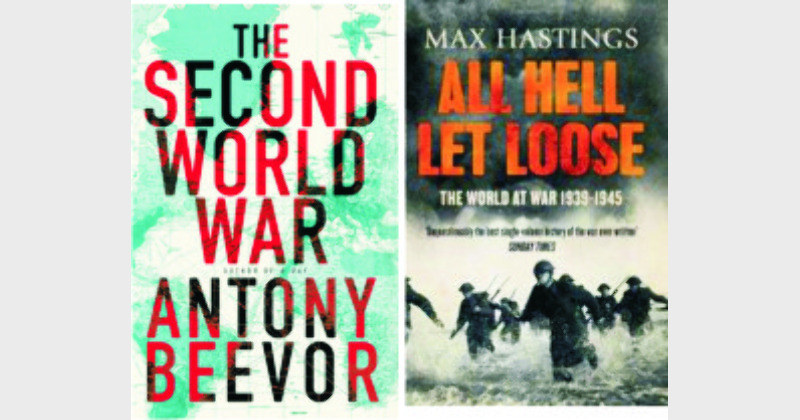
The Second World War, Antony Beevor, Weidenfeld & Nicolson, Orion House, (distributed in India by Hachette India), Pp 863(HB), Rs 1250
All Hell Let Loose – The World at War 1939-45, Max Hastings, Harper Press, an imprint of HarperCollins Publishers, Pp 748(PB), £ 30.00
Two voluminous books on World War II are out, near simultaneously. By all definitions WW II was the most devastating, inhuman and terrible wars. Human beings died worse than bees, families were torn apart and centuries old cities turned power in minutes, It was as though human kindness had ended and everyone wanted to kill everyone else. So much has been written about the war from military, social, human, and political angles. And still it seems so much more is left to be told. While Antony Beevor has put together a colossal amount of work on World War II in his latest book, simply titled The Second World War, Max Hastings has done stupendous work in his ALl Hell Let Loose- The World at War 1939-1945.
Beevor begins with the story of a Korean soldier who changes hands several times between various nations before he finally lands in America. Yang Kyoungjong is among thousands of soldiers who went to war for their nation, were captured by the enemy, put into fight, caught yet again by a third force and the story repeats. So who started the war? There is a continuing argument on this. “Arguments on the subject can go round and round, but the Second World War was clearly an amalgamation of conflicts. Most consisted of nation against nation, yet the international civil war between left and right permeated and even dominated many of them. It is therefore important to look back at some of the circumstances which led to this,the cruellest and most destructive conflict which the world has ever known.”
In a way, this round was beginning to happen ever since the World War I got over. It left Germany and France exhausted, Americans wanted to wash their hands off what they saw “the vicious Old World,” Central Europe was fragmented, humiliated. At the same time, the east was stirring up. Beevor proceeds on the course of war, covering the military maneuovers of each party. Japan was winning territories and Hitler was moving on gobbling up one nation after another. Soon France and Britain got dragged in. Japan gave a stunning defeat to China, to the shock of all. Month by month, year by year, Beevor covers the war, describing the air, land and naval moves of each of the player. “Japan would never have dared to attack the United States if Hitler had not started the war in Europe and the Atlantic. A two-ocean war offered its only chance against the naval power of the United States and the British Empire. It was for this reason that the Japanese sought assurances from Nazi Germany in November 1941 that it would declare war on the United States as soon as they attacked Pearl Harbor,” says Beevor.
The account of the German invasion of Russia is gripping. Repeatedly warned of the attack, Stalin remained unconvinced. “Stalin had already dismissed all warnings from Britain about German preparations to invade Soviet Union as ‘angliiskaya provokatsiya… The most astonishing warning of all came from the German ambassador in Moscow, Graf Friedrich von der Schulengurg, an anti-Nazi who was later executed…” When told of the warning, Stalin exploded in disbelief “Disinformation has now reached ambassadorial level.”
Japan which was in alliance with Germany did not keep it informed well. The attack on Pearl Harbor came, according to Goebbels, (Hitler’s close associate) ‘like a bolt from the blue.’ Decades after the war, some new material keeps emerging even today that adds a new dimension to the war. Beevor’s volume will be watershed in the endless writings.
Max Hastings’s book is no less packed. He says when asked to describe the war, most survivors resorted to the cliche: ‘All hell broke loose.’ “An average of 27,000 perished each day between September 1939 and August 1945 as a consequence of the global conflict.” Hastings has penned eight books on the War. This is his ninth. The chief aim of this book he says is to illuminate the conflict’s significance for a host of ordinary people of many societies, both active and passive participants — though the distinction is often blurred… Almost everyone who participated in the war suffered in some degree: the varied scale and disparate nature of their experiences are themes of this book.”
The German invasion of Russia, the starving of Leningrad make for dramatic presentation in the book. The entire population of the city held on, starving, dying, but not surrendering. A small sample of the scene: Elena Kochina a desperate mother had just received a handful of ration after standing long in the queue. A man snatched the food and put it in his mouth. Elena pounced on him, pinned the weak man down, forced open his mouth and got up and declared that she had retrieved most of the food. The crowd in the queue watched the scene, unmoving. Before the invasion, the German officers who had been taken on a tour of Soviet arms factory reported back to Hitler how the German forces would not succeed. Hitler on the other hand brushed aside the assessment and said this only meant that they had to conquer Russia at all costs. Smaller nations like Poland and Norway fell to the Germans rather easily. “Poland became the only nation occupied by Hitler in which there was no collaboration between the conquerers and conquered. The Nazis henceforth classified Poles as slaves, and received in return implacable hatred.”
India too was indirectly party to the war. It was under the British rule. While a section of the freedom fighters wanted to use this opportunity and align with Japan, another section was against such a move. Subhash Chandra Bose walked out of the Congress to form his own Forward Bloc. India became a large supplier of military support. “It manufactured a million blankets for the British Army – the wool clip of sixty million sheep – together with forty-one million items of military uniform, two million parachutes and sixteen million pairs of boots. It was a source of fury to Churchill that India’s sterling balances – the debt owed by Britain to the subcontinent in payment for good supplied – soared on the strength of this output.” He thought “that it was monstrous to expect that we should not only defend India and then have to clear out, but be left to pay hundreds of millions for the privilege.”
There is a beautiful quote from Goethe, which Hastings uses to summarise the war. He wrote in the early nineteenth century: ‘Our modern wars make many unhappy while they last and none happy when they are over.’ The war ended abruptly. “For the most part, the conquerors and the conquered shared an over-powering relief that history’s greatest bloodletting was ended.” At least sixty million people had died in the war. Says Hastings in conclusion, “Allied victory did not bring universal peace prosperity, justice or freedom; it brought merely a portion of those things to some fraction of those who had taken part.”
Hastings, a journalist, historian and author has put together the skill of all three and produced a volume that is highly readable, even if World War II is not the hottest of subjects today. Interspersed with photographs and maps, the book goes beyond the guns and manoeuvers and reaches the people, the individuals who were participants, spectators and victims of the War.
Antony Beevor, an author of immense repute has gone into the assault part of the war, involving men who decided the fate of others and strategies that shaped the next move in the war. Which nation got involved when and why and how each move changed the game in a manner not perhaps anticipated – that is the forte of Beevor. Precious rare archival photos have been included in the thick volume running over eight hundred pages. Both the books are documents on World War, in capsule form. Beevor’s book has won acclaim from Hastings.
(Weidenfeld & Nicolson, Orion House, 5 Upper Saint Martin’s Lane, London WC2H 9EA, (distributed in India by Hachette India)
(Harper Press, an imprint of HarperCollins Publishers, 77-85 Fulham Palace Road, Hammersmith, London W6 8JB)