“Swaraj is my birth right and I shall have it.”
Life of Lokmanya Tilak shows the way
V Shanmuganathan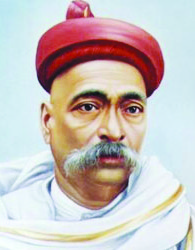
Bal Gangadhar Tilak, from his younger days was actively involved in various public works. He used to say, that the religion and practical life are not different. To take sanyasa is not to abandon life. The real spirit is to make the country as your family and work together instead of working only for your own.
Bal Gangadhar Tilak was born on July 23, 1856 in Ratnagiri, Maharashtra. His father Gangadhar Ramachandra Tilak was a Sanskrit scholar and a famous teacher. Tilak was a brilliant student and he was very good in mathematics. Since childhood Tilak had an intolerant attitude towards injustice and he was truthful and straightforward in nature. He was among India’s first generation of youth to receive a modern, college education.
The sanskars given by his mother, moulded him as a patriot. His actions were led by the cause of the nation. He was a man of ideological conviction. Once he said, I regard India as my motherland and Goddess, the people in India, are my kith and kin, and loyal and steadfast work for their political and social emancipation is my highest religion and duty.
Nation centric education
These thoughts and ideas were shaping his life. He dedicated himself for the freedom of the country. After graduating, Tilak began teaching mathematics in a private school in Pune. He felt strongly that western education disrespected India’s heritage and demeaned the Indian students. Thus he organised the Deccan Education Society with a few of his college friends, including Gopal Agarkar and Vishnu Shastri Chiplunkar. Their goal was to improve the quality of education for India’s youth. The Deccan Education Society was set-up to create nationalist ideas with an emphasis on Indian culture.
Tilak joined the Indian National Congress in 1890, but he was opposed to its moderate attitude towards the fight for self-government.
Newspapers for mass level awakening
The very next year, after the Deccan Education Society was founded, Tilak started two weeklies, Kesari in Marathi language and Mahratha in English. Soon both the newspapers became very popular. In his newspapers, Tilak highlighted the plight of Indians. He gave a vivid picture of the peoples sufferings and of actual happenings. Tilak called upon every Indian to fight for his rights. Bal Gangadhar Tilak used fiery language to arouse the sleeping Indians.
Tilak’s Kesari and Mahratha weeklies played an important role in the national awakening, imbibing patriotic thoughts and being drawn as an active force into a great social, political and cultural movement in India. Both, the newspapers continuously worked to spread the education and the general awareness of national pride and socio-political consciousness among the different sections of the people. A unique feature of the paper was that it was used as a powerful vehicle for mass communication. The newspapers motivated people to raise themselves from the slavish attitude and bondage of alien rule. The weeklies prepared them for a mass level awakening against the atrocities and inhuman cruelties of the British rule.
First mass movement
Tilak was one of the first and strongest advocates of SWARAJ (Self-Rule). He brought the basic Indian consciousness of freedom and Independence to the forefront. His famous quote, “Swaraj, is my birth right and I shall have it” is well remembered in India even today. A plague epidemic spread from Mumbai to Pune in late 1896, and by January 1897, it reached epidemic proportions. Tilak took-up the people’s cause by publishing serious articles in his paper Kesari quoting the Hindu scripture and the Bhagavad Gita. Tilak was charged with incitement and sentenced to 18 months of imprisonment. When he came out from prison, he was revered as a martyr and a national hero. He thundered the slogan, “Swaraj is my birth right and I shall have it” and it was well reverberated by the people with great passion.
One after another Tilak began mass movements for India’s Independence with an emphasis on a socio, religious and cultural revival. Tilak transformed household worshipping of Ganesha into Sarvajanik Ganeshotsav. He also made anniversary celebrations of Chhatrapati Shivaji Maharaj as a social festival. Tilak travelled from village to village trying to mobilise the support of villagers, farmers, students and labourers and motivated them to join struggle for Independence.
Following the partition of Bengal in 1905, which was a strategy set out by Lord Curzon to weaken the nationalist movement, Tilak encouraged the Swadeshi movement. The Swadeshi movement consisted of the usage of goods produced by oneself or in India. Once foreign goods were boycotted, there was a gap which had to be filled by the production of those goods in India itself. Tilak, therefore, rightly said that the ‘Swadeshi’ and ‘Boycott’ movements are two sides of the same coin. Tilak energised Swadeshi movement, through newspaper articles and public lecture programmes. Tilak spread the message of Swadesh and Boycott to each and every village in Maharashtra. A big Swadeshi Market was also opened. The Swadeshi movement influenced the people for usage of goods produced in India. It gave a call to stand on their own legs and reject foreign goods and foreigners rule in India. The Swadeshi movement was the first mass movement in the history of Indian Nationalism.
Dynamic energy
On April 30, 1908 two Bengali youths, Prafulla Chaki and Khudiram Bose, threw a bomb on a carriage at Muzzafarpur. Tilak, in his paper Kesari, defended the revolutionaries and called for immediate Swaraj or self-rule. The Government swiftly arrested him for sedition. Then Tilak was sent to Mandalay, Burma from 1908 to 1914. While imprisoned, he continued to read and write, further developing his ideas on the Indian Nationalist Movement. While in the prison he wrote the most famous Gita Rahasya. Lots of copies of which were sold, and the money was donated for the cause of freedom struggle. While fighting for people’s cause, Bal Gangadhar Tilak died on August 1, 1920.
Tilak was the personification of the national endeavour. He had the closeness with the spirit of the masses. He had always been able to unite all classes of men behind him, to be the leader not only of the educated, but of the people, the merchant, the villagers, the farmers, labourers, women young and old. His bravery, his simplicity, his wonderful industry and his love for the country made him Lokmanya of India i.e., beloved of the people. In fact, he laid the foundation of the freedom struggle and brought out the mass consciousness, political consciousness, dynamic energy to the entire movement. He was a tremendously dynamic person.
Galvanise the masses
In the present cirucumstances, Lokmanya Bal Gangadhar Tilak’s life is the right model to emulate and follow. The present UPA-II has lost all the moral and ethical credibility. There is wide spread discontentment about the corruption, price rise, agricultural and industrial stagnation, farmers suicides, economic mismanagement, rupee devaluation and lack of decision making leading to policy paralysis. If we want to save the people from suffering, this Central Government led by UPA-II must be voted out by galvanising the masses like Lokmanya Tilak did.