“Vaishnava Jana To Tene Kahiye Re, Peed Parai Jaane Re” — one who truly deserves to be called a noble human being is one who understands the pain of others. To feel the suffering of others and, in that feeling, naturally act to relieve them from it: this has been called Dharma.
King Rantideva’s celebrated prayer expresses this ideal beautifully: “I seek neither a kingdom, nor heaven, nor even emancipation(Moksha). My only wish is that those scorched by suffering and burdened by pain may find relief.” (Kāmaye duḥkha-taptānāṁ prāṇinām ārti-nāśanam.)
It was this understanding of Dharma that was carried into the nation’s institutions after Independence by the architects of Bharat and the framers of her Constitution. Above the Speaker’s seat in the Lok Sabha is inscribed “Dharma Chakra Pravartanaya” (For the propagation of the Wheel of Dharma). In the Rajya Sabha, “Satyam Vada, Dharmam Chara” (Speak the truth, practise Dharma) is inscribed. The motto of the Supreme Court reads, “Yato Dharmastato Jayah” (Where there is Dharma, there is victory). The wheel at the centre of Bharat’s national flag, the Ashoka Chakra, is also associated with the Dharma Chakra.
In the Bharatiya understanding, “Rashtra” does not mean what “nation-state” means in the West. Here, the nation is understood as society itself. Dr S Radhakrishnan described this spiritual, integral and holistic Bharatiya view of life as the “Hindu View of Life”. To live by Dharma on this foundation is itself an expression of Hindutva.
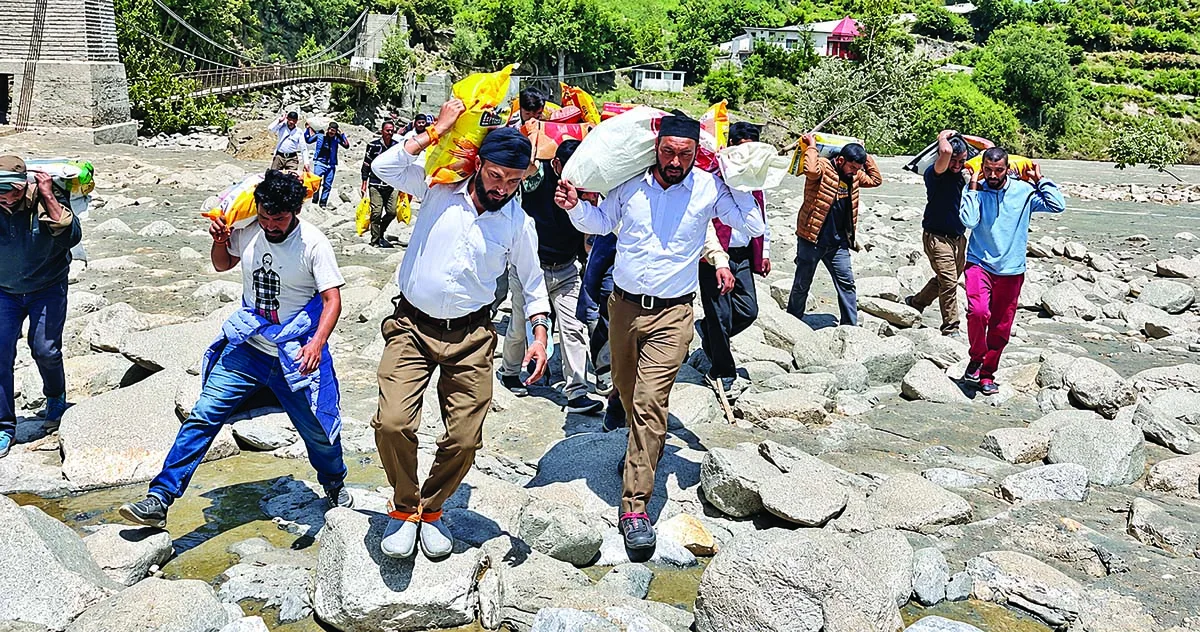
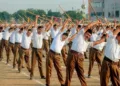
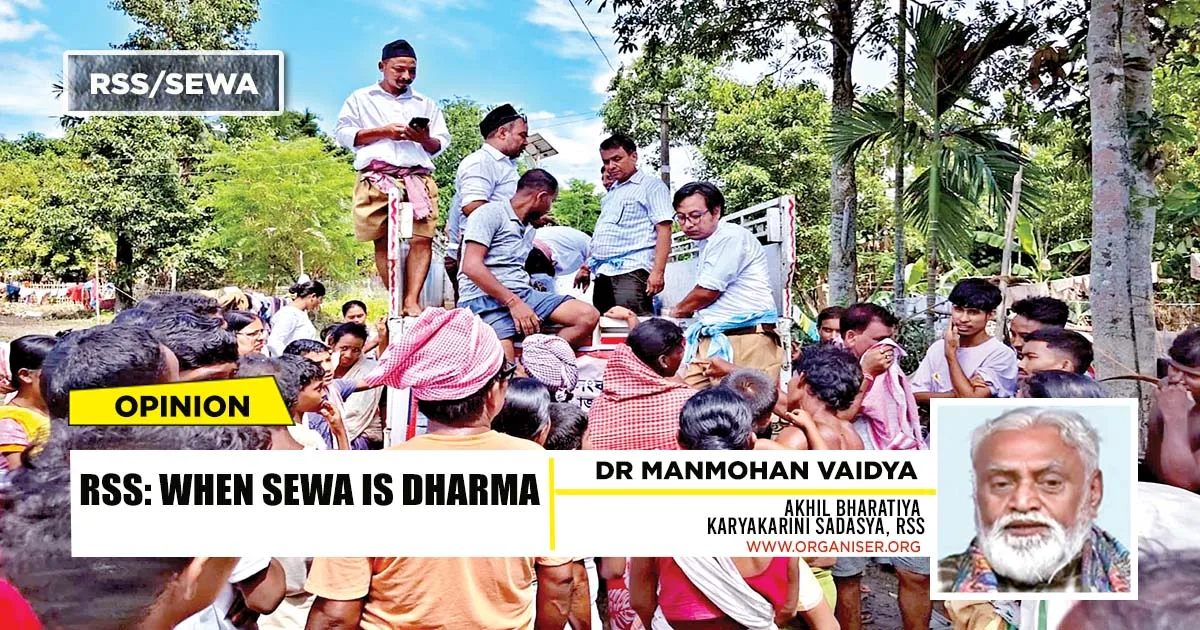
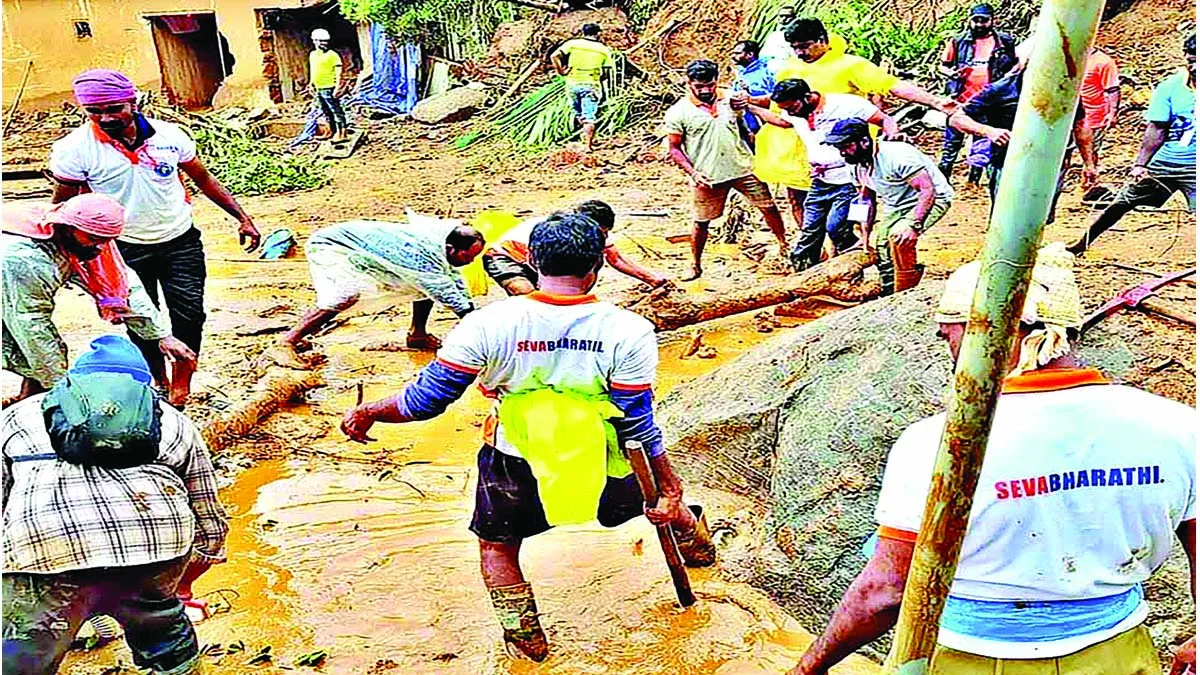
The society that lives across the whole of Bharat is one; we are all equal, and all belong to one another. This understanding and this formation are what a Swayamsevak absorbs through the activities of the shakha and by living alongside fellow karyakartas from across the country. Society has witnessed, again and again, the tireless and heartfelt service rendered by Swayamsevaks in times of human and natural calamity — whether during the horrors of Partition, earthquakes, floods or a pandemic such as Covid–19. Even those who oppose the Sangh’s philosophy have been moved by the patriotism, discipline, dedication and service of its Swayamsevaks and have not withheld their praise.
When Sewa Becomes Dharma
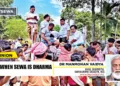
In 1977, a devastating cyclone struck the Diviseema coast of Andhra Pradesh, causing enormous destruction. The alacrity and courage with which Swayamsevaks undertook relief work at the time, including cremating decomposing and foul-smelling bodies — such Swayamsevaks came to be called the Shava Sena, or corpse brigade — are still remembered. When the fully destroyed village of Mulapalem was rebuilt with permanent housing for every family and renamed Deendayalpuram, External Affairs Minister Atal Bihari Vajpayee and the Chief Minister of Andhra Pradesh, Dr Chenna Reddy, attended the inauguration. Both spoke highly of the Sangh’s relief work. It was on that occasion that the well-known Gandhian thinker Prabhakar Rao offered a new interpretation of the acronym “RSS”. He remarked that RSS truly stood for “Ready for Selfless Service”.
In May 2009, Cyclone Aila struck West Bengal, causing severe damage in the 24 Parganas district. Swayamsevaks were in the field almost immediately. I happened to travel there shortly afterwards for a Sangh training camp, and to see the relief work, I had to go first by jeep, then by boat and finally on foot through knee-deep mud to reach the worksite. When I asked who else was carrying out relief work in the area, I was told that every other organisation engaged in relief work was confined to the main roads; in the interior, where the destruction
was worst, only Sangh Swayamsevaks were present.
In 2013, when a cloudburst caused sudden and catastrophic flooding at Kedarnath, Swayamsevaks across the country were collecting funds from the public to help the victims. Around that time, I received an email from M D Ramteke of Vidarbha, who wrote: “I am a staunch opponent of the RSS. I am a staunch Ambedkarite, and I believe Dr Ambedkar was an incarnation of the Tathagat Buddha. But I can say from my own experience that RSS people carry out relief work with great integrity. If you give them Rs hundred for the work, they will add ten of their own and spend a hundred and ten. So my appeal is this: if Sangh Swayamsevaks come to you asking for relief funds at this time, help them generously.”
It is from the shakha that a Swayamsevak absorbs this instinct for selfless, heartfelt service. Swayamsevaks have continued to carry out relief and rehabilitation work in the wake of natural and man-made disasters alike. Driven by political hostility, the Congress Government imposed the unjust, unlawful and undemocratic bans on it twice, first in 1948 and again in 1975, and made every effort to suppress the organisation. Yet, through democratic resistance and steadfast struggle, the Sangh emerged each time with renewed strength, and its work resumed with even greater vigour.
During the birth centenary of the Sangh’s founder, Dr Keshav Baliram Hedgewar, in 1989-90, the idea emerged to develop a Sewa vertical so that the Sangh could establish regular contact with economically disadvantaged and deprived sections of society living in slums and undertake service activities to address their basic needs. Accordingly, the Sewa Department was evolved within the Sangh in 1991. Today, through numerous service organisations, Swayamsevaks are carrying out 167,113 service projects in the fields of education, healthcare, social security and economic self-reliance.
Swayamsevaks have been able to do this, and continue to do it, because their philosophical foundation rests on Hindutva. Hindutva is not a “religion”; it is a spiritual, integral and holistic view of life. It is on this basis of aatmiyata, a felt sense of belonging, that Swayamsevaks undertake this work of service without expecting anything in return.
Some compare this with missionary “service” work. However, missionary service is often undertaken for the sake of conversion. This particular idea of “service” is not originally Bharatiya; it gained currency because of the service activities Christian missionaries carried out as a means to conversion, where service itself was often secondary and conversion the real objective, and where conversion was not a realistic prospect, no service was offered. One example makes this distinction clear.
There is a village called Ukhrul near the Myanmar border in Manipur, where the entire population had become Christian and where, as a result, there was no school or adequate arrangement for education. When an RSS pracharak, Shankar (Bhaiyaji) Kane, went there in 1971, he saw that the children had no means of schooling and grew concerned about their future. He began taking some of the children to Maharashtra to be educated. But sending a child from Manipur to Maharashtra in the care of a stranger was not easy for parents to agree to. So Bhaiyaji left behind, in Ukhrul itself, a 12-year-old boy who had travelled with him from Maharashtra, as a token of trust. Confidence grew gradually. Each year, a few more children began coming to Maharashtra to study, and it changed the course of their lives.
Every child who came to study was Christian. Bhaiyaji made no attempt to convert them to Hindu Dharma; they remained Christian. Once educated, these children returned to Ukhrul, began to earn well and, inspired by Bhaiyaji, established a school there so that children could study without having to leave home. While nearby schools were named simply “School” or “High School”, the one founded at Bhaiyaji’s inspiration was named Ojha Shankar Vidyalaya. In the local dialect, “Ojha” is the respectful term for an elder of the community.
From Aatmiyata to Social Capital
Before the word Sewa came into use in this sense, all such acts in Bharat were understood, and are still understood, as belonging to the category of Dharma. Here, Dharma does not mean religion; what English calls “religion” is closer to what we would call Upasana, or worship.
In the Bharatiya outlook on life, which is rooted in spirituality, Dharma is integral and holistic, holding the entire creation to be spiritually interconnected. This is why the practice of Vasudhaiva Kutumbakam, the world as one family, has been part of Bharatiya life since ancient times. When the sense of “I” is diminished and the eyes are opened, the circle of “we” naturally widens; those who were not one’s own begin to feel like one’s own. And from that felt sense of belonging (Aatmiyata) arises the impulse to do something for them. To give out of a sense of belonging to society, to return something to society — this is true Dharma.
Sister Nivedita, the Irish-born disciple of Swami Vivekananda, observed that a society in which people do not keep the fruits of their labour entirely to themselves, but give back to society, grows rich through this accumulated wealth — a form of social capital. As society becomes prosperous, the standard of living of its members also improves. This is Dharma. Dharma does not discriminate. It connects, binds and holds all together. Every act of enriching this social capital is Dharma. Preserving and strengthening this social capital is Dharma.
Religion is not Dharma; it is Upasana. The practice of Upasana helps diminish or minimise the “I” and widen the “we”, and in that way aids the practice of Dharma, but Upasana itself is not Dharma.
Bharatiya thought gives equal importance to the pursuit of material prosperity (abhyudaya) and liberation (nihshreyas). This is why Dharma has been defined as “Yato’bhyudaya Nihshreyasa Siddhih Sa Dharmah” — that which leads to both. Abundance in production, equity in distribution and restraint in consumption have been held up as guiding principles of conduct. To offer, out of a felt sense of belonging, the surplus left over from restrained consumption for the good of society — this is Dharma, and it is what builds social capital. Rabindranath Tagore put it memorably: to give to society is charity; to give back to society is Dharma.
Dharma in Everyday Life
Bharat has followed this tradition for centuries. A resting place built for pilgrims is called a Dharmashala. A Dharmadaya dispensary offers medical care to all, without distinction or discrimination. In earlier times, building roads, planting trees for shade, digging wells or step-wells for water, and building ghats on rivers at places of pilgrimage were all regarded as acts of Dharma.
During the Second World War, when Poland was invaded, and around 1,000 Polish women and children fled for their lives aboard a ship, country after country refused them asylum. Even in Mumbai, under British rule, they were denied permission to land, although they were Christian. When word of this reached the Maharaja of Nawanagar (now Jamnagar, Gujarat), Jam Saheb Digvijaysinhji Ranjitsinhji, he appealed to the British administration to let them come ashore in Mumbai, offering to bring them all into his own state. The British still refused. In the end, the Maharaja had them brought by sea directly to Jamnagar, arranged accommodation for all of them at nearby Balachadi, and even brought in seven cooks from Goa to prepare their food (not asking them to give up their own dietary habits or impose vegetarianism on them). To keep the British administration from interfering further, the Maharaja signed their adoption papers, treating every woman as his daughter and every boy as his son, and told them, “You are my sons and my daughters; stay here as long as you wish.” They remained in Jamnagar for nearly nine years before returning to Poland after the war. In gratitude to the Maharaja of Jamnagar, a square in the Polish capital was later named the “Good Maharaja Square.”
On the night of November 12, 1996, near Charkhi Dadri in Haryana, a Saudi Arabian and a Kazakh airliner collided in mid-air and crashed. Up to 351 people aboard the two aircraft were killed. Almost all among them were Muslims and some Christians. Within moments of the crash, the district Sanghchalak, Jitram ji, along with other Swayamsevaks and doctors from Dr Hedgewar Hospital, reached the site. Working in darkness, they arranged petromax lamps and generators and moved the bodies without delay to the hospital at Bhiwani. As news spread, the families of the victims, police and journalists began arriving by morning, and the bodies were handed over to their families. Where no family could be traced, the bodies of Muslim and Christian victims were given burial according to their respective faiths and rites, with the cooperation of local religious leaders and others who had arrived to assist. Three days later, on November 15, at a thanksgiving gathering held at the mosque in Dadri, district Sanghchalak Jitram ji was honoured. Most newspapers reportedly carried the headline: “Khaki Shorts and Saffron Scarf Honoured in the Mosque.”
In the Bharatiya outlook on life, which is rooted in spirituality, Dharma is integral and holistic, holding the entire creation to be spiritually interconnected. This is why the practice of Vasudhaiva Kutumbakam has been part of Bharatiya life since ancient times
This too was an expression of Dharma through the Swayamsevaks. The Maharaja of Jamnagar’s act sprang from pure Dharma. So did Bhaiyaji Kane’s initiative to educate children in Manipur. In each case, it was their spiritual grounding that enabled them to connect naturally with others, understand their suffering and act, without distinction of any kind, to relieve it wherever possible. This is true Dharma.
We may sum it up thus: the Sangh’s endeavour is that the individual should become Dharmapravan (inclined towards Dharma) and that society should remain Dharmadhishthit (founded on Dharma), rather than “Dharma-Nirapeksha” (secular) in the sense of being indifferent to it. To build such a society is what it means, in the Sangh’s understanding, for the nation (Rashtra) to become Hindu. When it comes to service, Bharat’s tradition has always been to perform it as Dharma. Swami Vivekananda expressed this as serving Jeeva in the spirit of Shiva (Shiva bhave Jeeva sewa): to serve man is to worship God. (Views are personal)