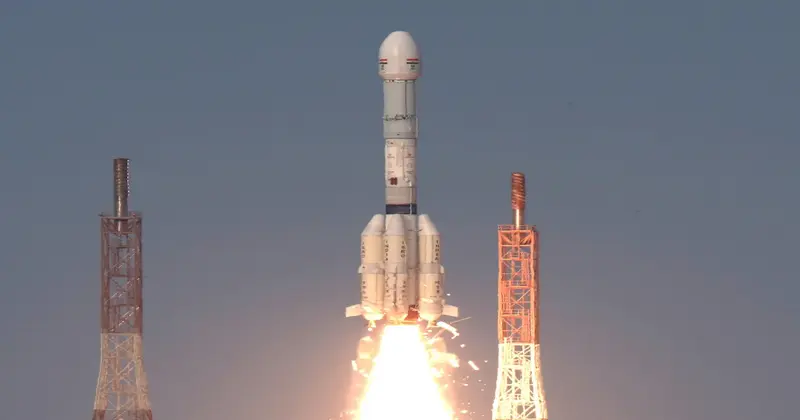
Bengaluru/Sriharikota: At 2:55AM on September 4, Friday, a 51.7-metre-tall GSLV-F17 launch vehicle thundered into the skies carrying a satellite that will significantly change the way India watches & keep vigilance over its own territory and the surrounding region.
Nineteen minutes later, the mission had achieved its crucial objective. The 2,367-kg Earth Observation Satellite(EOS-05) was successfully injected into a sub-geosynchronous transfer orbit, marking a major comeback for the Indian Space Research Organisation(ISRO) and opening of a new chapter in India’s Earth-observation capabilities.
The launch was not merely another entry in ISRO’s growing list of successful missions. It was a symbol of India’s growing space ambitions and state-of-the-art capabilities. It isa vindication of India’s long journey & mission to master cryogenic propulsion. EOS-05 is designed to become India’s first dedicated imaging satellite operating fromthe geosynchronous orbit, offering something conventional Earth-observation satellites cannot easily provide.
Mission Success!
GSLV-F17 has successfully accomplished its mission, placing EOS-05 into the intended orbit.
Sharing a few memorable moments from the lift-off.
For more information:https://t.co/VneB2jgZoY#GSLVF17 #EOS05 #ISRO pic.twitter.com/kv0zB6V5Vi
— ISRO (@isro) September 3, 2026
EOS-05 gives India a new perspective of earth from a vantage point, for prolonged duration
Most Earth-observation satellites operate in low Earth orbit, hundreds of kilometres above the planet. They can deliver highly detailed imagery, but because they constantly circle the Earth, they see a particular location only when they pass overhead. However, EOS-05 changes this equation.
As EOS-05 is launched into a sub-geosynchronous transfer orbit, the satellite will use its own propulsion system to reach its operational orbit at roughly 36,000 km above Earth. From this vantage point, its orbital period will match Earth’s rotation, allowing it to remain focused on the same broad geographical region.
The distinction is important. Conventional satellites provide snapshots. EOS-05 is designed to provide something closer and continous. Its ability to repeatedly observe large areas could prove valuable in tracking cyclones, thunderstorms, cloudbursts, floods, forest fires and rapidly changing environmental conditions. Agriculture, forestry, water-resource management and disaster response could also benefit from frequent observations.
The satellite’s imaging systems cover visible, infrared, multispectral and hyperspectral bands, allowing scientists to extract different kinds of information about land, water, vegetation and atmospheric conditions. This makes EOS-05 less about simply taking pictures of India and more about creating a continuous stream of strategic Earth data.
ISRO Chairman V Narayanan said that EOS-05 has an assured lifetime of seven years, while expressing confidence that it could remain operational for more than nine years.
ISROs ‘Naughty Boy’ turns into a ‘Smart Boy’
The rocket carrying EOS-05 has its own dramatic history. The GSLV Mk II Launch Vehicle has often been described as ISRO’s “Naughty Boy” because of its turbulent record. Out of its 19 missions, six have ended in failure. Yet the same vehicle has become central to India’s ability to place heavier payloads into high orbits.
Friday’s launch was particularly important because EOS-05 is the heaviest satellite ever launched by a GSLV, weighing 2,367 kg. The GSLV-F17, with a lift-off mass of about 420.5 tonnes, also demonstrated better-than-expected performance. The predicted injection altitude was around 29,934 km, while the mission achieved approximately 31,000 km.
The numbers matter, but the trajectory of the technology matters even more. India’s GSLV has evolved from carrying a 1,536-kg payload on its first flight to successfully deploying a satellite weighing more than 2.3 tonnes.
Six year-old dream finally takes flight
The significance of EOS-05 cannot be understood without revisiting the failed GISAT-1 mission. India’s original attempt to place an imaging satellite in geostationary orbit dates back to 2020. The mission was delayed before finally launching as GSLV-F10/EOS-03 on August 12, 2021.
The first two stages performed normally. The mission, however, ended in failure when the cryogenic upper stage failed to ignite because of a technical anomaly. That failure was particularly painful because GISAT-1 was intended to provide near-continuous observation from a high orbit. EOS-05 is effectively the realisation of that unfinished ambition.
This time, the GSLV’s cryogenic upper stage worked, the satellite reached its intended transfer orbit and India finally demonstrated that it could execute a mission that had previously eluded it.
India’s incredible mastery over indigenous cryogenic engines
When India began pursuing cryogenic propulsion in the 1990s, access to this technology was tightly controlled internationally. India initially sought assistance from Russia, but geopolitical pressure and technology-denial regimes complicated the transfer of complete cryogenic technology. What followed was a long and difficult indigenous development programme.
Cryogenic engines are among the most technically demanding propulsion systems because they operate using super-cooled liquid hydrogen and liquid oxygen. Developing them requires mastery over complex systems involving extremely low temperatures, turbopumps, combustion and precision engineering.
India spent years learning through failures and incremental successes. The result is visible today in the GSLV Mk II. Every successful GSLV flight therefore carries a significance beyond its payload. It represents the country’s ability to develop and operate critical space technology without remaining dependent on external suppliers.
EOS-05: An eye in the sky
EOS-05 has been described by scientists as an “eye in the sky” and its strategic value is undeniable. Its persistent observation capability can strengthen India’s awareness of its land borders, surrounding oceans and areas of strategic interest. Senior representatives of the Indian Navy and Indian Air Force were present at Sriharikota for the launch, underlining the broader importance of advanced Earth observation.
But ISRO has stressed that the satellite should not simply be labelled a spy satellite. Narayanan has described EOS-05 as a platform for continuously scanning India and generating strategic data for national activities. That distinction is important because modern Earth observation is inherently dual-use.
The same satellite that can monitor the evolution of a cyclone can provide maritime awareness. The same imagery that can help track floods can also provide information useful for national security. The same ability to monitor changes in terrain can support agriculture, environmental management and strategic planning.