-By Manoranjana Gupta, New York
New York: The Rashtriya Swayamsevak Sangh (RSS) can be questioned, challenged and scrutinised. Dr Mohan Bhagwat’s ideas can be debated as vigorously in America as they are in India. But when scrutiny of an organisation begins determining which American citizens are acceptable political participants, the argument changes.
America has long claimed pluralism not as agreement, but as the ability of profoundly different beliefs and identities to coexist within the same democratic space. If an ‘RSS-linked’ label becomes sufficient to politically disqualify an American donor without a clearly established organisational, financial or legal connection, the issue is no longer merely what Americans think about the RSS. It becomes a question about America itself: when does legitimate scrutiny begin to resemble cancel culture and can that sit comfortably with American pluralism?
That question has become more urgent since Dr Bhagwat’s August 29 appearance at Madison Square Garden. The demonstrations are over and his address on universal oneness has been delivered, but the debate around the RSS in America has only accelerated.
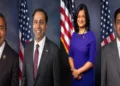
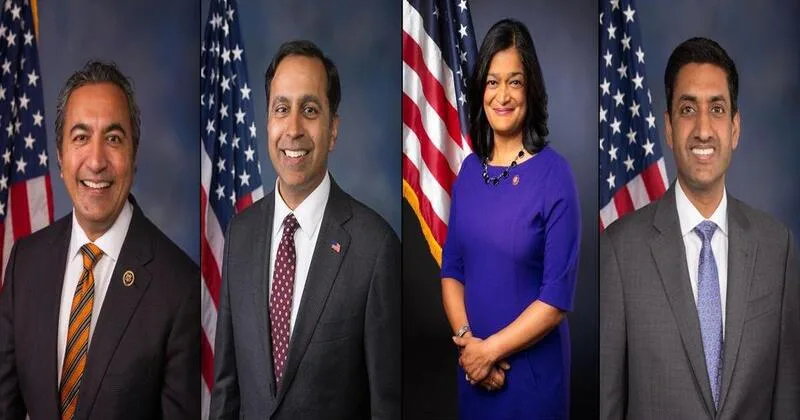
Nearly 90 US elected officials and candidates have been reported as backing a pledge to reject campaign contributions they regard as linked to the RSS or its affiliates. Prominent names associated with the pledge include Ro Khanna, Pramila Jayapal, Brad Lander and Abdul El-Sayed. Hindu-American organisations have responded by arguing that the campaign risks singling out Hindu donors and subjecting them to a political loyalty test.
What began around one New York event has therefore moved beyond Madison Square Garden and into the machinery of American electoral politics.
The most visible new escalation came on September 2, when Democracy Now devoted a substantial broadcast segment to Dr Bhagwat’s Madison Square Garden visit, the anti-RSS protest and the campaign-finance pledge. The programme brought New York congressional nominee Brad Lander and Hindus for Human Rights Action co-founder Sunita Viswanath into a national broadcast discussion about the RSS, Hindutva, political funding and American democracy.
Lander repeated the striking comparison he had made before the event, invoking the infamous 1939 Nazi rally at Madison Square Garden and characterising Dr Bhagwat as advancing a similar ‘fascist ideology’. That is Lander’s political characterisation, not an established equivalence. Its appearance on a substantial US broadcast platform nevertheless shows how far the debate has travelled from the sidewalks outside MSG.
The programme also introduced a potentially important campaign-finance claim. Democracy Now said it had information from an upcoming report alleging that the top 50 Hindu-nationalist donors contributed about $17 million over the last six US election cycles.
The underlying report, donor list and methodology were not publicly available for independent examination at the time of writing. The figure must therefore remain a claim pending documentation. If the report is published with names, definitions and a transparent explanation of how somebody is classified as a ‘Hindu nationalist’ or ‘RSS-linked’ donor, it could materially change the debate. For the first time, the donor question would have a substantial numerical claim attached to it. But the usefulness of that number will depend heavily upon the definition behind it.
Who gets to define an “RSS-linked American”?
At first glance, the campaign-finance issue appears straightforward. US candidates routinely decide whose money they will and will not accept. A candidate who considers an organisation objectionable is entirely free to refuse contributions from people associated with it.
Foreign interference in US elections is also a legitimate and serious concern. Any evidence that an overseas organisation is illegally directing money into American campaigns should be investigated under US law. The problem arises when unlawful foreign influence and lawful political association by American citizens begin to be treated as though they are the same thing.
An American citizen of Indian origin is not foreign money. Nor does an American become a foreign political actor simply because he or she admires Narendra Modi, supports Hindutva, attends an event addressed by Dr Bhagwat, donates to a Hindu organisation, knows people associated with the RSS or disagrees with the ideological assessment of Hindus for Human Rights.
Where there is evidence of organisational control, financial direction or unlawful coordination, it should be produced and investigated. But sympathy for an idea, cultural association and institutional control are very different things. Treating them interchangeably can turn legitimate scrutiny into something much wider: suspicion based upon association.
That is why the phrase ‘RSS-linked’ deserves particular attention. It sounds precise, but how precisely is it being used?
Does it mean formal membership of the RSS? Does it include association with the Hindu Swayamsevak Sangh in America? What about an American temple whose trustees have hosted a Sangh functionary? A businessman who attended an RSS-related programme? A donor to a Hindu charity later mapped by an activist database? A BJP supporter? A believer in Hindutva? Or somebody with no organisational position at all whose name appears in a network chart because of social or philanthropic association?
These distinctions matter because the moment a description carries political consequences, those deciding who fits that description acquire considerable power. The September 2 Democracy Now discussion brought this problem sharply into focus. Viswanath said the pledge organisers rely on research including the Sciences Po ‘Seeing the Sangh’ database, which she said has identified 113 RSS-affiliated organisations operating in the United States.
Such research deserves serious consideration and may contain significant evidence. But if research of this kind is going to be used as a basis for screening American political donors, the definitions and evidentiary standards behind the classifications need scrutiny too. Mapping an ideological or organisational network for academic or advocacy purposes is one exercise. Deciding, on the strength of that map, which American citizens are acceptable political donors is a much more consequential one.
The counter-argument from Hindu America
This is where the response from Hindu-American organisations becomes important.
The Hindu American Political Action Committee (HAPAC), describing itself as an independent non-partisan federal PAC for Hindu Americans, has called the pledge discriminatory and argued that it singles out Hindu-American donors for a test not applied to other citizens. It has alleged that some signatories were misled or pressured and has warned against placing American Hindus under a burden of proving that they are fit to participate in politics.
Suhag Shukla of the Hindu American Foundation has similarly described the approach as ‘un-American’, arguing that it can presume a form of dual loyalty to a foreign entity. Those are serious counterclaims. They should be judged on evidence, in exactly the same spirit in which allegations about RSS-linked political networks should be judged on evidence.
There is, however, another side to the argument which cannot simply be brushed aside. Organisations promoting the pledge say they are defending pluralism, multifaith democracy and human rights against what they regard as a supremacist political ideology. Some of the campaign’s most visible advocates identify themselves as Hindu and explicitly say that they are contesting Hindutva from within Hindu America.
They have every right to organise, persuade candidates and investigate financial or institutional relationships they consider politically important. The question is not whether they have that right. Of course they do. The question is what standard should be used when criticism of an ideology begins affecting the political acceptability of individual citizens.
America has accommodated extraordinary ideological disagreement throughout its history. Some ideas deserve fierce moral opposition and some organisations deserve investigation. Individuals, too, may make choices that candidates and voters find unacceptable. But a pluralist democracy still has to distinguish political advocacy from unlawful conduct and personal association from actual agency. Otherwise, cancel culture can cease to be merely a phrase describing social ostracism and become something more politically consequential.
Lander’s 1939 analogy matters for precisely this reason.
Comparing Dr Bhagwat’s appearance at Madison Square Garden with the Nazi rally held there in 1939 dramatically raises the moral stakes. If that historical analogy is accepted, refusing money from anyone meaningfully connected to the RSS can be portrayed as an obvious democratic duty. If the analogy is regarded as historically excessive or politically inflammatory, however, a broadly applied donor pledge can look quite different.
That is why evidence, proportion and precise definitions become indispensable.
What Dr Bhagwat actually said in New York!
There is another element that belongs in this debate: what Dr Bhagwat actually said in New York.
His critics are under no obligation to accept his description of the RSS, nor should one speech be treated as the final word on a century of organisational history. The Sangh, particularly as it enters its second century and seeks greater international visibility, should expect examination of its ideas, finances, structures and relationships.
But serious scrutiny also requires an accurate account of the message its chief chose to deliver to an American audience.
Dr Bhagwat spoke of diversity as natural and unity as a deeper truth. He argued that oneness did not require sameness. Most significantly in the context of the present debate, he told Indian Americans that America was their Karma Bhumi and that their first responsibility was to the country in which they live, work and prosper.
It was an important formulation because he was making a distinction between civilisational inheritance and civic allegiance. Bharat could remain Janmabhumi — a source of memory, culture and belonging — while America, as Karma Bhumi, commanded the first civic obligation of Indian Americans.
One can disagree with the RSS, distrust the Sangh’s politics or question whether every organisation associated with it lives up to that distinction. But Dr Bhagwat’s stated formulation does not easily fit an automatic presumption that sympathy for the RSS establishes divided American loyalty. Such a conclusion requires evidence of conduct, not merely an assumption about identity.
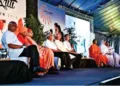
The event itself supplied another dimension often lost in the political argument. Around 180 religious leaders from some 30 countries announced a five-point ‘One World: One Humanity’ call to action, committing themselves to stand for one another, build relationships before crises, serve together and refuse to leave another community isolated when threatened.
None of that erases criticism of the RSS. It does not settle the history of Hindutva or invalidate the concerns of minorities. But it is part of what happened inside Madison Square Garden and belongs in any complete account of an event that has subsequently become the subject of such an intense political argument.
From protest to political infrastructure
There is a larger reason this debate is unlikely to disappear.
Indian America is no longer simply a diaspora seeking professional success and cultural recognition. It is increasingly a political constituency. Indian Americans fund campaigns, contest elections, staff administrations, build lobbying networks, lead companies, run foundations and expect to shape the country in which they have built their lives.
Political arrival inevitably brings ideological difference.
Modi supporters and Modi critics, Hindutva advocates and Hindutva opponents, Hindus, Muslims, Sikhs, Christians, Jains, secular Indians and second- or third-generation Americans will not speak with one voice. There is no reason they should. The more important question is whether American institutions can accommodate those disagreements without turning them into competing tests of political legitimacy.
The campaign-finance pledge marks an important threshold because it takes the debate from protest to political infrastructure. Demonstrations end. Donor-screening systems, databases, candidate questionnaires, endorsements and political pledges can endure.
The next phase may involve increasingly detailed attempts to map organisations, donors and personal relationships, accompanied by equally organised efforts from Hindu-American groups challenging those classifications and defending their political participation.
The $17 million figure, if documented, could become an important data point. So could the reported list of 113 organisations. But impressive numbers cannot answer a definitional question. In fact, the larger the numbers become, the more important it is to know exactly who is being counted and why.
There is responsibility on both sides.
The RSS cannot seek global legitimacy while treating every inquiry into its networks as prejudice. American Hindu organisations that say they are institutionally independent of organisations in India should be prepared to demonstrate that independence transparently. Donors and PACs must comply fully with US campaign-finance law.
Those making allegations carry responsibilities of their own. If the relationship being alleged is organisational, show the structure. If financial direction exists, document it. If foreign interference is alleged, identify the mechanism. If the argument instead rests upon ideological affinity or participation in community organisations, that should be stated plainly so the American public can decide whether it considers such association sufficient grounds for political rejection.
As of this writing, the calls made before Dr Bhagwat’s visit for US sanctions or visa measures have not been followed by a new State Department, White House, Treasury or USCIRF action implementing such measures.
The significant movement has instead occurred in political and media space. The pledge has attracted nearly 90 signatories. Democracy Now has taken the debate to a substantial US broadcast audience. Lander has repeated the 1939 Nazi-rally comparison. An upcoming donor report has been previewed with a $17 million claim. HAPAC and the Hindu American Foundation, meanwhile, have mounted a direct counterargument centred on discrimination, assumptions of dual loyalty and the right of American Hindus to participate fully in political life.
Cancel culture & the test of American pluralism
This is what makes the aftermath of Madison Square Garden more consequential than the event itself.
The central question is not whether the RSS should be scrutinised. It should be. Any organisation seeking influence in a democracy should expect examination, particularly one carrying a century of intense political debate and a close ideological relationship with India’s governing movement.
What matters is what happens after that scrutiny.
Evidence of unlawful conduct should lead to accountability for that conduct. But does association itself become a transferable political stigma? At what point does a description such as ‘RSS-linked’ cease to describe and begin to blacklist? And can a country that prides itself on pluralism challenge ideas it considers illiberal without itself creating illiberal tests of political belonging?
These questions go well beyond the RSS.
America is home to diasporas carrying political debates from every part of the world — over Israel and Palestine, China and Taiwan, Cuba, Iran, Turkey, Pakistan, Kashmir and Hindutva. Inevitably, those arguments enter American politics. That is not necessarily evidence of foreign interference; often it is simply the consequence of democratic citizenship in a nation built by immigrants.
America’s challenge is not to prevent these disagreements. It is to absorb them without allowing political identity to substitute for evidence of unlawful conduct. For the first century of the RSS, the defining debates about the Sangh were overwhelmingly Indian. Its second century is beginning differently. After Madison Square Garden, that debate has crossed the ocean. It is now entering US elections, campaign finance, broadcast media and, ultimately, the politics of belonging.
The RSS can be scrutinised. Hindutva can be challenged. Genuine foreign influence can and should be investigated. But if an ‘RSS-linked’ label, without a clearly demonstrated organisational, financial or legal connection, becomes enough to decide that an American citizen’s political participation is unacceptable, the argument has entered very different territory.
The ultimate question after Madison Square Garden is therefore not only what America thinks of the RSS. It is whether, in confronting ideas it opposes, America can preserve the pluralism invoked in the very campaign against them.