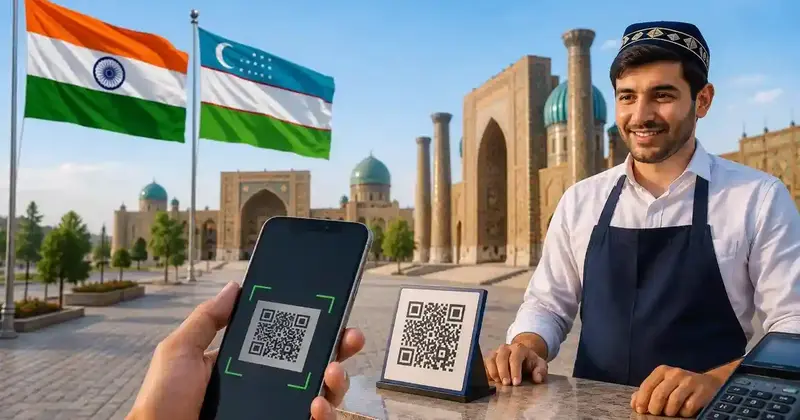
Tashkent: India’s landmark digital revolution, Unified Payments Interface (UPI) is set to be rolled out in Uzbekistan, marking a significant step in expanding India’s digital payment public infrastructure overseas and strengthening economic & financial ties between the two countries.
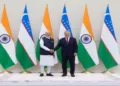
The Ministry of External Affairs Secreatry(West) Sibi George made the remarks in a special briefing on Prime Minister Narendra Modi’s visit to Uzbekistan. George said that the UPI rollout would facilitate digital transactions between India and Uzbekistan and enable Indian travellers to use UPI-enabled applications in the Central Asian nation.
“Another important development is the UPI rollout for Uzbekistan. It adds to the global expansion of Indian digital infrastructure, which helps further digital transactions between our two countries”, he told the media. Uzbekistan is thus the latest country to adopt India’s indigenous digital public infrastructure UPI, after a series of countries where UPI is functional. This includes Singapore, UAE, Bhutan, Nepal, Sri Lanka, France, Mauritius, Qatar etc. This reflects how India is globally revolutionising and leading from the front, as a stellar example for cashless, hasstle-free and swift financial transactions.
Agreement signed between NPCI & Uzbekistan’s HUMO
Secretary (West) also highlighted how a network agreement signed between NPCI International Payments Limited (NIPL) and Uzbekistan’s HUMO represents an important first step towards interoperability between the digital payment ecosystems of the two countries.
“This represents an important first step towards establishing greater interoperability between the digital payment ecosystems of our two countries. The arrangement is expected in a year’s time. Indian travellers visiting Uzbekistan will be able to use their UPI-enabled applications here”, he said.
The development comes as India and Uzbekistan seek to significantly expand bilateral economic engagement, including the two sides setting an ambitious target of increasing bilateral trade from the current level of around USD 1 billion to USD 5 billion by 2030.
India-Uzbekistan deepen defence industrial & military ties
India and Uzbekistan agreed to further strengthen cooperation between their defence and security agencies, including through regular exchanges, institutional mechanisms, capacity-building, joint activities and cooperation in the defence industrial domain.
According to a joint statement issued during Prime Minister Narendra Modi’s State Visit to Uzbekistan, the two sides also expressed satisfaction with the activities of the Joint Working Group on Military Cooperation, through which new avenues of cooperation in the defence industrial domain are being explored.
Leaders also welcomed the successful conduct of the Uzbekistan-India Joint Military Exercise “DUSTLIK”, the latest edition of which was held in Namangan Region in April 2026. The exercise involved joint planning, tactical drills, land navigation, strike missions on enemy bases and seizure of enemy-held areas. It also included a 48-hour validation exercise focused on the preparation and execution of joint special operations aimed at neutralising unlawful armed groups.
DUSTLIK also enabled the two sides to share best practices in tactics, techniques and procedures for joint operations and strengthen interoperability, operational synergy and joint command-and-control coordination.
During a special briefing Secretary George said that India has provided the Uzbekistan Army with Arogya Maitri Bisham Cubes to augment its disaster relief capabilities. India has also equipped the polyclinic at the University of Military Security and Defence of Uzbekistan, he added.
PM Modi and his Uzbekistan counter part also agreed to promote direct defence linkages in terms of co-production and co-development between the defence industries of the two countries.
The two countries have longstanding defence and security ties. A Joint Working Group on Defence was established in 2019, and its sixth meeting was held in Uzbekistan in August 2026. The fifth Joint Working Group meeting on defence cooperation was held in New Delhi on August 11, 2025, while the ninth Joint Working Group on Counter Terrorism was held in Tashkent on September 30, 2025.
The two countries have also stepped up interaction between their defence industries, including through the participation of a delegation from the Defence Industry Agency of Uzbekistan at Aero India 2025.
Uzbekistan backs India’s bid for permanent UNSC seat; Supports zero-tolerance to terrorism
Uzbekistan also reaffirmed its support for India’s candidature for permanent membership of the United Nations Security Council (UNSC), while both nations have also agreed to establish a Foreign Ministers-led mechanism to oversee the implementation of bilateral agreements and strengthen cooperation under the Joint Working Group on Counter Terrorism.
The two leaders called for comprehensive reform of the United Nations, including the Security Council, to reflect contemporary global realities and make it more representative, effective and efficient in addressing issues of international peace and security.
The two sides also reaffirmed their commitment to strengthening coordination at international forums to advance the common interests of the Global South and agreed to deepen cooperation within the Shanghai Cooperation Organisation (SCO).
On security cooperation, the leaders unequivocally condemned terrorism, including cross-border terrorism, in all its forms and manifestations and reiterated their “zero tolerance approach to terrorism”. “Leaders called for concerted actions against terrorist entities and for disrupting terrorism financing networks, safe havens and infrastructure”, the Joint Statement read.
The two sides stressed that those responsible for terrorism should be held accountable and that perpetrators, backers, facilitators and affiliates must be brought to justice. They also highlighted the importance of strengthening cooperation in law enforcement, intelligence sharing and combating violent extremism, illicit drug trafficking, organised crime and cyber threats.
(With Inputs from ANI)