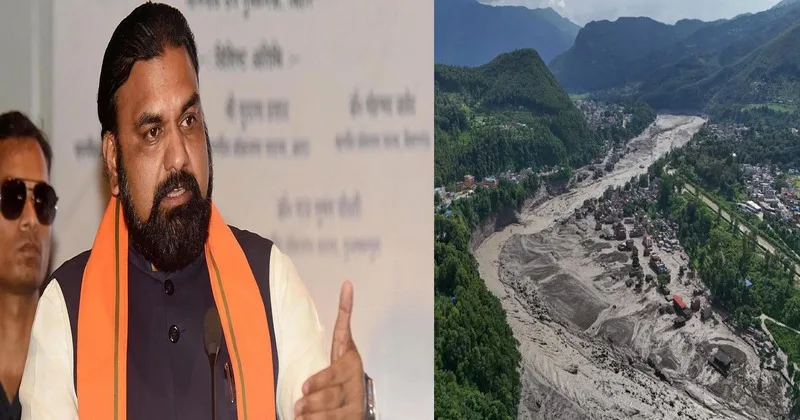
The sudden flood from Nepal has raised concerns in Bihar. The rising water levels of Nepal’s Narayani River, which is being known as Gandak in Bihar has raised tensions about potential flooding in several districts of Bihar ranging from the bordering district of West Champaran to Gopalganj, Saran and beyond these districts too. The main issue is that the flood from Nepal has the potential to wreak havoc in Bihar.
However, the devastation in Nepal will not be replicated in Bihar: The damage in Bihar is averted mainly due to the promptness and preparedness of the Bihar government. Hence, it is a matter of big relief that in Bihar the danger has been averted. The images emerging from the flood prone areas of Bihar are reassuring this fact. The Gandak River is flowing well below the danger mark and the rapid flooding in Nepal has not had the same widespread impact in Bihar.
This cannot be just attributed to luck but the timely and proper intervention by the Bihar government. The opening of all 36 gates of the Gandak Barrage is one of the timely and crucial step for controlling the potential damage triggered by the Nepal flood. Deployment of engineers in sensitive areas and the constant monitoring by the administration has also controlled the situation. We can say in other words that the devastation weakened in the state of Bihar by the vigilant administration.
The administration in districts like West Champaran, East Champaran, Gopalganj, Saran, Muzaffarpur, Vaishali, Siwan and Sitamarhi was highly vigilant and averted the catastrophe and its impact on lives and infrastructure. These districts are located along the Gandak River.
What triggered Nepal floods?
Now the moot question: how did this massive influx of water from Nepal weaken upon reaching in Bihar? Besides, how was the potential crisis controlled? Are Nepal’s rivers always a time bomb for Bihar, destined for disaster, or can they also be controlled too by the timely and proper action? To answer these questions we have to understand the flow of water in Nepal’s Bhote Koshi,Trishuli and Narayani rivers.
The flood’s strong current first flowed into the Bhote Koshi River, which originates in Tibet. This water later merged with theTrishuli River. The Trishuli is one of Nepal’s major rivers and the sudden surge of water increased the pressure on it.
The water then moved from theTrishuli River to the Narayani River. The strong currents caused devastation in Nepal. However, as the water flowed from Trishuli to Narayani and then towards Bihar, the water spread rapidly. Due to the river’s wide width, the pressure and velocity of the current gradually decreased. The strong current weakened as it reached Bihar: This is why the deluge of water seen in Nepal did not remain as intense by the time it reached Bihar. Furthermore, preparations had already been made on the barrages and embankments on the Bihar side.
Vigilant Bihar administration & timely action thwarts major disaster
All 36 gates of the Gandak Barrage were opened: Besides it took approximately 6 to 8 hours for water from Bhote Koshi and other rivers in Nepal to reach the Gandak river. The water level of the Gandak began to rise on Wednesday evening and continued to rise rapidly until nightfall. The water flow rapidly climbed on Wednesday night, peaking at approximately 150,000cusecs around 11:00 PM. Approximately 150,000 cusecs of water was discharged from the Valmikinagar Barrage.
The decision to reduce pressure on the barrage proved effective: The most significant decision taken by the Water Resources Department was to open all 36 gates of the Gandak Barrage. This allowed for the rapid release of excess water and prevented the barrage from experiencing increased pressure. According to officials and experts, if the water had not been discharged timely, the pressure on the barrage could have increased, potentially leading to an uncontrolled discharge.
High-alert at vulnerable districts
Therefore, a strategy was adopted to allow the excess water to flow freely. High Alerts were immediately issued across eight vulnerable districts in Bihar including West Champaran, East Champaran, Gopalganj, Saran, Muzaffarpur, and Vaishali. Precautionary evacuations have shifted over 5,000 plus families to higher ground The immediate danger has largely subsided. The bulk of the floodwaters spilled safely through the Narayani river system, causing less downstream impact than originally feared. Embankments have held firm, and the discharge rates at the Valmikinagar Barrage have stabilized back down to a routine 100,000 cusecs.
Early hydrological warning, advanced technology & swift action dismantled the disaster
Engineers had anticipated the danger: The department has prior information about the direction and potential impact of the water coming from Nepal. Based on this, preparations are made at sensitive locations providing them with requisite resources in sensitive areas. Since Gandak is a large river and it receives water from many small and large multiple water outlets. Therefore, the department identifies sensitive areas in advance and arranges for deployment and resources there.
Sensitive areas were already in focus: The most important step in this entire development was to allow free flow of water by opening all the gates of the barrage. Engineers were priorily deployed at sensitive locations. Besides Special monitoring was also maintained where anti-erosion work was already underway to ensure that the safety measures undertaken were not affected by the high water level.
The availability of flood fighting material was ensured in potentially sensitive areas. Additional engineers were deployed and officers were also sent from headquarters as needed. Constant patrolling and monitoring kept the situation under control.