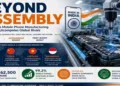
The Ministry of Electronics and Information Technology (MeitY) has notified the Mobile Phone Manufacturing Scheme (MPMS) with a budgetary outlay of Rs 62,500 crore, in a move aimed at expanding India’s mobile phone manufacturing capacity, strengthening domestic supply chains and increasing value addition within the country.
The five-year scheme will cover FY 2026-27 to FY 2030-31 and is designed to sustain the growth achieved by India’s electronics manufacturing sector while encouraging Indian-owned brands to develop indigenous technology, intellectual property and product design capabilities.
Union Electronics and Information Technology Minister Ashwini Vaishnaw said the scheme would provide a significant push to Indian-owned mobile brands, intellectual property and product design.
He said genuine Indian ownership of the brand, design and intellectual property would be an important requirement for companies seeking support under the scheme. The government will undertake detailed evaluations to establish that intellectual property claimed by applicants is genuinely Indian-owned.
Non-fiscal and other support measures for Indian brands will also be developed in consultation with industry.
Electronics manufacturing expands seven-fold
The government said the Make in India initiative has helped electronics manufacturing expand seven-fold since FY 2014-15, while electronics exports have increased eleven-fold during the same period.
The electronics manufacturing sector has also emerged as an important source of employment, particularly for young people from rural areas.
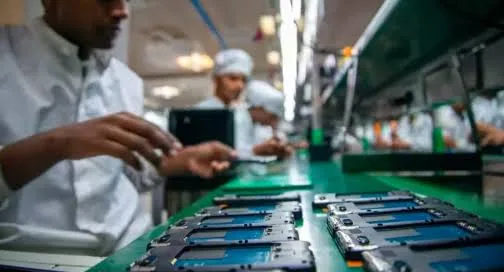
Several large manufacturing facilities employ more than 5,000 people at a single location, with employment at some facilities reaching 20,000.
Mobile phone manufacturing has been one of the major drivers of this expansion. Handsets account for a substantial share of India’s electronics production and exports and have helped integrate Indian manufacturers into global value chains.
India is currently the world’s second-largest mobile phone manufacturer by volume, while 99.2 per cent of mobile phones used in India are manufactured domestically, according to the government.
Smartphones also became India’s largest exported product category in 2025, surpassing traditional leading export items such as diesel fuel and cut diamonds.
MPMS follows completion of mobile phone PLI scheme
The government’s Production Linked Incentive Scheme for Large Scale Electronics Manufacturing (PLI-LSEM) played a key role in establishing India as a major global manufacturing and export hub for mobile phones.
The PLI-LSEM scheme completed its tenure on March 31, 2026.
The new MPMS is intended to build on that manufacturing base and maintain the growth momentum by focusing on scale, domestic sourcing and the development of Indian brands and technology.
Two target segments under the scheme
The MPMS has been divided into two target segments.
Target Segment 1: Mobile phone manufacturing
Target Segment 1 (TS1) will focus on incentivising mobile phone manufacturing.
Companies eligible under TS1 will receive differentiated incentives ranging from 2.25 per cent to 5 per cent.
An additional incentive of up to 1.5 per cent will be available for domestic sourcing of specified key components and sub-assemblies.
Target Segment 2: Indian mobile brands
Target Segment 2 (TS2) is aimed specifically at supporting Indian mobile phone brands.
Eligible Indian brands will receive a 5 per cent incentive, along with an additional 3 per cent incentive for Indian design and research and development (R&D).
The scheme will also provide non-fiscal support to Indian brands to help them compete in their respective market segments.
Applicants under TS2 may also receive a one-year gestation period, giving new or expanding Indian brands additional time to establish operations and meet prescribed requirements.
Who can apply?
Applicants must be mobile phone manufacturers registered in India, including Electronics Manufacturing Services (EMS) providers.
Sales and incentives under the scheme will be calculated on a brand-wise basis.
For TS1, manufacturers, including EMS companies registered in India, must have recorded a minimum turnover of Rs 10,000 crore in FY 2025-26.
Existing brands must achieve annual sales of at least Rs 5,000 crore above their FY 2025-26 sales threshold.
For a new brand, eligibility will begin after it achieves annual sales of Rs 10,000 crore in India, following which it will have to meet the prescribed year-on-year threshold of Rs 5,000 crore.
For TS2, applicants must have recorded a minimum turnover of Rs 1,000 crore in FY 2025-26 and meet the prescribed requirements for an Indian brand.
What makes a brand eligible under TS2?
The scheme places specific emphasis on Indian ownership and domestic capabilities.
An eligible Indian brand must meet criteria including:
1. Registration or incorporation in India
2. Ownership of intellectual property and trademarks in India
3. Management control by Indian citizens
4. More than 51 per cent shareholding held by Indian citizens
5. In-house R&D and product design capabilities in India
The government has indicated that ownership of intellectual property will be closely examined as part of the evaluation process.
The objective is to ensure that incentives meant to strengthen Indian brands translate into genuine domestic ownership of technology, design and intellectual property rather than simply supporting manufacturing carried out under foreign-owned brands.
Additional incentive for domestic sourcing
A key feature of MPMS is an additional incentive of up to 1.5 per cent for domestic sourcing of key components and sub-assemblies.
The measure is aimed at increasing localisation beyond final assembly and building a stronger domestic component ecosystem.
To qualify for the additional incentive, the relevant components must be localised for at least 25 per cent of the total mobile phone units manufactured by an applicant in a financial year.
The government expects the provision to encourage manufacturers to source a larger share of components from domestic suppliers and strengthen India’s local electronics supply chain.
Focus on Indian design and R&D
The scheme also places greater emphasis on developing indigenous product capabilities.
Under TS2, Indian brands can receive an additional 3 per cent incentive for Indian design and R&D.
The focus is intended to encourage companies to move beyond manufacturing and assembly towards developing their own products, designs, technologies and intellectual property.
The government has also said that non-fiscal support measures will be developed in consultation with the industry to address broader challenges faced by Indian brands.
Expected production and employment
The government expects the scheme to generate a substantial increase in mobile phone manufacturing during its five-year tenure.
Cumulative mobile phone production in India is projected to reach approximately Rs 39 lakh crore, accompanied by a significant increase in exports.
The scheme is also expected to generate around 60,000 direct jobs.
Beyond direct employment, the government expects increased manufacturing activity to support wider economic activity across the component, logistics, packaging, design, research and related supply chains.
Strengthening India’s position in global electronics
The notification of MPMS comes as India seeks to consolidate its position as a major global electronics manufacturing hub.
The government’s strategy is increasingly focused not only on increasing the number of mobile phones manufactured domestically but also on increasing the share of components, technology, design and intellectual property originating within India.
The Rs 62,500 crore scheme therefore combines manufacturing incentives with measures aimed at developing Indian brands, domestic sourcing and R&D capabilities.
With the PLI-LSEM scheme having completed its tenure in March 2026, the MPMS is positioned as the next major policy intervention to sustain mobile phone manufacturing growth and deepen India’s participation in global electronics value chains.