NEW DELHI: The BJP has launched a sharp attack on the ruling Aam Aadmi Party (AAP) in Punjab, alleging that the Bhagwant Mann-led government is focused on managing headlines and covering up issues while the state grapples with a worsening law and order situation, drug abuse and rising crime.
Addressing a press conference at the BJP headquarters in Delhi, BJP national general secretary Tarun Chugh also raised concerns over alleged paper leaks in Punjab and accused the AAP government of shielding those responsible.
“People in Punjab are living in the atmosphere of fear because the gangsters and mafia are ruling the state under the protection of the AAP government,” Chugh alleged.
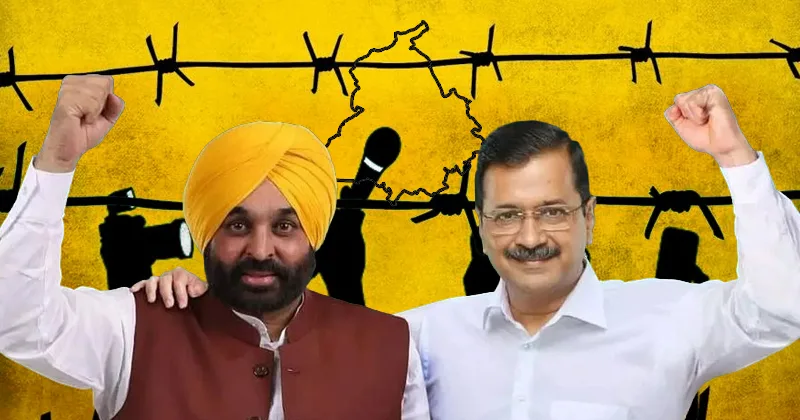
The BJP leader further claimed that the Bhagwant Mann government has imposed “undeclared censorship” on the media in Punjab. He alleged that the chief minister’s office is influencing decisions on what gets published in newspapers and aired on television news channels.
Notably, since September 2025, the official Facebook page of AAP Punjab and affiliated handles have issued numerous copyright notices, commonly called “copyright strikes”, against posts and videos critical of the CM Bhagwant Mann-led Punjab government.
A detailed investigative report published by The Reporters’ Collective on August 18 cites various incidents in the recent past to establish its claim that AAP claimed copyright ownership over around 48 videos and posts.
The report further states that between January and April 2026 alone, four Facebook pages were taken down due to a copyright claim by AAP. Later, a fifth page was removed after the Punjab Police under the state government issued a notice. The affected pages had 30 lakh followers collectively.
The Reporters’ Collective analysis found that the targeted material often included press releases from Sri Akal Takht Sahib, photos of opposition MLAs, Chief Minister Bhagwant Mann’s own social media posts, representational AI-generated images of Mann and Arvind Kejriwal, state government notifications, AAP’s digital posters, and visuals from inside the Punjab Legislative Assembly, including videos of Vidhan Sabha proceedings despite the fact that content related to government works are not private party property under copyright law principles.
The Collective report also highlights how a September 2025 video of Lok Awaz TV was accused by AAP of ‘copyright infringement’. In the video, AAP MLAs were seen raising placards inside the state assembly during a protest against the BJP-led Central government over flood relief funds. One of these pictures was shared by the official X handle of AAP Punjab.
Another independent journalist targeted by AAP Punjab is Rattandeep Singh Dhaliwal, whose Facebook page received as many as 19 copyright strikes from AAP in recent months. In late February 2026, Dhaliwal’s page, which had 3.24 lakh followers at that time, was taken down. AAP had alleged ‘infringement of intellectual property rights’.
AAP’s practice of hounding journalists and small media outlets is not confined only to copyright strikes. In May this year, Dhaliwal claimed that Punjab Police visited his residence over a video in which it was claimed that 32 sitting AAP MLAs might not get tickets in the next elections. Several AAP MLAs filed police complaints against him, and even termed Dhaliwal and his reporting ‘anti-national’.
One Bhatinda-based digital journalist, Jass Grewal, lost his Facebook page boasting 1.4 million followers due to three AAP copyright strikes in April 2026.
Similarly, one Parmeet Singh Bidowali’s page with 66,000 followers received 3 Intellectual proprietary rights claims in February from AAP.
To protect his second page Punjab Inside TV, with 45,000 followers, from AAP’s copyright strikes, Bidowali was forced to delete all the content related to AAP.
Some of these independent creators approached courts for relief, and cases remain pending.
In January this year, Punjab Kesari accused the AAP government of engaging in a “targeted witch hunt” over an article on Arvind Kejriwal published in October 2025. Soon after the publication of the said article, Punjab Kesari alleged that all state government advertisements to the newspaper and its digital arms were stopped from 2nd November, according to the publication.
Punjab Kesari alleged the AAP government was pressuring it through a string of raids and regulatory measures against its publications and affiliated businesses.
“We are writing to express our deep concern and anguish regarding certain recent developments which give rise to a serious apprehension that the Punjab government is specifically targeting the Punjab Kesari Group and its associate concerns with an extraneous motive to intimidate the press,” read a formal letter signed by the outlet’s editor-in-chief, Vijay Kumar Chopra, alongside Joint Managing Directors, Avinash Chopra and Amit Chopra.
In April 2026, Independent journalists from Punjab alleged that the Aam Aadmi Party-led government in the State was systematically targeting voices in the State. In a press conference on Monday (April 27, 2026), members of the Press Di Azaadi Bahal Karo Sangharsh Committee Punjab (Committee for the Struggle to Restore Press Freedom) said the State Government was using intimidation, copyright claims and notices under the IT Rules, 2021 to target critics online.
In May 2023, Times Now reporter Bhavana Kishore, who exposed “Operation Sheesh Mahal” related to AAP National Convenor and former Delhi CM Arvind Kejriwal’s lavish official residence, was arrested by the Ludhiana Police along with video journalist Mritunjay Kumar and driver Parminder.
The Constitution of India, in Article 19, clearly states that the freedom of free speech and expression of every Indian must be protected in light of the reasonable restrictions on the same. This also aligns with the global convention, as the Universal Declaration of Human Rights (UDHR) in its Article 19 mentions that ‘Everyone has the right to freedom of opinion and expression; this right includes freedom to hold opinions without interference and to seek, receive and impart information and ideas through any media and regardless of frontiers.’
In Punjab, fear among journalists grew amid legal notices and alleged police harassment. To avoid a strike, journalists reportedly began blurring the faces of political leaders or replacing them with AI-generated sketches.