Oldest evidence of life on Earth? Jharkhand rock holds clues
August 30, 2026
  • Read Ecopy
  • Circulation
  • Advertise
  • Careers
  • About Us
  • Contact Us
Android AppiPhone AppArattai
Organiser
  • ‌
  • Bharat
    • Assam
    • Bihar
    • Chhattisgarh
    • Jharkhand
    • Maharashtra
    • View All States
  • World
    • Asia
    • Europe
    • North America
    • South America
    • Africa
    • Australia
  • Editorial
  • International
  • Opinion
  • RSS @ 100
  • More
    • Op Sindoor
    • Analysis
    • Sports
    • Defence
    • Politics
    • Business
    • Economy
    • Culture
    • Special Report
    • Sci & Tech
    • Entertainment
    • G20
    • Azadi Ka Amrit Mahotsav
    • Vocal4Local
    • Web Stories
    • Education
    • Employment
    • Books
    • Interviews
    • Travel
    • Law
    • Health
    • Obituary
  • Subscribe
    • Subscribe Print Edition
    • Subscribe Ecopy
    • Read Ecopy
  • ‌
  • Bharat
    • Assam
    • Bihar
    • Chhattisgarh
    • Jharkhand
    • Maharashtra
    • View All States
  • World
    • Asia
    • Europe
    • North America
    • South America
    • Africa
    • Australia
  • Editorial
  • International
  • Opinion
  • RSS @ 100
  • More
    • Op Sindoor
    • Analysis
    • Sports
    • Defence
    • Politics
    • Business
    • Economy
    • Culture
    • Special Report
    • Sci & Tech
    • Entertainment
    • G20
    • Azadi Ka Amrit Mahotsav
    • Vocal4Local
    • Web Stories
    • Education
    • Employment
    • Books
    • Interviews
    • Travel
    • Law
    • Health
    • Obituary
  • Subscribe
    • Subscribe Print Edition
    • Subscribe Ecopy
    • Read Ecopy
Organiser
  • Home
  • Bharat
  • World
  • Operation Sindoor
  • Editorial
  • Analysis
  • Opinion
  • Culture
  • Defence
  • International Edition
  • RSS @ 100
  • Magazine
  • Read Ecopy
Home Bharat

Oldest Evidence of Life on Earth? 3.5-billion-year-old Jharkhand rock reveals ancient microbial clues

Scientists have found possible evidence of microbial life dating back nearly 3.5 billion years in a rock from Jharkhand’s Singhbhum region. The discovery could rank among the oldest directly dated evidence of life on Earth, offering new clues about how early life emerged

WEBDESKWEBDESK
Aug 30, 2026, 06:00 pm IST
inBharat, Culture, Jharkhand
Follow on Google News
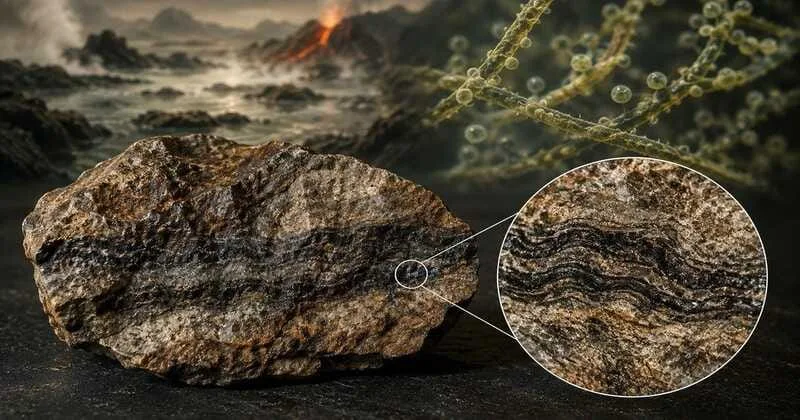
Scientists have found possible evidence of microbial life dating back nearly 3.5 billion years in a rock from Jharkhand’s Singhbhum region

Scientists have found possible evidence of microbial life dating back nearly 3.5 billion years in a rock from Jharkhand’s Singhbhum region

Facebook
Twitter
WhatsAppTelegramEmail

Singhbhum: Scientists have identified what could be among the oldest directly dated evidence of life on Earth in a rock from the Singhbhum region of Jharkhand. The rock, estimated to be about 3.497 billion years old, contains dark carbon-rich bands and chemical signatures that researchers interpret as possible remnants of ancient microbial activity.

India Finds Oldest Evidence Of Life On Earth?

A 3.5bn-year-old rock found in Jharkhand’s Singhbhum region has yielded chemical signatures that scientists say point to ancient microbial life – potentially the oldest directly dated evidence of life ever documented on Earth.

The… pic.twitter.com/uCDxPX9Ock

— RT_India (@RT_India_news) August 19, 2026

The finding is significant because it pushes the search for Earth’s earliest life deep into the Paleoarchean Era, when the planet was still in its formative stages. If the biological interpretation is confirmed, the discovery could provide one of the oldest directly dated records of life preserved in an ancient rock.

The research builds on growing scientific evidence that microbial life existed billions of years ago, long before plants, animals or other complex organisms appeared. A 2025 study published in the Proceedings of the National Academy of Sciences (PNAS) identified biogenic molecular signatures in rocks from the Singhbhum Craton dating to around 3.51 billion years, using pyrolysis–gas chromatography–mass spectrometry and machine-learning analysis.

Also Read: Onam 2026: History, Hindu heritage, traditions and cultural significance of Kerala’s harvest festival

What was found in the rock?

Researchers examined tiny, dark bands preserved within ancient silica-rich rock. These structures are being interpreted as remnants of microbial mats, communities of microorganisms that may have lived together in shallow aquatic environments billions of years ago.

The chemical evidence is particularly important. Organic matter can survive in ancient rocks, but geological processes over billions of years can heavily alter or destroy biological signatures. Scientists therefore need to distinguish material produced by living organisms from carbon and organic compounds that could have formed through non-biological geological processes.

The PNAS research used chemical analysis and supervised machine learning to make this distinction. The study examined 406 ancient, modern, meteoritic and synthetic samples, finding that patterns in degraded organic material could be used to distinguish biogenic from abiogenic sources with significant accuracy.

Did these microbes use carbon dioxide?

One of the most intriguing implications of the discovery is that early microorganisms may have already been carrying out forms of carbon fixation, converting inorganic carbon, including carbon dioxide, into organic matter.

Such a capability would indicate that microbial ecosystems had developed surprisingly sophisticated metabolic processes at a very early stage in Earth’s history. However, scientists distinguish between evidence for ancient biological activity and proof of a particular metabolic pathway. The broader PNAS study found evidence consistent with biogenic organic matter in approximately 3.51-billion-year-old Singhbhum rocks, while its strongest evidence for photosynthetic organic molecules occurred in younger, approximately 2.52-billion-year-old rocks.

The Singhbhum Craton in eastern India is one of the world’s important geological windows into the early Earth. Its rocks preserve material dating back more than 3.5 billion years and provide scientists with an opportunity to investigate the conditions that existed when some of the earliest forms of life may have emerged.

Previous geological research has established that the Singhbhum Craton contains rocks from roughly 3.51 to 3.29 billion years ago, making the region particularly valuable for studying Earth’s Paleoarchean history.

Life in an ancient volcanic world

The discovery also raises questions about where the earliest organisms lived. Early Earth was dramatically different from the planet today. The atmosphere contained little or no free oxygen compared with modern levels, volcanic activity was widespread, and oceans interacted extensively with the young crust.

Scientists have long considered underwater volcanic and hydrothermal environments as possible habitats for early microbial life. Geological studies of other 3.5-billion-year-old rocks have also found organic carbon associated with ancient seafloor hydrothermal systems, demonstrating that such environments could preserve material relevant to the origins of life.

The evidence from Singhbhum is extremely ancient, but scientists must still establish that the structures and chemical signatures are genuinely biological and not the result of geological processes. The recent reporting describes the finding as potentially the oldest directly dated evidence of life, rather than an absolutely confirmed record. If the interpretation withstands further examination, the discovery would strengthen the case that life appeared on Earth remarkably early, perhaps only a few hundred million years after the planet became habitable.

The significance therefore extends beyond India. A confirmed 3.497-billion-year-old biosignature would give scientists a valuable new window into the conditions under which the first microbial ecosystems emerged and could also influence the search for life on other worlds.

For now, the Singhbhum rock offers something equally important: a rare chemical and geological glimpse into a time when Earth was still young and microscopic life may already have been transforming its environment.


 

Topics: SinghbhumOldest Life On EarthAncient Microbial Life3.5 Billion YearsPNASJharkhandGeological Survey of India
Share
Tweet
SendShareSend
✮ Subscribe Organiser YouTube Channel. ✮
✮ Join Organiser's WhatsApp channel for Nationalist views beyond the news. ✮
Previous News

UP: Hindu youth assaulted for being with Muslim woman in hijab; Ghaziabad Police probe viral video

Next News

Pakistan demolishes 200-year-old Sikh Gurdwara in Quetta; Historic minority heritage land sold for commercial project!

Related News

JPSC-JSSC Exam Row: ABVP holds nationwide protests over irregularities; Demands CBI probe

Maoists surrender before senior police officials at the West Singhbhum District headquarters, Chaibasa's police lines

Jharkhand Naxal-Free Push: 4 maoists surrender as West Singhbhum declared Naxal-free

ABVP protests outside Jharkhand Assembly against lathicharge on students

JPSC-JSSC Exam Row: ABVP protests outside Jharkhand Assembly over lathicharge on students; Many arrested

Students at the protest site give slogans of Vande Mataram and Bharat Mata Ki Jai

Jharkhand JPSC Protest: Beyond one examination

14TH JPSC Civil Services Exam: Restoring reliability of recruitment

Two decades after Mamata Banerjee drove Tata out of Singur, Bengal is now seeking the industrial giant's return. (AI-generated Image)

From ‘Tata go back’ to ‘Tata come back’: Bengal begins undoing Mamata’s Singur disaster

Load More

Latest News

When Faith Becomes Data: What the Joshua Project reveals about missionary targeting in India!

The demolition of Shri Guru Singh Sabha Gurdwara has intensified fears over the disappearance of Pakistan’s Sikh religious heritage

Pakistan demolishes 200-year-old Sikh Gurdwara in Quetta; Historic minority heritage land sold for commercial project!

Scientists have found possible evidence of microbial life dating back nearly 3.5 billion years in a rock from Jharkhand’s Singhbhum region

Oldest Evidence of Life on Earth? 3.5-billion-year-old Jharkhand rock reveals ancient microbial clues

Ghaziabad: Shivam Beaten for Being With Muslim Woman, UP Police Probe

UP: Hindu youth assaulted for being with Muslim woman in hijab; Ghaziabad Police probe viral video

Kollakkayil Devaki Amma turned adversity into a green legacy by creating a 4.5-acre forest with over 3,000 trees in Kerala

Kollakkayil Devaki Amma: The Kerala woman who turned her backyard into a 4.5-acre forest with 3,000+ trees

Chinese artist Gao Zhen

China sentences artist Gao Zhen to three years over decades-old artwork as CCP criminalises criticism of its leaders

Karnataka: HC slams dark field policing; Questions detention of Hindu activist over social media post on Kunal Kamra

PM Modi conferred highest state honour of Uzbekistan

PM Modi recieves Uzbekistan’s highest state honour “Oliy Darajali Dustlik”; Vows to strive for Global South prosperity

Mundeshwari Mandir

Mundeshwari Mandir: Exploring India’s 1,900-year-old Hindu shrine and its ancient legacy in Bihar

Prime Minister Narendra Modi & Uzbekistan President Shavkat Mirziyoyev

India-Uzbekistan upgrade ties to comprehensive strategic partnership; Foreign Ministers Council to seek bilateral goals

Load More
  • Privacy
  • Terms
  • Cookie Policy
  • Refund and Cancellation
  • Delivery and Shipping

© Bharat Prakashan (Delhi) Limited.
Tech-enabled by Ananthapuri Technologies

  • Home
  • Search Organiser
  • Bharat
    • Assam
    • Bihar
    • Chhattisgarh
    • Jharkhand
    • Maharashtra
    • View All States
  • World
    • Asia
    • Africa
    • North America
    • South America
    • Europe
    • Australia
  • Editorial
  • Operation Sindoor
  • Opinion
  • Analysis
  • Defence
  • Culture
  • Sports
  • Business
  • RSS @ 100
  • Entertainment
  • More ..
    • Sci & Tech
    • Vocal4Local
    • Special Report
    • Education
    • Employment
    • Books
    • Interviews
    • Travel
    • Health
    • Politics
    • Law
    • Economy
    • Obituary
  • Subscribe Magazine
  • Read Ecopy
  • Advertise
  • Circulation
  • Careers
  • About Us
  • Contact Us
  • Policies & Terms
    • Privacy Policy
    • Cookie Policy
    • Refund and Cancellation
    • Terms of Use

© Bharat Prakashan (Delhi) Limited.
Tech-enabled by Ananthapuri Technologies