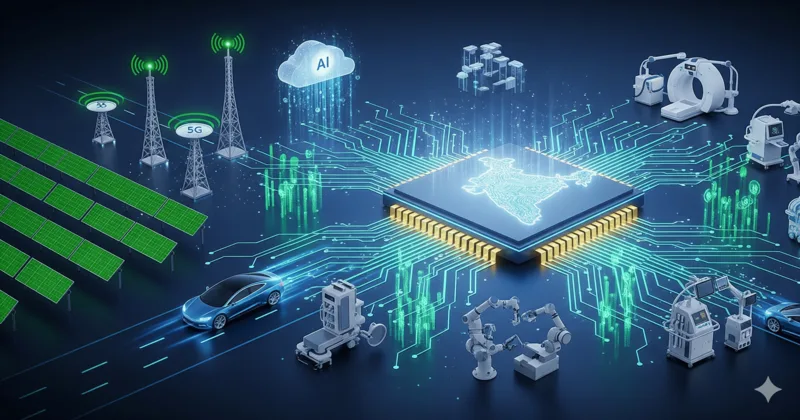
New Delhi: From mobile phones to missiles, and from electric vehicles to artificial intelligence and space technology, the power of the modern world lies hidden within a tiny chip. India is now moving towards establishing an entire ecosystem for these chips within its own borders. The goal is to create a complete value chain, spanning design, fabrication (fab), packaging, testing, materials, equipment, and skills, culminating in final electronic systems.
‘Semicon India 2026,’ scheduled to be held at Yashobhoomi in New Delhi from September 17 to 19, 2026, will serve as a global showcase of this ambition. India faces a significant challenge regarding semiconductor manufacturing; while it is one of the world’s largest electronics markets, it has historically relied heavily on imports for chips. Efforts are now underway to transform this scenario through the ‘India Semiconductor Mission.’ India aims to evolve from merely being a major chip market to developing world-class capabilities across the spectrum, from design to manufacturing and from chips to complete systems.
The impact of Semicon 1.0; Success visible on the ground
It is noteworthy that this transformation began with the first phase of the Semicon India program. Under ‘Semicon 1.0,’ 12 semiconductor projects have been approved so far, with commercial production already underway in three of them. This signifies that India’s semiconductor journey has moved beyond policy and announcements to the stage of actual production.
S. Krishnan, Secretary of the Ministry of Electronics and Information Technology, remarks, “This year’s Semicon India is special because the event takes place against the backdrop of the ‘ground-level success’ of the Semicon program. Furthermore, the six key pillars of ‘Semicon 2.0’ have further clarified India’s commitment to building a robust and resilient semiconductor ecosystem.”
Krishnan stated that on July 15, 2026, the Union Cabinet approved ‘Semicon 2.0’ with an outlay of ₹1,27,500 crore. Its objective is to elevate the semiconductor design and manufacturing ecosystem to the next level. The initiative emphasizes strengthening areas such as the development of Indian-designed chips, fab expansion, advanced packaging, and the supply of materials, gases and equipment used in semiconductor manufacturing.
Why ‘silicon to systems’ is significant
The theme of Semicon India 2026- ‘Silicon to Systems: Building the Ecosystem’, reflects this comprehensive vision. Consequently, the conference will focus on key areas including manufacturing and technology, AI and digital transformation, supply chains, chemicals and materials, policy, sustainability and ESG, product manufacturing and design, startups and innovation, talent and skills, as well as the ‘India Brand’ and market development.
Leveraging India’s strength in design
India’s greatest strength in the semiconductor sector lies in its talent pool. To strengthen the design ecosystem, the government is providing state-of-the-art design tools to educational institutions and startups. Under the core program, over 332 educational institutions and 105 startups are being granted access to these tools, while 24 startups have received approval under the Design Linked Incentive (DLI) scheme.
There is also a strong emphasis on developing design talent through government programs. Recent government data indicates that initiatives such as the deployment of EDA tools across 320 educational institutions and the training of over 68,000 students are aligning this capability with future requirements. This is the domain where India can transition from being merely a manufacturing site to becoming a hub for chip design and intellectual property.
A $200 billion opportunity for India
The global demand for semiconductors presents a massive opportunity for India. Amitesh Kumar Sinha, CEO of ISM and Additional Secretary at the Ministry of Electronics and IT, states, “Global semiconductor demand is expected to grow from approximately $1 trillion to $2 trillion. During the same period, India’s semiconductor demand is also likely to rise from around $100 billion to $200 billion”.
According to Sinha, “Semicon India 2026 offers an opportunity to bring together on a single platform countries and companies keen on manufacturing in India, Indian firms already approved for manufacturing, policymakers from central and state governments, and supply chain partners, all of whom will form part of this ecosystem”.
Over 500 exhibitors, participation from more than 40 countries
The scale of Semicon India 2026 reflects India’s growing ambitions. The event will feature over 500 exhibitors, more than 240 international companies, over 150 international speakers, and delegations from more than 40 countries. Spanning an exhibition area of over 15,000 square meters, the event will host pavilions representing six nations and ten state governments, alongside a startup pavilion and an innovation showcase. Meanwhile, a startup pitch competition, a student hackathon and a workforce development pavilion will demonstrate that India is not relying solely on large corporations for this industry but is also integrating next-generation innovation and talent.
Presence of global giants bolsters confidence
Industry leaders from major companies, including ASML, Applied Materials, Teradyne, Infineon, Ebara, Jabil, IBM Research, NXP, Tata Electronics, Micron, Merck KGaA, Rapidus, Lam Research, CG Power, Advantest, SEMI, Horiba STEC, SCREEN, Tokyo Electron, and others—will participate in the event.
India aims to become an ‘integral part’ of the global supply chain
Ajit Manocha, President and CEO of SEMI, has clearly articulated the opportunity before India. He states, “Driven by its momentum, ambition, talent, and long-term vision, India is well-positioned to advance in this sector. The country’s intent is not merely to participate in the global supply chain but to emerge as an integral part of it by seizing this opportunity. Indeed, this transformation is the primary objective of India’s semiconductor strategy.”
‘Sand-to-silicon-to-system’ to showcases the entire journey
A special ‘Sand-to-Silicon-to-System’ value chain experience will be a key highlight of Semicon India 2026. Ashok Chandak, President of Semicon India and IESA, notes that this experience will demonstrate how India is moving beyond merely establishing credibility to showcasing its capabilities and strengthening its prowess across the entire semiconductor ecosystem.
He added that India’s strategy involves strengthening its core capabilities through collaborations with global companies and technology partners. Round-table meetings involving six nations at Semicon India 2026 will further advance this vision. The conference will serve as a platform for collaboration, investment, and technology partnerships, allowing India to showcase its market potential alongside its manufacturing and design capabilities.
The goal now extends beyond Made-in-India chips
Ashok Chandak, President of Semicon India, further emphasizes that the next phase of India’s semiconductor journey involves progressing from chips to systems and ultimately to global products. The 12 projects under Semicon 1.0, including three where commercial production has already commenced and the ₹1,27,500 crore expansion under Semicon 2.0 are laying the groundwork for this journey. Semicon India 2026 will showcase this transformation on the global stage.
According to him, the opportunity before India is extraordinary; global demand is expected to double in the coming years and domestic demand could reach $200 billion. If the links of design, manufacturing, packaging, materials, equipment, skills and system assembly are robustly integrated, India will evolve beyond being merely a major semiconductor market. Indeed, establishing the entire ecosystem chain, from silicon to systems, is the path that can propel India into the front ranks of global semiconductor powers.