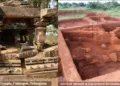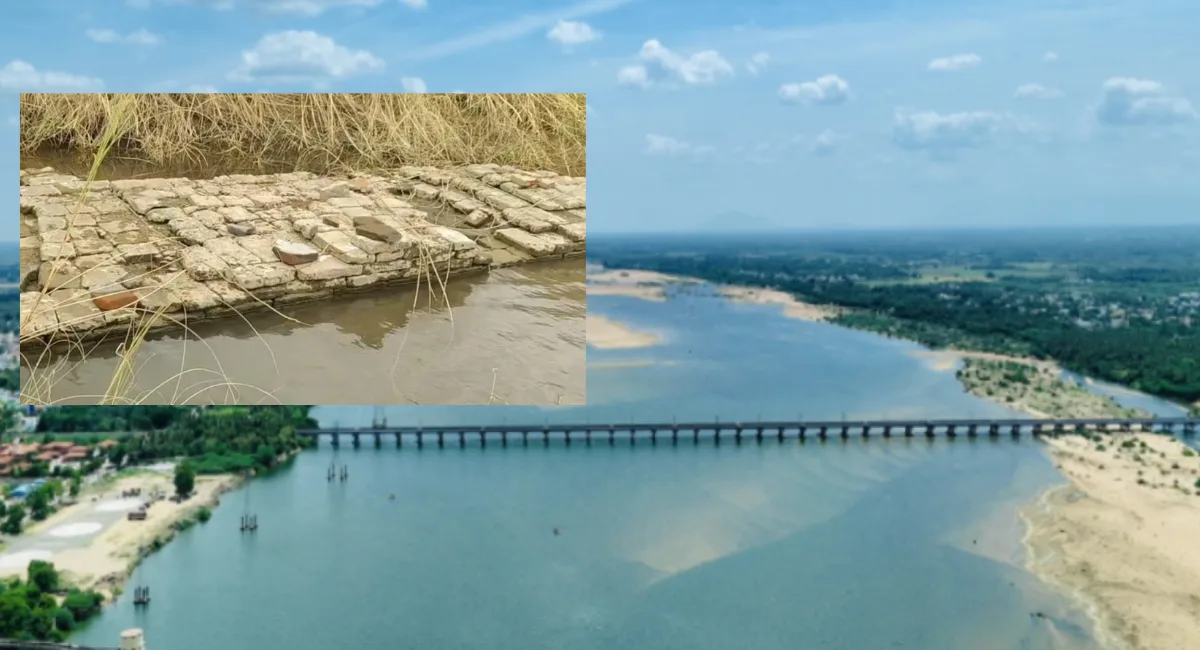
Villagers recently unearthed a brick structure on the bed of the Kollidam river near Lalgudi in Tiruchi district in what could be another example of the water-management skills of the people of Tamil Nadu during the Sangam age, around 2,000 years ago. The structure, found a few days ago in a pool of stagnant water on the river bed, is suspected to be a possible Sangam-age irrigation structure. Pictures and videos of the discovery soon flooded social media.
On hearing of the discovery, a team of ASI officials visited the area. They assumed it could be a Sangam-age irrigation structure. Brick remains were identified at two places on the Kollidam river, about 500 metres to the south of the Moongil Karuppar temple.
P Aravazhi, Superintendent of ASI Tiruchi Circle, told the media, “The first one was a semi-circular brick wall, of which only two courses were visible above the water. The second, located to the east, was fully submerged. Underwater observation revealed two walls running parallel to each other, with a gap between them suggestive of an entrance or a channel opening.”
He said, “Based on its structural characteristics, it has been provisionally identified as an inlet channel of possible historic period (3rd-4th Century CE). The large-sized bricks and the location suggest that it could be the remnant of an ancient water regulation structure, possibly a sluice or an inlet or outlet channel.”
The bricks from both structures, according to the ASI, were rectangular and wedge-shaped, with a consistent dimension ratio. The structural remains are broadly comparable to the water management structure exposed at Vanagiri near Kaveripattinam (Poompuhar), where, after excavations, officials found a brick-built inlet sluice/channel associated with a reservoir.
ASI official Arvazhi said, “The large-sized bricks and constructional characteristics found in Trichy are suggestive of an early historic/Sangam-age structure. Its exact period can be ascertained after systematic excavation of the material.”
It is assumed that the site could have been a structure linked to the Kallanai, built by the Karikala Chola dynasty around 150 CE, who built the Grand Anicut. The dam is thought to be the oldest dam that is still in use. It is considered to be the oldest hydraulic structure in the world that continues to function as efficiently as its modern counterparts.
In Gingee Fort in Villupuram district, there were storage ponds and catchment tanks for rainwater harvesting, and there were two systems for water supply. One supplied perennial water to the inner fort from a pond which was fed by surface drainage, using the principles of gravity flow and the siphon to carry water through earthen pipes hidden underground to the palaces, tanks and fountains.
Another marvel is the olden drainage system in Chidambaram temple found in 2020. The report says, “There are nine tanks around the temple. If they are maintained properly, groundwater in Chidambaram would not have turned saline. All the jala tharais (drainages) were repaired when consecration was performed in 1987. The drainage canal which collects the excess rainwater from Chidambaram Natarajar temple and drains it to a pond north of the temple. It was built by Chola Kings. The 10th Century canal takes water from a lower level to the pond which is at a higher level. How was it done? The canal expands and narrows down at specific intervals and also bends like a snake at many places. This type of structure acts like an ‘electric pump’ which takes water against the natural flow. The 1250 metre canal was built with bricks with a top covered by granite for joining them using paste of lime (chunam). Veernam Lake also gets water in the same way.”
In another development, locals working under the VB-GRAM (100 days employment scheme) found a trove of copper coins at Cheranur panchayat in Pudukottai district.
516 செப்பு நாணயங்கள் கண்டெடுப்பு!#Pudukottai | #Ponnamaravathi | #Ancient | #Coins pic.twitter.com/7RbfFAOlMi
— News7 Tamil (@news7tamil) August 11, 2026
They found a cloth bag while digging a pond and handed it over to the VAO and Tahasildar.
செம்பு நாணயங்கள்….
புதுக்கோட்டை: சேரனூரில் குளம் வெட்டும் பணியின்போது 516 பழங்கால செம்பு நாணயங்கள் கண்டெடுப்பு; கிராம நிர்வாக அலுவலர், தாசில்தாரிடம் ஒப்படைப்பு #SSnews #Pudukkottai #AncientCoins #Archaeology #TamilNadu pic.twitter.com/YeEh9xsPYu
— SS News Digital (@SSNEWSDigital) August 11, 2026
In the bag, there were 516 copper coins with some images of snakes, javelin and Bhagwan Shiva. The coins were forwarded to experts to determine their age, origin and historical importance.