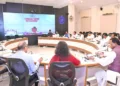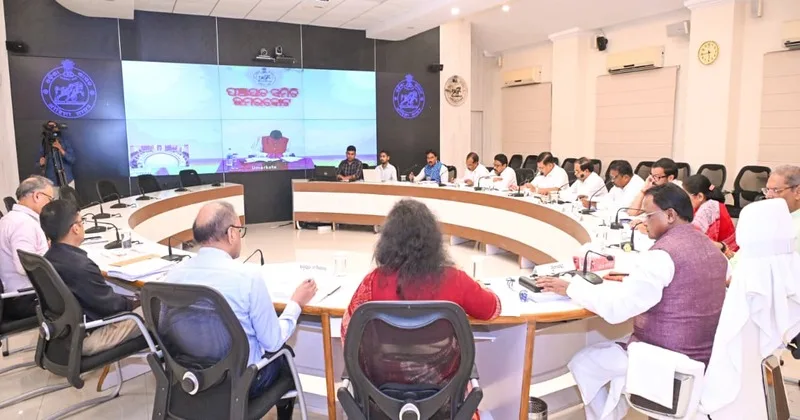
Bhubaneswar: The Odisha Cabinet, chaired by Chief Minister Mohan Charan Majhi, on Wednesday approved 10 proposals from six departments, taking a series of major decisions aimed at strengthening digital governance, expanding the State’s semiconductor ecosystem, accelerating renewable energy development and improving irrigation infrastructure.
The Cabinet decisions also included the approval of the Rs 12,458-crore Parbati Giri Mega Lift Irrigation Project, continuation of major child welfare schemes with an outlay of Rs 883.50 crore, and the implementation of the “Improvement to Tanks & MIPs – Phase-III” scheme with a financial outlay of Rs 389 crore.
Semiconductor Policy Gets Third Amendment
The Cabinet approved the third amendment to the Odisha Semiconductor Manufacturing and Fabless Policy, originally notified in September 2023 and subsequently amended in March 2024 and July 2025.
The policy has already facilitated proposals from five companies, including two projects that have secured support under the India Semiconductor Mission (ISM).
Under the visionary leadership of Hon’ble Chief Minister Shri Mohan Charan Majhi, Odisha is shaping its next generation of industrial growth.
With the 3rd Amendment to the Odisha Semiconductor Manufacturing and Fabless Policy, aligned with ISM 2.0, Odisha is strengthening the… pic.twitter.com/7mkbwzH8Yl
— CMO Odisha (@CMO_Odisha) August 12, 2026
The latest amendment seeks to align Odisha’s policy framework with emerging national priorities, particularly ISM 2.0, while expanding the scope of incentives to critical segments of the semiconductor value chain.
The revised policy will cover semiconductor equipment, semiconductor-grade chemicals and gases, advanced materials and other semiconductor supply-chain components, in addition to semiconductor manufacturing, OSAT/ATMP, display manufacturing and fabless design.
The policy will also support research and development and manufacturing activities involving advanced technologies.
Under the amended framework, the Odisha Government will provide additional fiscal support equivalent to 25% of eligible capital expenditure for projects approved by the India Semiconductor Mission, subject to applicable policy provisions.
The State assistance will be disbursed on a pari passu basis with the Government of India’s fiscal assistance and linked to project milestones and corresponding releases approved under the ISM.
The amendment also enables customised incentive packages for mega projects in semiconductor equipment, input supply chains and raw materials. Such packages will be considered by the State Cabinet on the recommendation of a High-Level Committee headed by the Chief Secretary.
The Government expects the revised policy to attract investments, generate direct and indirect employment, promote specialised skill development and encourage the growth of supporting MSMEs.
By covering manufacturing, equipment, materials, supply chains and related infrastructure, Odisha aims to develop a more integrated semiconductor ecosystem and emerge as a preferred destination for semiconductor manufacturing, innovation and advanced technology.
Renewable Energy Policy Amended
The Cabinet also approved amendments to the Odisha Renewable Energy Policy (OREP), 2022, aimed at accelerating renewable energy development, enhancing investor confidence and ensuring affordable green power for consumers.
Under the amended policy, eligible net-metering consumers will receive an Electricity Duty exemption of 50 paise per unit on renewable energy consumed from projects established within Odisha. The exemption will remain available for 10 years from the date of commissioning of the project.
The Cabinet further approved a 20 paise per unit exemption on State Transmission Utility (STU) charges for standalone Battery Energy Storage Systems (BESS) commissioned in Odisha.
The exemption will apply provided the energy used to charge the BESS is sourced from renewable energy projects and the stored electricity is utilised to meet the State’s demand.
The Government has also rationalised the wind power project allocation framework by removing the existing 500 MW cumulative cap for projects allocated through the first-come, first-served mechanism.
The amended policy provides for the promotion of Wind Power Parks and a Right of First Refusal (ROFR) of up to 25% of capacity for renewable energy captive projects.
Other reforms include harmonisation of operational guidelines and designating GRIDCO as the nodal agency for implementation of legacy Small Hydro Electric Projects (SHEPs).
The Government expects the reforms to improve operational efficiency, encourage investments and accelerate renewable energy deployment across Odisha
Rs 12,458 Crore Parbati Giri Mega Lift Irrigation Project
In a major push to expand irrigation coverage, the Cabinet approved the Parbati Giri Mega Lift Irrigation Project with an estimated outlay of Rs 12,458 crore over five years beginning from FY 2026-27.
Chief Secretary Anu Garg said the project would comprise 161 schemes across all 30 districts and create additional irrigation potential of 2,62,275 hectares.
The State has so far completed 209 Mega Lift Irrigation schemes, creating irrigation potential of approximately 2.66 lakh hectares across 23 districts.
The Chief Secretary said a considerable portion of Odisha’s cultivable land remains dependent on rainfall, making agriculture vulnerable to erratic rainfall, drought and the impacts of climate change.
Against this backdrop, Mega Lift Irrigation Projects are being prioritised in upland and water-deficit areas where conventional gravity-based irrigation is not feasible.
The project is expected to provide more reliable access to irrigation in areas where farmers face water shortages and contribute to strengthening agricultural productivity and rural livelihoods.
680 Minor Irrigation Projects to Be Renovated
The Cabinet also approved the “Improvement to Tanks & MIPs – Phase-III” scheme to revive and strengthen Odisha’s minor irrigation infrastructure.
The scheme will be implemented over four years, from FY 2026-27 to FY 2029-30, with a total financial outlay of Rs 389 crore. It will cover the renovation of 680 Minor Irrigation Projects (MIPs), including spillover works from Phase-II.
The initiative is expected to restore irrigation potential over approximately 15,700 hectares of ayacut and provide farmers with greater access to assured irrigation.
The renovation works will include reservoir desilting, strengthening of dam embankments, repair and restoration of spillways and head regulators, canal improvement and other rehabilitation measures.
The Government said the interventions are aimed at restoring the live storage capacity of reservoirs to their designed levels and improving the efficiency and reliability of existing irrigation infrastructure.
Besides supporting agriculture, the renovated water bodies are expected to facilitate allied activities such as pisciculture, while contributing to sustainable agricultural productivity and improving rural livelihoods.
The Phase-III initiative is expected to be particularly important in areas dependent on tank and MIP-based irrigation. By restoring existing projects to their designed capacity, the scheme seeks to make better use of available water resources and reduce the impact of inadequate irrigation facilities on farming communities.
Government Offices to Go Paperless
In a major step towards strengthening digital governance, the Cabinet approved the implementation of OSWAS 3.0, aimed at making government office functioning paperless up to the block level.
Under the leadership of Hon’ble Chief Minister Shri @MohanMOdisha, Odisha is strengthening good governance through digital transformation.
With OSWAS 3.0, the State is advancing towards paperless, faceless and transparent administration through an integrated digital workflow… pic.twitter.com/IASCJ5d6XO
— CMO Odisha (@CMO_Odisha) August 12, 2026
The initiative will streamline official work through electronic file movement and digital communication, reducing dependence on physical files and improving efficiency, transparency and speed in government administration.
By extending the digital workflow to the grassroots administrative level, the initiative is expected to create a more integrated and efficient system for handling government files and official communication.
Rs 883.50 Crore for Child Welfare Schemes
The Cabinet also approved the continuation of major child welfare schemes with a combined outlay of Rs 883.50 crore.
The Jashoda scheme and its sub-scheme Ashirbad have been approved for continuation for another five years, from FY 2026-27 to FY 2030-31, with a total budgetary outlay of Rs 296.99 crore.
Jashoda provides financial, educational and social support to children without biological parents, those with incapacitated parents, children affected or infected by HIV and children who lost their primary breadwinner during the COVID-19 pandemic.
The scheme provides assistance for technical education, coaching for competitive examinations, scholarships, Sukanya Samriddhi support and marriage assistance. It also provides for periodic surveys of orphaned children and issuance of orphan certificates to ensure their protection, care, rehabilitation and holistic development.
The Cabinet also approved the continuation of the Malati Devi Prak Vidyalaya Paridhan Yojana for five years, from FY 2026-27 to FY 2030-31, with an outlay of Rs 586.51 crore.
The scheme will benefit around 14.76 lakh pre-school children aged 3-6 years every year through Anganwadi Centres.
Under the revised provisions, pre-school boys will receive two pairs of uniforms at Rs 175 per pair, while girls will receive two pairs at Rs 225 per pair. Each beneficiary will also receive shoes, two pairs of socks and a sweater.
The initiative is expected to support children’s smooth transition to primary education while creating livelihood opportunities for Self Help Groups, SHG federations and Subhadra beneficiaries involved in stitching and supplying uniforms.
Besides supporting children’s smooth transition to primary education, the scheme is expected to create livelihood opportunities for Self Help Groups, SHG federations and Subhadra beneficiaries engaged in stitching and supplying uniforms.
Overall, the Cabinet decisions underline the Odisha Government’s focus on digital transformation, advanced technology, irrigation expansion, clean energy and social welfare. The measures are aimed at strengthening essential infrastructure, attracting investment, creating employment opportunities and improving public services while addressing key developmental challenges across the State.