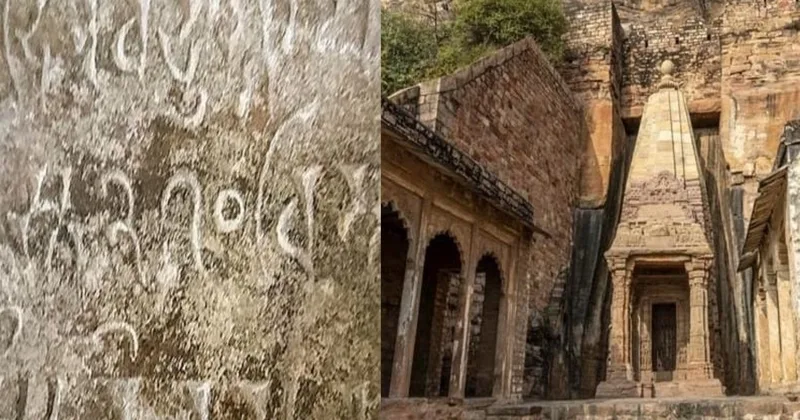
Gwalior: Nestled within the rocky slopes of the majestic Gwalior Fort stands a small, unassuming shrine that holds an extraordinary place in human history. The Chaturbhuj Mandir, carved into the fort’s sandstone around 875-876 CE and dedicated to Bhagwan Vishnu, preserves one of the earliest known stone inscriptions featuring the circular symbol for zero in the same form still used across the world today.
One of India’s greatest hill forts, Gwalior Fort is renowned for its magnificent palaces, Mandirs and museums built over centuries of Rajput and Mughal rule. Amid these grand monuments, the modest Chaturbhuj Mandir is easy to miss. Yet this simple square-shaped shrine with intricately carved pillars has earned global recognition as the “Zero Mandir” because of a remarkable inscription engraved on one of its walls.
The Inscription That Made History
Dating back to around 876 CE, the Sanskrit inscription records the donation of a flower garden and adjoining land to the temple. While the text itself documents a routine land grant, it contains numerals representing 270 and 50, both written with a small circular symbol for zero that closely resembles the numeral used today.
Although the inscription appears to be an ordinary administrative record, it has become one of the most celebrated examples of early mathematical notation. The concept of zero had already been developed by Indian mathematicians centuries earlier. The Bakhshali manuscript, radiocarbon dated to around the 3rd century CE, is believed to contain an even older representation of zero, while a 7th-century inscription at Cambodia’s Sambor temple has also been cited as an earlier example.
What makes the Chaturbhuj Mandir unique is that its zero is carved into a permanent Mandir wall, making it one of the oldest surviving publicly visible examples of the numeral preserved in stone rather than on fragile manuscripts or relocated artefacts.
A Quiet Monument to Mathematics
Despite centuries of exposure to wind and rain, much of the inscription remains visible, including the famous circular zero. Visitors walking towards the Hathi Pol gate of Gwalior Fort often stop at the Mandir, where pilgrims, historians, mathematicians and curious travellers gather to witness this remarkable piece of India’s scientific heritage.
The Mandir may appear modest beside the fort’s towering palaces, but its historical significance is immense. The tiny circular mark etched into its stone wall represents an idea that transformed mathematics and became the foundation of modern science, engineering, finance and computing.
Today, the Chaturbhuj Mandir stands not only as a place of worship but also as a timeless reminder of India’s profound contribution to the world of mathematics, where one of history’s most revolutionary symbols continues to endure in silence.