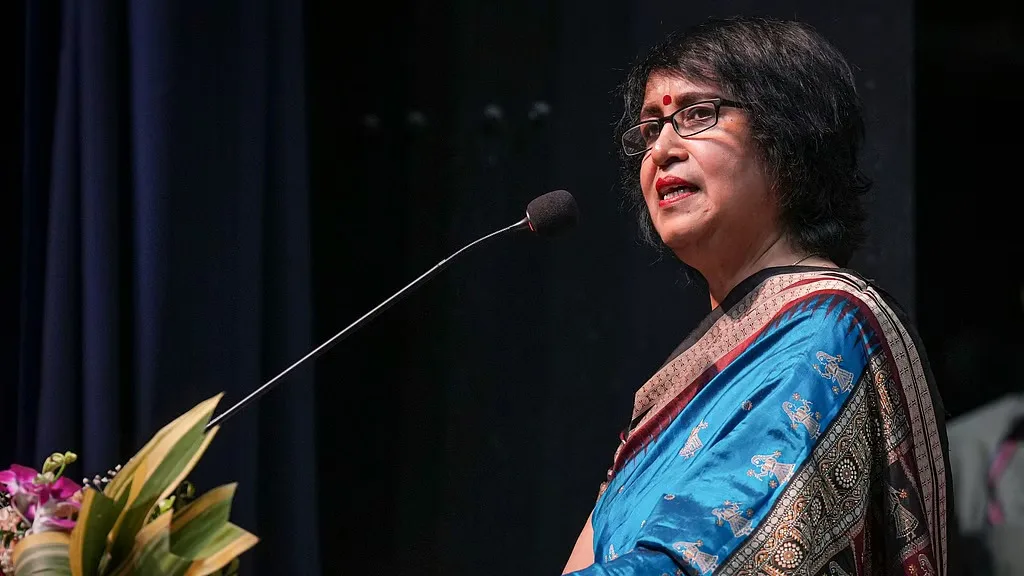
Exiled Bangladeshi author Taslima Nasreen has shared on one of the most painful episodes of her life, the night she was compelled to leave Kolkata following violent protests in 2007, describing it as “one of the longest nights” she has ever endured.
Speaking nearly 19 years after the incident, Nasreen said the events of November 22, 2007, continue to haunt her. While time has passed, she says the emotional trauma of being abruptly removed from the city she considered her literary home remains as vivid as ever.
Violent Protests Led to Sudden Departure
The events unfolded amid widespread unrest in Kolkata over Nasreen’s presence in the city.
Violent demonstrations erupted in several parts of the West Bengal capital as groups opposing the Bangladeshi writer took to the streets, creating a major law-and-order challenge for the then Left Front government.
As tensions escalated, the state government decided that Nasreen would have to leave West Bengal.
According to her account, the decision was implemented with little notice.
She recalled that on the evening of November 22, Kolkata Police officials arrived at her residence and informed her that arrangements had been made for her immediate departure.
Nasreen said she was handed an airline ticket and escorted to the airport without being told where she was being taken.
‘I Didn’t Know Where I Was Being Taken’
According to Nasreen, it was only after boarding the aircraft that she realised the flight was headed to Jaipur.
The uncertainty, however, did not end with the flight.
She reached Jaipur late that night and was taken to a hotel for temporary accommodation.
The author has described the hotel as isolated and insecure, adding that journalists had already gathered outside, indicating that news of her arrival had spread quickly.
Midnight Move to Delhi
Nasreen recalled that around midnight, the Jaipur Police Commissioner visited her hotel room and informed her that she could not remain there.
She said she pleaded to be allowed to return to Kolkata but was instead told that she would be taken to Delhi.
According to her recollection, police officials informed her that the decision had been communicated by the then Union External Affairs Minister Pranab Mukherjee, and that the West Bengal government would not permit her return to the state.
She described the overnight journey from Jaipur to Delhi under police escort as one of the most difficult experiences of her life.
“It was one of the longest nights of my life,” she has recalled.
Travelling through the night with little clarity about her future, Nasreen said she had no option but to comply with the authorities.
Life After Leaving Kolkata
Upon reaching Delhi, Nasreen was accommodated at Rajasthan House before being shifted to another secure location.
The move marked the beginning of another uncertain phase in her stay in India.
Although nearly two decades have passed, she says the memories remain deeply painful.
According to Nasreen, the episode was not merely a change of location but the sudden loss of the city where she had built her literary life and felt most connected.
Return After 19 Years
During her recent visit to Kolkata after nearly two decades, one of the first places Nasreen visited was her former residence on Rowdon Street.
She has repeatedly described Kolkata as the city where she feels most at home because it allows her to speak Bengali freely and engage with readers in her native language.
Nasreen said she hopes to visit Kolkata more frequently in the future but believes the circumstances are still not favourable for her permanent return.
No Hope of Returning to Bangladesh
Reflecting on her homeland, Nasreen expressed little optimism about returning to Bangladesh.
She said she no longer believes she will ever be able to return permanently, arguing that threats from religious extremists continue to make such a move impossible.
While acknowledging that she expected opposition from religious fundamentalist groups, Nasreen said what hurt her most was the response of the then Left Front government in West Bengal.
According to her, she never imagined that a government she regarded as progressive would ask her to leave Kolkata under such circumstances.
She believes the government yielded to pressure from fundamentalist groups instead of defending the principles of free expression.
For Nasreen, her recent visit to Kolkata was therefore far more than a personal trip.
It represented a return to a city from which she believes she was forced to leave against her wishes—a city she still considers her own despite the passage of nearly two decades.
The events of November 22, 2007, she says, remain not only a significant political chapter in West Bengal’s history but also a deeply personal story of exile, uncertainty and loss that continues to shape her life.