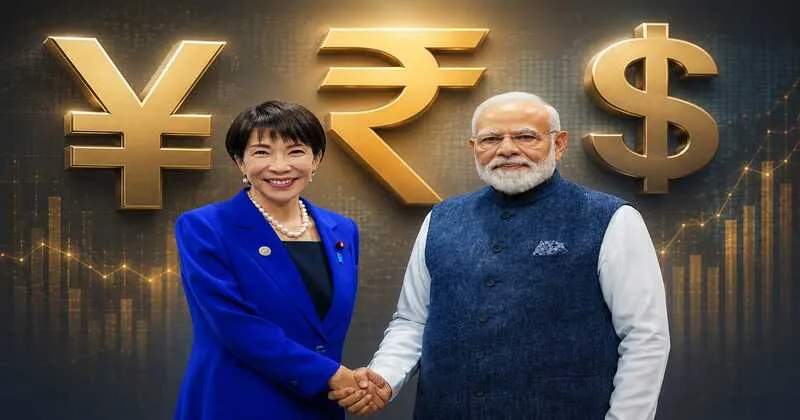
The arrival of Japanese Prime Minister Sanae Takaichi in New Delhi from July 1 to 3 for the 16th India-Japan Annual Summit is significant not merely because it marks her first bilateral visit to India since assuming office, but because it could reshape one of the most important dimensions of the India-Japan economic partnership that the way the two countries settle trade.
Prime Minister Narendra Modi and Takaichi are expected to review cooperation across trade, investment, advanced technology, artificial intelligence (AI), infrastructure, defence, supply-chain resilience and regional security. Yet among the many items on the agenda, one proposal has attracted particular attention, the creation of a framework for direct settlement of bilateral trade in Japanese yen and Indian rupees.
At first glance, the proposal appears to concern banking procedures. In reality, it represents a broader effort to modernise financial cooperation between two trusted strategic partners. It also reflects India’s steadily expanding role in promoting local-currency trade without seeking to overturn the existing global financial order.
The phrase “de-dollarisation” is frequently used to describe such initiatives. However, the proposed India-Japan framework is better understood as diversification rather than displacement. The US dollar remains the world’s dominant reserve currency and will continue to play a central role in international commerce. What India and Japan are exploring is a mechanism that allows businesses to transact more efficiently by using their own currencies whenever commercially practical.
The proposal builds upon the momentum generated during Prime Minister Modi’s visit to Tokyo for the 15th India-Japan Annual Summit in August 2025. During that visit, Japan committed to more than doubling its investment in India to over $61 billion over the coming decade, highlighting the growing strategic importance of the bilateral economic partnership. The Japan-India Joint Vision for the Next Decade, adopted during that summit, had already referred to payment-system cooperation, including local-currency transactions. The current discussions therefore represent a logical progression rather than an entirely new policy direction.
Beyond the Dollar: Lower costs, faster trade
Today, a substantial share of trade between Indian and Japanese businesses is settled through the US dollar. While this has long been the standard practice in international trade, it involves multiple stages of currency conversion.
For instance, when a Japanese company exports industrial machinery or automobile components to India, payments are generally routed through the dollar. Japanese yen are converted into US dollars before settlement, while the Indian buyer subsequently converts those dollars into rupees. Every conversion introduces additional foreign-exchange costs, remittance charges and exposure to exchange-rate fluctuations.
Large multinational corporations often possess sophisticated hedging systems that help minimise these financial risks. Smaller and medium-sized enterprises, however, usually have fewer resources to absorb such costs. As a result, transaction expenses can disproportionately affect businesses that have limited financial flexibility.
The proposed framework seeks to address this inefficiency. Under the arrangement under discussion, Japanese non-resident entities would be permitted to open accounts with commercial banks operating in India. This would allow financial institutions to settle cross-border invoices directly in Japanese yen and Indian rupees without routing transactions through the US dollar or relying on correspondent banks located in third countries.
#WATCH | Delhi: During press statement with Prime Minister Narendra Modi, Japanese PM Sanae Takaichi says, "You called me a beautiful younger sister, Prime Minister Modi but at, the small meeting before the big meeting, we we confirmed that we are on the same page and develop… pic.twitter.com/VsIG9QeGil
— ANI (@ANI) July 2, 2026
The expected outcome is straightforward that reduced foreign-exchange conversion costs, lower remittance expenses and faster settlement of payments. For businesses engaged in regular bilateral trade, these operational improvements could make commercial transactions both simpler and more predictable.
Japan’s Ministry of Finance is also targeting the signing of a Memorandum of Cooperation with the Reserve Bank of India during fiscal year 2026 to strengthen local-currency settlement arrangements. If finalised, another milestone would be achieved through the inclusion of currency cooperation in the leaders’ joint statement for the first time since annual summits between the two countries began.
Rather than signalling confrontation with the existing international financial architecture, the proposal demonstrates how trusted strategic partners are creating practical mechanisms to facilitate trade while retaining flexibility within the broader global monetary system.
Building on an existing financial architecture
The proposed framework is not being developed in isolation. India and Japan already possess a substantial financial foundation that supports deeper monetary cooperation. The two countries maintain a bilateral currency swap agreement valued at $75 billion, which has been extended through 2026. Such swap arrangements enable central banks to exchange currencies when necessary, ensuring liquidity during periods of financial stress while reinforcing confidence in bilateral financial stability.
India has simultaneously been broadening the use of local-currency settlement with multiple trading partners. In July 2022, the Reserve Bank of India introduced the Special Rupee Vostro Account framework, allowing international trade to be invoiced, paid and settled directly in Indian rupees.
The Finance Ministry subsequently informed Parliament that the arrangement was intended to promote global trade with particular emphasis on Indian exports while encouraging wider international acceptance of the rupee. The Reserve Bank has consistently clarified that rupee settlement serves as an additional mechanism alongside existing arrangements based on freely convertible currencies rather than replacing them. Exchange rates under the framework continue to remain market determined.
My remarks during the India-Japan Joint Economic Forum. https://t.co/dhFvUo0YET
— Narendra Modi (@narendramodi) July 2, 2026
The system has gradually expanded. By August 2025, the Reserve Bank had allowed foreign entities maintaining Special Rupee Vostro Accounts to invest surplus balances in central government securities. Parliamentary information later indicated that the RBI had approved 156 Special Rupee Vostro Accounts across 26 Indian banks for 123 correspondent banks representing 30 trading partner countries.
Japan itself has experience with similar local-currency arrangements elsewhere in Asia. In December 2025, Tokyo renewed and expanded its memorandum of cooperation with Indonesia to encourage the use of local currencies across bilateral transactions, building upon an earlier framework established in 2019. The India-Japan proposal therefore aligns with broader regional efforts aimed at improving payment efficiency through greater use of domestic currencies.
Strengthening a strategic economic partnership
The proposed settlement framework arrives at a time when India-Japan economic ties continue to expand across multiple sectors despite structural trade imbalances. According to the latest figures for FY2025-26, bilateral merchandise trade reached approximately $27.47 billion. India’s exports to Japan stood at around $6.04 billion, while imports from Japan amounted to approximately $21.43 billion, resulting in a trade deficit of $15.39 billion.
India exports a diverse range of products including organic chemicals, vehicles and automobile components, marine products, aluminium and aluminium-based goods, electrical equipment and components associated with nuclear reactors.
Japanese exports remain concentrated in high-value industrial sectors such as heavy machinery, nuclear reactor equipment, electrical machinery, automotive parts, copper products, iron and steel, and inorganic chemicals.
The broader commercial relationship continues to be anchored by the India-Japan Comprehensive Economic Partnership Agreement (CEPA), which entered into force in 2011 and remains the principal framework governing bilateral trade.
Investment ties are equally significant. Between April and December 2025, Japanese investment in India reached $3.2 billion according to Indian government data. Around 1,400 Japanese companies currently operate in India, with nearly half engaged in manufacturing activities. Japanese participation also extends to major infrastructure initiatives, including the Mumbai-Ahmedabad High-Speed Rail Corridor, while Japanese firms continue expanding investments in Indian companies, including the recent $1.6 billion acquisition of a 20 per cent stake in Yes Bank.
The summit agenda extends well beyond financial cooperation. Both leaders are expected to discuss defence collaboration, resilient supply chains, semiconductor manufacturing, artificial intelligence, automobiles and regional security. As members of the Quad alongside the United States and Australia, India and Japan continue to emphasise cooperation in advancing a free and open Indo-Pacific.
インドの首都・デリーに到着しました。
日本の総理として約3年ぶり、私個人としては初めてのインド訪問になります。… pic.twitter.com/F8PKt61SLn— 高市早苗 (@takaichi_sanae) July 1, 2026
Against this wider strategic backdrop, the proposed yen-rupee settlement framework should not be viewed solely through the narrow lens of currency politics. Instead, it represents another layer of institutional integration between two democratic partners whose relationship increasingly spans finance, technology, manufacturing, infrastructure and security.
If incorporated into the joint statement as anticipated, the initiative would symbolise the maturity of the India-Japan partnership. It would demonstrate that both governments are prepared to introduce practical financial innovations that reduce transaction costs, enhance business confidence and improve the ease of bilateral commerce without disrupting the broader international monetary system.
For India, the framework also complements its wider objective of gradually internationalising the rupee through market-based mechanisms while expanding economic partnerships with trusted nations. Rather than representing an abrupt challenge to dollar dominance, the proposed arrangement illustrates a more calibrated approach, one that strengthens India’s financial autonomy, supports bilateral trade and reflects the country’s growing confidence as a leading economic power in the Indo-Pacific. In that sense, the proposed yen-rupee framework is less about replacing the dollar and more about giving India and Japan greater flexibility, resilience and efficiency in conducting business with each other.