
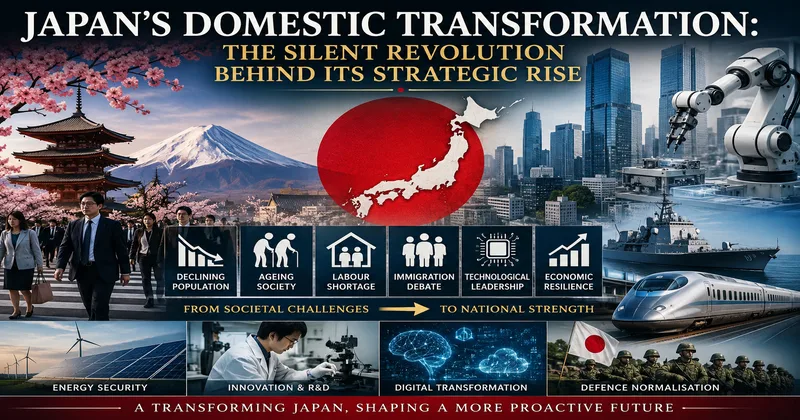
To understand the significance of the Modi–Takaichi Summit, one must look beyond diplomatic engagements and defence agreements. Equally important is the profound transformation unfolding within Japan itself. Beneath the image of a technologically advanced and economically resilient nation lies a society grappling with demographic decline, labour shortages, immigration, and an increasingly vigorous debate over national identity. These domestic realities are not peripheral to Japan’s foreign policy; they are becoming one of its principal drivers.
For decades, Japan represented one of the world’s most culturally homogeneous societies. Unlike many Western democracies that embraced large-scale immigration after the Second World War, Japan consciously prioritised cultural continuity, social harmony, and gradual economic adaptation. Its remarkable post-war economic rise was achieved largely without fundamentally altering its demographic composition.
Today, however, that model faces unprecedented strain.
Japan’s fertility rate has remained well below replacement level for years, while its ageing population continues to grow rapidly. Every year, the country records fewer births and a shrinking workforce. Labour shortages have become acute across manufacturing, healthcare, agriculture, logistics, hospitality, and construction. For a nation aspiring to remain a technological and industrial powerhouse, these demographic realities have evolved from a social concern into a strategic challenge.
Consequently, successive Japanese governments have cautiously expanded foreign worker programmes through technical intern schemes, specified skilled worker visas and sector-specific labour initiatives. While Tokyo still avoids describing itself as an immigration country, the practical effect has been unmistakable: Japan is becoming more diverse than at any point in its modern history.
Yet immigration, as many societies have discovered, is never merely an economic phenomenon.
It inevitably raises broader questions concerning integration, cultural adaptation, legal norms, social cohesion and national identity. Japan has now entered precisely that phase.
Revisiting Earlier Warnings
Nearly three years ago, this author argued in Organiser that Japan’s demographic transition was quietly reshaping its religious and social landscape. In the article “Religious Tensions in Japan Grows Amidst Burgeoning Muslim Population in the Land of the Rising Sun” (June 2023), attention was drawn to the rapid growth of Japan’s Muslim population, the increasing number of mosques across the country and the emerging debates surrounding religious accommodation within one of Asia’s most culturally cohesive societies.
At the time, these developments appeared to many observers as isolated local issues.
However, the underlying argument was that demographic necessity would eventually intersect with questions of civilisational identity, creating debates that would increasingly enter mainstream Japanese politics.
Events over the subsequent three years have largely validated that assessment.
Japan’s Muslim population has continued to expand, driven primarily by labour migration from Indonesia, Bangladesh, Pakistan, Malaysia and other parts of Asia. Alongside this demographic change has emerged a parallel discussion over religious infrastructure, burial practices, urban planning and the integration of communities with distinct religious and cultural traditions.
What initially appeared to be administrative questions have gradually evolved into national political issues.
From Local Disputes to National Debate
Perhaps nowhere has this transformation become more visible than in the controversies surrounding Muslim burial grounds and mosque construction.
Japan’s funeral traditions are overwhelmingly centred on cremation, a practice deeply embedded within both Buddhist customs and modern civic administration. Islamic religious practice, however, generally requires burial.
As the Muslim population has increased, local governments have begun exploring burial facilities to accommodate these communities. Yet proposals in prefectures such as Miyagi, Oita and Ibaraki have encountered strong local resistance. Residents have raised concerns over land availability, environmental impact, consultation processes and the preservation of long-established community practices.
Similarly, mosque construction has become a subject of growing public debate in several municipalities. While many projects have proceeded peacefully through sustained dialogue with local communities, others have generated controversy over planning permissions, traffic management, environmental concerns and adherence to local regulations.
These developments should not be interpreted simplistically as religious disputes.
Rather, they reflect a broader national conversation about how a historically homogeneous society adapts to increasing diversity while preserving the social harmony that has long characterised Japanese public life.
Unlike many Western democracies, where multiculturalism evolved over several decades, Japan is confronting these questions within a comparatively compressed timeframe, while simultaneously managing economic stagnation, demographic ageing and an increasingly volatile regional security environment.
From Prediction to Reality
This broader transformation became particularly evident in 2026 with the controversy surrounding the Japan Jame Masjid Ramzan in Kawagoe, Saitama Prefecture.
As analysed by this author in the recent Organiser article “Pakistan Embarrassed in Japan as Illegal Mosque Inaugurated by Ambassador Faces Demolition,” the issue extended far beyond a dispute over urban planning. The demolition order issued by Japanese authorities, following allegations of illegal construction on protected land, evolved into a national debate concerning legal compliance, immigration, foreign funding and social integration.
The episode proved significant not because it involved a single structure but because it demonstrated how concerns once confined to local administrative bodies had entered Japan’s mainstream political discourse.
Equally revealing was Pakistan’s own decision to publicly advise its nationals to comply fully with Japanese laws, distancing its embassy from the project despite its earlier association with the mosque’s inauguration. Such developments underscored an important reality: in contemporary Japan, respect for law and social discipline remains central to public legitimacy, irrespective of religious or national identity.
The Kawagoe controversy therefore represented not an isolated incident but another chapter in Japan’s evolving debate over the relationship between immigration, integration and national cohesion.
Civilisational Confidence Versus Civilisational Conflict
Yet Japan’s experience also demonstrates another important lesson.
The challenge is not the presence of foreign cultures, but the manner in which cultural exchange occurs.
In an earlier Organiser article, “Commemorating Chhatrapati Shivaji Maharaj in Japan: A Monument to Transnational Cultural Synergy,” this author examined the unveiling of Chhatrapati Shivaji Maharaj’s statue in Japan as an example of civilisational diplomacy rooted in mutual respect and historical appreciation.
Unlike controversies surrounding unauthorised construction or legal disputes, the Shivaji Maharaj memorial was widely welcomed as a symbol of friendship between two ancient Asian civilisations. It celebrated shared values of courage, national pride, cultural continuity and respect for local traditions. Rather than creating social friction, it strengthened people-to-people goodwill and deepened bilateral understanding.
The contrast is instructive.
One represents cultural engagement that enriches the host society through mutual respect.
The other illustrates the tensions that can emerge when legal norms and community sensitivities become contested.
This distinction is increasingly recognised within Japan’s own public discourse.
The Rise of Civilisational Conservatism
These domestic debates are also reshaping Japanese politics.
Issues once considered administrative—immigration policy, cultural integration, demographic sustainability and national identity—have steadily acquired political salience. Conservative leaders increasingly argue that economic modernisation should not come at the expense of Japan’s cultural continuity.
Prime Minister Sanae Takaichi has emerged within this broader intellectual tradition.
While internationally recognised primarily for her advocacy of economic security and defence modernisation, her political philosophy also emphasises national resilience, constitutional confidence, historical continuity and the preservation of Japan’s civilisational identity. For Takaichi and many contemporary Japanese conservatives, strategic strength begins with social cohesion at home.
This represents an important point of convergence with Bharat.
Both nations are ancient civilisations navigating the pressures of globalisation while seeking to preserve their distinctive cultural identities. Both recognise that technological progress and economic development need not require civilisational amnesia. Both increasingly reject the assumption that modernisation must necessarily follow Western ideological models.
Why Bharat Must Understand This Transformation
For Indian strategic thinkers, these domestic developments are far more than matters of Japanese internal politics.
They explain why Tokyo increasingly seeks trusted, like-minded partners capable of contributing not only to economic prosperity but also to regional stability.
Japan’s search for resilient supply chains, trusted technology ecosystems, dependable defence partnerships and democratic strategic cooperation cannot be separated from its internal transformation. A nation confronting demographic pressures while preserving social cohesion naturally values partners that share long-term strategic thinking, institutional stability and respect for civilisational heritage.
In this regard, Bharat occupies a uniquely favourable position.
The partnership between New Delhi and Tokyo is no longer founded solely upon converging geopolitical interests. It increasingly rests upon a deeper appreciation that both nations are ancient Asian civilisations striving to modernise without severing themselves from their historical identities.
Understanding this silent transformation within Japan is therefore essential to understanding the true significance of the Modi–Takaichi Summit. The strategic agreements announced during high-level meetings are visible manifestations of a much deeper convergence—one rooted not merely in economics or security, but in a shared civilisational confidence about Asia’s future.