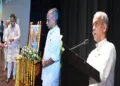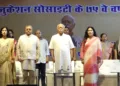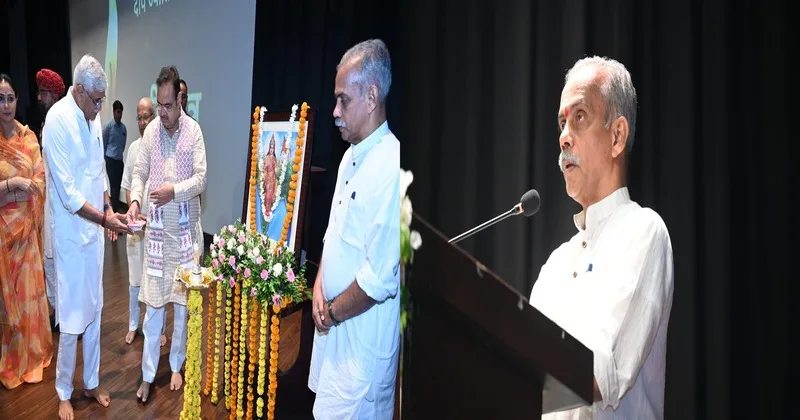
Jaipur: The preparations for Lokmanthan 2026, a major national forum dedicated to India’s civilisational thought, cultural heritage and intellectual traditions, formally commenced on July 7 with the announcement of organising and reception committees by Rajasthan Chief Minister Bhajan Lal Sharma at the Constitution Club in Jaipur.
Scheduled to be held in Jaipur from December 4 to 6, 2026, the fifth edition of Lokmanthan will revolve around the theme “We the People of India” and is expected to bring together leading scholars, thinkers, artists, policymakers, social leaders and representatives from across the country for discussions on India’s civilisational identity and future.
The Chief Minister also launched the official website of Lokmanthan 2026, marking the formal beginning of preparations for the national event.
Addressing the gathering, Bhajan Lal Sharma described Lokmanthan as far more than a conference, calling it “a grand intellectual and cultural yajna that reflects the nation’s ideological energy and cultural consciousness.” He said Rajasthan’s selection as the host state for the fifth edition was a matter of pride, noting that the state has historically been a land of both devotion and valour.
Highlighting Rajasthan’s rich cultural traditions, Sharma said village gatherings, Ramleela and Rasleela performances had historically served as platforms for public dialogue and social learning. He credited Prime Minister Narendra Modi with strengthening the spirit of “Nation First” and promoting India’s cultural renaissance.
“We must move forward by preserving both development and heritage. Platforms like Lokmanthan are essential to carry forward our traditions and inspire future generations,” the Chief Minister said.
Delivering the keynote address, Pragya Pravah National Convenor J. Nandakumar emphasised that meaningful dialogue has always been central to India’s civilisational evolution.
“India was built through constructive dialogue, and the India of the future will also be strengthened through continuous, healthy and multidimensional dialogue,” he said.
Tracing the origins of Lokmanthan, Nandakumar explained that the initiative was launched to revive India’s ancient tradition of intellectual engagement after centuries of disruption during the medieval and colonial periods. He said the platform seeks to democratise national discourse by ensuring participation from villages, tribal communities, forests and remote regions rather than limiting discussions to urban intellectual circles.
“India’s dialogue must belong to the entire society. Every citizen, including the person standing in the last row, should become a participant in the national conversation,” he remarked.
Nandakumar outlined four essential pillars of India’s dialogue tradition—healthiness, constructiveness, continuity and multidimensionality. According to him, Indian dialogue is rooted in the pursuit of truth rather than victory in debate.
Quoting the philosophy behind Indian discourse, he said, “Not to debate and win, but to know and let others know.”
He contrasted India’s inclusive dialogue tradition with Western models, arguing that Indian discourse encompasses society, nature and the wider universe instead of remaining confined to exchanges between individuals.
Union Tourism and Culture Minister Gajendra Singh Shekhawat described Lokmanthan as a celebration of India’s civilisational confidence and announced that the main event would take place during the first week of December.
Calling the conclave “the beginning of a new ideological movement,” Shekhawat said India’s civilisation had never accepted colonial thought despite centuries of foreign domination.
“‘We the People of India’ is not merely a constitutional phrase; it is the collective cultural expression of 1.4 billion Indians. We are ‘Lok’ ourselves, not merely ‘folk’,” he said.
The Union Minister also observed that India’s indigenous wisdom continues to remain relevant even in the age of artificial intelligence and machine learning. He noted that Lokmanthan offers an opportunity to bridge the perceived divide between India’s classical traditions and its living folk culture.
Deputy Chief Minister Diya Kumari described Chief Minister Bhajan Lal Sharma as “Rajasthan’s Bhagirath” and credited J. Nandakumar’s efforts for bringing the prestigious national event to the state.
She said Lokmanthan would provide a platform for generating new ideas and strengthening India’s cultural identity while stressing the need for families, educational institutions and society to work together to connect younger generations with India’s traditions.
“Our science, yoga tradition and the philosophy of Vasudhaiva Kutumbakam define our identity. Such forums help preserve and promote these timeless values,” she said.
The inaugural programme also featured Padma Shri awardee Tagaram Bheel, while folk artists presented colourful cultural performances showcasing Rajasthan’s rich artistic traditions.
Organisers said Lokmanthan 2026 will serve as a national platform for discussions on India’s knowledge systems, cultural continuity, civilisational values and the role of dialogue in shaping the country’s future, with Jaipur expected to emerge as a focal point of national intellectual and cultural discourse during the three-day conclave.