
Why Pakistan is rewriting its civilizational narrative
July 1, 2026
  • Read Ecopy
  • Circulation
  • Advertise
  • Careers
  • About Us
  • Contact Us
Android AppiPhone AppArattai
Organiser
  • ‌
  • Bharat
    • Assam
    • Bihar
    • Chhattisgarh
    • Jharkhand
    • Maharashtra
    • View All States
  • World
    • Asia
    • Europe
    • North America
    • South America
    • Africa
    • Australia
  • Editorial
  • International
  • Opinion
  • RSS @ 100
  • More
    • Op Sindoor
    • Analysis
    • Sports
    • Defence
    • Politics
    • Business
    • Economy
    • Culture
    • Special Report
    • Sci & Tech
    • Entertainment
    • G20
    • Azadi Ka Amrit Mahotsav
    • Vocal4Local
    • Web Stories
    • Education
    • Employment
    • Books
    • Interviews
    • Travel
    • Law
    • Health
    • Obituary
  • Subscribe
    • Subscribe Print Edition
    • Subscribe Ecopy
    • Read Ecopy
  • ‌
  • Bharat
    • Assam
    • Bihar
    • Chhattisgarh
    • Jharkhand
    • Maharashtra
    • View All States
  • World
    • Asia
    • Europe
    • North America
    • South America
    • Africa
    • Australia
  • Editorial
  • International
  • Opinion
  • RSS @ 100
  • More
    • Op Sindoor
    • Analysis
    • Sports
    • Defence
    • Politics
    • Business
    • Economy
    • Culture
    • Special Report
    • Sci & Tech
    • Entertainment
    • G20
    • Azadi Ka Amrit Mahotsav
    • Vocal4Local
    • Web Stories
    • Education
    • Employment
    • Books
    • Interviews
    • Travel
    • Law
    • Health
    • Obituary
  • Subscribe
    • Subscribe Print Edition
    • Subscribe Ecopy
    • Read Ecopy
Organiser
  • Home
  • Bharat
  • World
  • Operation Sindoor
  • Editorial
  • Analysis
  • Opinion
  • Culture
  • Defence
  • International Edition
  • RSS @ 100
  • Magazine
  • Read Ecopy
Home Bharat

‘Ancient Pakistan’ to ‘Children of the Indus’: Why Pakistan is rebranding its identity

'Ancient Pakistan' to 'Children of the Indus': Why Pakistan is rebranding its identity Intro: Pakistan is increasingly claiming the Indus Civilisation, Sanskrit, the Rigveda, Yoga and other pre-Islamic traditions as part of its heritage. This marks a major shift for a country founded on Islamic identity, raising questions about why it is rebranding itself

Yatharth SikkaYatharth Sikka
Jul 1, 2026, 06:20 pm IST
in Bharat, World, Asia, Jammu and Kashmir, International Edition
Follow on Google News
FacebookTwitterWhatsAppTelegramEmail

For nearly eight decades, Pakistan defined its national identity by distancing itself from civilisational past. It’s school textbooks, political discourse and ideology largely projected Pakistan’s history as beginning with the arrival of Muhammad bin Qasim in Sindh in 711 CE, while pre-Islamic civilisation was often treated as irrelevant. Today, however, that narrative appears to be undergoing a remarkable shift.

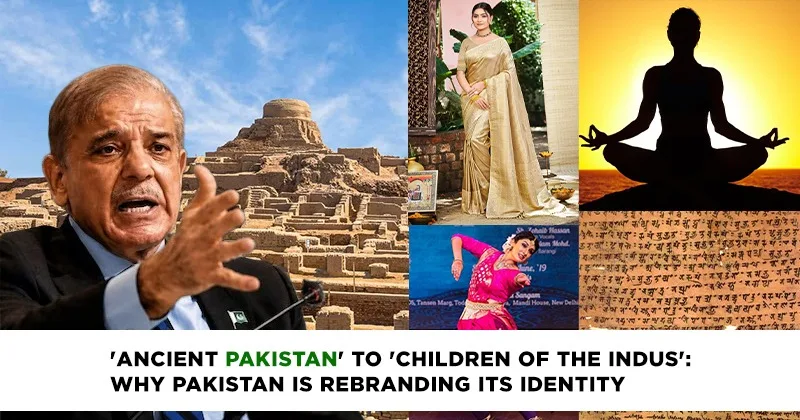
Amid growing tensions with India over the Indus Waters Treaty, Pakistani politicians, academics and diplomats have increasingly begun invoking the Indus Valley Civilisation, Harappa, Mohenjo-daro, Taxila, Sanskrit and even ancient Hindu-era personalities such as Panini as part of Pakistan’s historical inheritance. Defence Minister Khawaja Asif has openly acknowledged that the ancestors of most Pakistani Muslims were Hindus, while Information Minister Attaullah Tarar has declared Pakistanis to be the “children of the Indus”, claiming civilisational ownership of the river system.

The sudden embrace raises an obvious question that ‘Why is Pakistan trying to redefine its identity now?’

Pakistan’s foundation largely rested on the Two-Nation Theory, separating Muslims politically from Hindus. Over time, the state increasingly promoted an identity linked with Central Asia, Persia and Arabia. Turkish rulers, Arab conquerors and Mughal emperors occupied place in nation’s history, while indigenous civilisation received comparatively little emphasis.

Read More: Ahmedabad Riots 1946: Revisiting Gandhi’s controversial “if few lakhs are killed’ remark

Today, however, a different narrative is emerging. Pakistan is increasingly speaking of the Indus Valley Civilisation, Gandhara, Taxila, Harappa, Mohenjo-daro and Panini. Universities in Lahore have introduced Sanskrit courses, with scholars arguing that the language forms part of Pakistan’s own historical legacy. Cultural events like celebrating Basant Panchami, performing Kathak and pre-Islamic archaeological sites are also receiving greater public visibility than before.

This is not merely an academic development. It reflects a broader search beyond Arabisation.

Indus Waters Treaty changed the narrative

The turning point appears closely connected to India’s decision to place the Indus Waters Treaty in abeyance after the Pahalgam terrorist attack.

For Pakistan, the Indus River is not simply a source of water; it is central to its agriculture, and economy. Consequently, Islamabad has launched an international diplomatic campaign portraying itself as the natural heir and custodian of the Indus civilisation. They are also taking foreign diplomats to Taxila, the historic centre of Buddhist and Gandharan civilisation.

Official statements increasingly argue that because Harappa, Mohenjo-daro and much of the Indus basin lie within present-day Pakistan, the country’s claim over the Indus carries historical as well as geographical legitimacy.

Interestingly, Pakistan’s new discourse does not describe these traditions as Hindu. Instead, they are increasingly presented as “South Asian heritage.”

Whether discussing Sanskrit, the Indus Valley Civilisation, Harappa or Basant Panchami, the argument often follows a common pattern that these traditions are said to belong to the region rather than to Hindu civilisation. This framing enables Pakistan to take advantage of its ancient past without appearing to challenge its Islamic national identity.

The rebranding is no longer limited to Harappa, Mohenjo-daro, or the Indus Valley Civilisation.

Pakistan is increasingly attempting to associate itself with traditional Indian cultural symbols such as the saree. Politicians now describe Pakistanis as the “children of the Indus.”

There have also been discussions about restoring the ancient names of cities and highlighting their pre-Islamic identities. Although many such proposals are later withdrawn under pressure from Islamist groups, these repeated attempts also raise the question of why Pakistan is doing this.

Some voices in Pakistan are now also seeking to connect themselves with the Rigveda because it was composed in that region. Notably, the Rigveda predates the arrival of Islam in the region by several millennia. Regardless of academic debates, it belongs to the ancient Vedic-Hindu civilisation that flourished long before the emergence of Pakistan or Islam. For centuries after the advent of Islam, the Rigveda was neither preserved nor accepted within Pakistan’s dominant religious tradition.

A similar pattern is visible with Yoga. Rooted in the Vedas, the Upanishads, and the broader Hindu philosophical tradition, Yoga has for millennia been an integral part of Hindu civilisation. Yet Pakistan is increasingly seeking to portray Yoga as a universal practice while distancing it from its Hindu origins.

These developments contrast sharply with earlier decades, when many of these very traditions were viewed primarily through a religious lens and were often referred to as “Hindu.”

Over the years, attacks on minority communities and damage to temples and gurdwaras have repeatedly been reported in Pakistan. Hindus and Sikhs continue to struggle for protection, rights, and dignity in the Islamic nation.

One reason Pakistan may be doing this is that it is facing severe economic challenges and is attempting to improve its image as a hub of terrorism. At the same time, it is seeking to draw global attention to the Indus Waters issue after India placed the treaty in abeyance.

Ironically, even within Pakistan, this shift has generated criticism. Many social media users have accused the government of promoting a “Hindu past” or acting against the country’s Islamic identity.

Topics: Indus Waters TreatySouth Asian HeritageAncient PakistanBuddhist and Gandharan civilisation
Yatharth Sikka
Yatharth Sikka
Yatharth Sikka is a PhD Research Scholar and a dynamic media professional, working as an Anchor, Writer, Researcher, and Voice-Over Artist. He has also served as a Research Assistant for two books and has produced one documentary, adding depth and scholarly rigour to his journalistic work. As one of the emerging young voices in Indian media, Yatharth extensively covers political and socio-cultural issues with a strong focus on North India — Punjab, Jammu & Kashmir, Haryana, Delhi, and Himachal Pradesh. His storytelling reflects a keen interest in the intersections of politics, sports, society, and everyday life, decoding how policy and power shape public experiences. He has conducted interviews with prominent political leaders, sportspersons, film figures, and cultural commentators, bringing authentic ground-level perspectives to his audience. Yatharth has participated in several national and international conferences and seminars, further strengthening his academic engagement and research capabilities. Combining research-backed analysis with sharp on-ground reporting, Yatharth continues to contribute to contemporary Indian journalism and Research Field. [Read more]
ShareTweetSendShareSend
✮ Subscribe Organiser YouTube Channel. ✮
✮ Join Organiser's WhatsApp channel for Nationalist views beyond the news. ✮
Previous News

9 Years of GST: The reform that reshaped India’s economic landscape

Next News

Veteran theatre director Vijaya Mehta passes away at 92; PM Modi remembers her legacy

Related News

India calls Indus Waters Treaty outdated at UNHRC, says Pakistan cannot seek cooperation while exporting terror

“Indus Waters Treaty outdated”: India slams Pakistan at UN for “exporting terror”

NHPC CMD Bhupender Gupta inaugurated construction activities of the 240 MW Uri-I Stage-II Hydroelectric Project in Uri

J&K eyes round-the-clock power supply: NHPC begins work on 240 MW Uri-I stage II project

Indus Water Treaty In Abeyance

Indus Waters Treaty in Abeyance: Pakistan grapples with India’s tough water policy

P. Harish, India’s Permanent Representative to the UN

India reiterates at UN that Indus Waters Treaty will remain in abeyance until Pakistan ends terror support

Salal reservoir desiltation, hastening hydropower projects top priorities for Modi government with IWT in abeyance

Wullar Lake

J&K: Cutting of willow trees in catchment of Wullar lake undertaken in phased manner to improve water holding capacity

Load More

Latest News

Bangladeshi Couple En Route to Mumbai Arrested at Guwahati Airport with Fake Aadhaar

Bangladeshi couple arrested in Guwahati airport en route to Mumbai with fake IDs; 8 infiltrators arrested in Agartala

BJP Minority Morcha National Secretary Vellore Syed Ibrahim

Tamil Nadu: TVK Minister pushes for higher Muslim quota; BJP leader Ibrahim says it violates Islamic tenets

Malaysia's growing backlash against Rohingya refugees has reignited debate over nationalism and the Islamic concept of the Ummah

Nationalism Trumps ‘Ummah’: Rohingya controversy in Malaysia exposes the reality behind Islamic unity claims

Veteran Theatre Director Vijaya Mehta passes away

Veteran theatre director Vijaya Mehta passes away at 92; PM Modi remembers her legacy

‘Ancient Pakistan’ to ‘Children of the Indus’: Why Pakistan is rebranding its identity

GST Completes 9 Years: A landmark reform reshaping India's economy

9 Years of GST: The reform that reshaped India’s economic landscape

Gujarat HC has ruled that a Hindu marriage is not legally valid without essential rites like Saat Pheras (AI-generated image)

Gujarat HC rules registration alone cannot validate Hindu marriage unless sacred ‘Saptapadi’ is performed

Keralam: Largest FDI in Bharat’s shipping sector as Swiss shipping giant MSC joins Adani at Vizhinjam Port

Veena Vijayan and Mohammed Riaz (file photo)

CMRL–Exalogic probe widens: After Veena Vijayan, ED turns focus to Pinarayi Vijayan’s son-in-law Mohammed Riaz

Commercial LPG cylinder price drops by Rs 183.50 in Delhi from July 1

Commercial LPG Price Cut: 19-kg cylinder becomes Rs 183.50 cheaper in Delhi

Load More
  • Privacy
  • Terms
  • Cookie Policy
  • Refund and Cancellation
  • Delivery and Shipping

© Bharat Prakashan (Delhi) Limited.
Tech-enabled by Ananthapuri Technologies

  • Home
  • Search Organiser
  • Bharat
    • Assam
    • Bihar
    • Chhattisgarh
    • Jharkhand
    • Maharashtra
    • View All States
  • World
    • Asia
    • Africa
    • North America
    • South America
    • Europe
    • Australia
  • Editorial
  • Operation Sindoor
  • Opinion
  • Analysis
  • Defence
  • Culture
  • Sports
  • Business
  • RSS @ 100
  • Entertainment
  • More ..
    • Sci & Tech
    • Vocal4Local
    • Special Report
    • Education
    • Employment
    • Books
    • Interviews
    • Travel
    • Health
    • Politics
    • Law
    • Economy
    • Obituary
  • Subscribe Magazine
  • Read Ecopy
  • Advertise
  • Circulation
  • Careers
  • About Us
  • Contact Us
  • Policies & Terms
    • Privacy Policy
    • Cookie Policy
    • Refund and Cancellation
    • Terms of Use

© Bharat Prakashan (Delhi) Limited.
Tech-enabled by Ananthapuri Technologies