
In the span of nine years, the Uttar Pradesh Police has moved from a single cyber-security police station serving 24 crore people to a network where every one of the state’s 75 districts has its own cyber team and every single police station houses a dedicated Cyber Help Desk. When one to seventy-five at the district level, and one to several thousand at the station level, capture the scale of the transformation of the Chief Minister Yogi Adityanath government. He laid out these data at Lok Bhavan in Lucknow on 17 June 2026, while distributing appointment letters to 930 newly selected Grade-A computer operators.
The numbers were not offered as isolated boasts. It was recruited at scale, trained in-house, equipped with forensic and digital capacity, restructured command through the Commissionerate System and bound it all into what the Chief Minister called a benchmark of model policing for the entire country. For a state that for decades carried a reputation for lawlessness, the claim is ambitious.
The Cyber Grid: From a Single Station to Universal Coverage
There was a time when Uttar Pradesh once had only one police station equipped to handle cybersecurity matters, it now has cyber thanas operational across all 75 districts. The expansion does not stop at the district headquarters. A Cyber Help Desk has been established inside every police station in the state, pushing first response digital capacity down to the thana level, the point where ordinary citizens actually walk in to report a fraud.
Cyber fraud is time-critical, where the window to freeze a fraudulent transfer and recover a victim’s money is measured in hours, sometimes minutes. A complainant in a remote tehsil who previously had to escalate to a distant specialised unit now files at the local desk, where the clock starts immediately. The Chief Minister framed this directly: when information reaches the system in time, the victim’s money can be saved. Coverage in this design is not a vanity metric; it will settle the difference between recovery and loss.
Restructuring Command: The Commissionerate System
Parallel to the digital build-out runs a structural reform. The Police Commissionerate System, which consolidates magisterial and policing powers under a senior police commissioner for faster, more accountable urban law enforcement, has now been implemented in 7 districts of Uttar Pradesh. The state government positions this as a core plank of its broader police reforms, bringing the metropolitan policing model long used in cities like Mumbai, Delhi and Chennai into UP’s largest urban centres.
The significance is qualitative rather than numerical. The Commissionerate System changes who decides and how quickly. In high-density urban districts, where law and order situations can escalate within hours, the compression of decision-making chains is the reform’s central promise. Seven districts is a measured rollout, not a blanket one, and an acknowledgement that the model suits dense urban governance more than rural administration.
Tripling the Backbone of Modern Prosecution of Forensic
If cyber thana are the visible front line, forensic science is the quiet backbone and the area where the new criminal laws have raised the stakes sharply. Under the Bharatiya Nyaya Sanhita framework, forensic evidence has become mandatory for serious categories of crime. A police force that cannot generate and process that evidence at scale simply cannot prosecute under the new regime. Uttar Pradesh response towards Forensic capacity before 2014 and after is represented below:
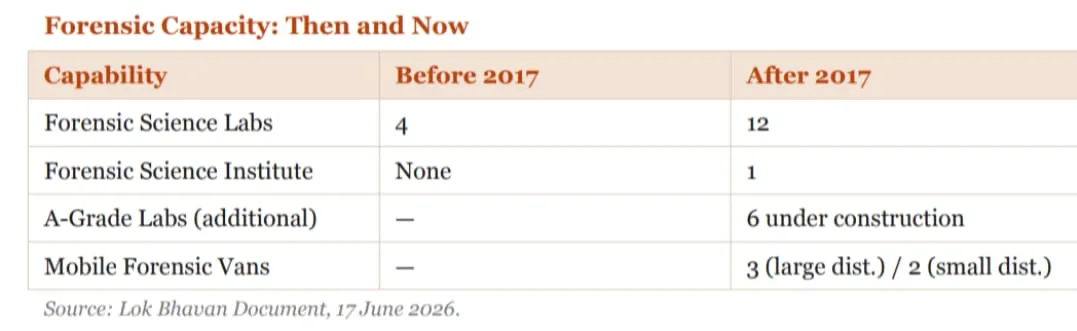 The lab count has tripled from 4 to 12. The state now operates its own Forensic Science Institutes, meaning it will train and certify forensic capacity internally rather than depending on outside agencies. A further 6 A-grade laboratories are under construction, which will roughly double the network again once commissioned. Critically, forensic capability has been made mobile 3 mobile forensic vans are deployed in larger districts and 2 in smaller ones, carrying evidence-collection capacity to the crime scene itself rather than waiting for samples to travel to a central lab.
This point matters for the BNS regime specifically. When forensic evidence is legally required, and the chain of custody is scrutinised, the speed and integrity of collection at the scene determines whether a case survives in court. Static labs cannot deliver that; mobile vans can. The infrastructure, in other words, was built to match the law, not the other way around.
Recruitment and Training: 60,244 in a Single Cycle
In the previous year, the Uttar Pradesh Police recruited 60,244 constables into the civil police in a single recruitment cycle, one of the largest such drives undertaken by any state police force. Of these, 12,048 were women, the first time so large a cohort of women received appointment letters in any security force in the state, lifting women’s representation in the ranks in a single stroke.
The recruitment scale becomes more striking against demanded the board received more than 48 lakh applications for roughly 60,000 posts a ratio of nearly 80 applicants per vacancy. The Chief Minister’s repeated emphasis on a selection process with no recommendations and no discrimination is aimed squarely at that applicant pool, for whom the credibility of a transparent, technology-driven exam is the whole point.
The women’s cohort deserves its own line of analysis. Inducting 12,048 women in one cycle is not merely a representation statistic; it reshapes the operational profile of the force. Cyber-fraud complaints, crimes against women and Help Desk interactions at the station level all benefit from a force with substantial women’s presence at the constabulary, the rank that actually staffs the front counter most citizens meet. A reform that pairs a universal Cyber Help Desk network with a sharp rise in women constables is, in effect, redesigning both the technology and the human face of first response at the same time.
The question was raised about what happened after the selection. All 60,244 recruits were trained at the Uttar Pradesh Police’s own training centres before deployment and are now serving in the field. In-house training at this volume is itself an infrastructure achievement; it requires physical centres, instructors and curriculum capacity sized to absorb sixty thousand trainees without outsourcing. The 930 Grade-A computer operators whose appointment letters were distributed on 17 June, described by the Chief Minister as digital warriors for the era of smart policing, slot directly into the cyber and data layer this report has described.
The decision to train in-house, rather than outsource, carries a strategic dividend that the raw figure understates. A force that owns its training pipeline controls its own doctrine; it standardises how the new criminal laws are taught, how forensic chain-of-custody is drilled and how cyber-complaint handling is practised, across every batch and every district. Outsourced training fragments that standardise, an internal Forensic Science Institute and dedicated police training centres lock it in. At sixty thousand recruits per cycle, that consistency compounds each year’s intake enters the field speaking the same procedural language as the last.
Double-Engine Together Builds National
The more revealing exercise is to read them as a system. Recruitment supplies the personnel, and in-house training certifies them. The Forensic Science Institute and labs give them the evidence tools the new criminal laws demand, the cyber grid extends its reach to every station, and the Commissionerate System sharpens command in the densest districts. Each element compensates for a gap the others would otherwise leave open.
Consider the dependency chain in the cyber domain alone. A universal Cyber Help Desk network is only as good as the trained operators staffing the 930 computer operators. Those desks in turn feed into district cyber thanas, which depend on forensic labs to convert seized devices into court-admissible evidence, which depends on the Forensic Science Institute to certify the analysts. Pull any single link, and the chain weakens.
Built together, they form what the state presents as an end-to-end pipeline from complaint to conviction.
Counting the institutions, labs built, desks established, and districts covered with measurable input and capacity. The figures tell us the machinery exists and is staffed; they do not by themselves tell us the conviction rate under BNS, the average time to freeze a fraudulent transaction or the recovery rate for defrauded citizens. Those are the outcome metrics that will ultimately validate or qualify the model policing claim, and they are the figures worth demanding in the next data release.
The Chief Minister set all of this within a national context, crediting the guidance of the Prime Minister and casting the pace of the UP Police work over the past nine years as an outstanding example of model policing for the country. A state that was once shorthand for breakdown of order is now offered as a template other states might study, a reversal that, if the capacity figures translate into sustained outcomes, would rank among the more consequential governance turnarounds in recent Indian administration.
What Uttar Pradesh event ultimately documented was not a single announcement but the visible surface of a decade-long rebuild: one cyber station became seventy-five, four labs became twelve, with six more rising, sixty thousand recruits trained and deployed, and command restructured in seven districts. The scaffolding of a modern police force is now demonstrably in place. Once the evidence is presented, the police are supposed to act according to new cyber protocols. Uttar Pradesh has earned the right to be measured by that higher standard.