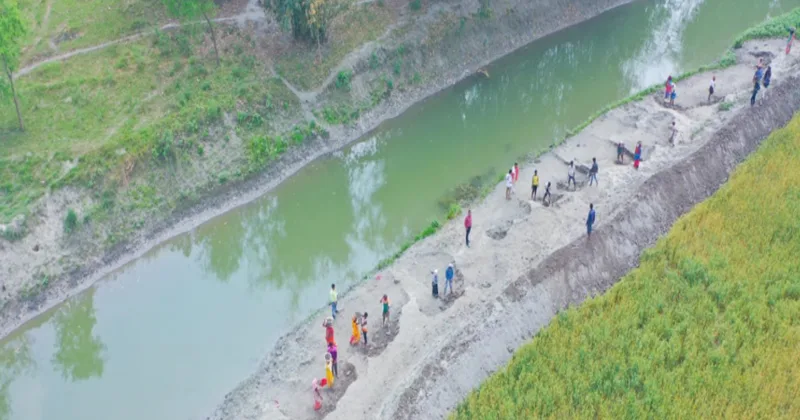
A river that was considered as dead two decades ago, is flowing again and this time it is the people of Bihar who made it possible with support of the government and NGO. The Baya River, a tributary that originates in East Champaran and travels nearly 290 kilometres through Muzaffarpur, Vaishali and Samastipur before merging into the Ganga near Begusarai. It had over the years been choked into near-extinction by silt and water hyacinth (jalkumbhi).
At several stretches, its flow had stopped almost entirely. Today, the same river is once again a “jeevan dayini dhara”, a life-giving stream which is carrying water to fields that had turned barren and this story of how this happened deserves to be told in full, not only as a positive news item. It also reflects how Modi Government in India intends to revive thousands of similar forgotten rivers.
A river strangled by neglect
For generations, the Baya irrigated thousands of acres across north Bihar’s plains, making it one of the more historically significant rivers of the region even though it never carried the fame of the Ganga or the Gandak running alongside it.
As the siltation built up unchecked and awareness of the river’s importance faded, the community gradually stopped engaging with it. The river was neglected to the point that its ecosystem collapsed, groundwater levels in the surrounding belt fell, irrigation systems dependent on it failed and large stretches turned into stagnant, weed-choked channels rather than a flowing waterbody. What had once been the lifeline of an agrarian region which serves all practical purposes, become a dead river and with it went the fortunes of the farmers who had built their lives around its seasonal flow.
Desilting, dredging and a jan andolan
The turnaround began with a coordinated effort between the district administrations of Vaishali and Begusarai, the international development agency GIZ India, the Dehradun-based NGO HESCO and the local communities living along the riverbanks. Desilting and dredging works were carried out across long stretches of the river to physically clear the accumulated muck and vegetation blocking its course.
Alongside this engineering work, the river’s flow was restored and reinforced through the Budhi Gandak–Noon–Baya–Ganga River link, reconnecting the Baya’s water cycle to the wider river network it had drifted away from. In Vaishali, MGNREGA labour was deployed to support the desilting and embankment work, turning a conservation project into a source of rural employment as well.
What made the difference, according to Ram Prasad who is involved in this project tells that “This was never purely a government contract executed by machines. Regular cleaning drives, tree plantation along the banks and sustained removal of water hyacinth were carried out with active local participation and women emerged as some of the campaign’s most consistent foot soldiers”. They take the lead in clearing weeds, river-cleaning drives and water conservation activities in their villages.
As one of the local collaborators working with HESCO put it “removing the water hyacinth was the key to saving the water itself and that conviction is what turned a cleanup into a movement a genuine Jan Andolan rather than a one-time drive.”
Why cleaning alone wasn’t enough
Experts following the project make an important point that dredging silt out of a river is only half the job. Unless people understand why a river matters and feel ownership over its revival, the cleanup eventually reverts. The Baya’s rejuvenation, moved in layers: first building awareness among residents about what the river’s death had cost their villages, then mobilising people to physically step out and participate, with the government stepping in to back that public momentum with funds, machinery and technical partners.
The sequence of mission success was awareness before infrastructure, ownership before engineering, that locals say “turned the river’s fortune around.” The results have been concrete and measurable on the ground, irrigation has become more reliable for farmers along the Baya’s course, agricultural output has risen and fields that had dried up are green again.
Groundwater recharge in the belt has also improved as the river’s restored flow re-feeds the surrounding water table, lending support to sustainable development goals in a region that had quietly been losing both its river and its farmland productivity together.
Larger vision of namami gange
The Baya River revival sits squarely within Namami Gange’s broader and often underreported, focus on the Ganga’s tributaries rather than the main river alone. As experts following the project note, the mission’s approach to reviving dying or dead rivers across the country treats small rivers like the Baya as the lifeline of the bigger river system. The channels that carry water and life into village after village before joining the Ganga itself.
This is not a one-off intervention, it is consistent with the National Mission for Clean Ganga’s stated philosophy of treating the Ganga basin as a single interconnected system rather than a single channel to be cleaned in isolation, which is why tributary-level projects increasingly get the same administrative attention once reserved only for the main river’s ghats and sewage outfalls. That logic is already paying off elsewhere in the Ganga basin, suggesting the Baya model is not an isolated success but part of a pattern.
In Uttar Pradesh’s Azamgarh district, the Tamsa river an ancient and significant tributary of the Ganga, flows through Ambedkar Nagar, Ayodhya and Azamgarh districts and had faced challenges of siltation, waste accumulation and encroachments before. Later it was revitalised through coordinated administrative efforts and strong community participation under the Namami Gange Programme.
Covering an approximate 89-kilometre stretch in Azamgarh district and passing through 111 Gram Panchayats, the campaign mobilised school children, youth, women’s self-help groups, Gram Panchayats and voluntary organisations through shramdaan to remove plastic, polythene and other solid waste from the riverbanks, a near-mirror of the citizen-led model used on the Baya.
In Uttarakhand the results show up in hard water-quality data, in 2013-14 the Ganga water quality in Haridwar was Category D and after the 2015 launch of Namami Gange it improved to Category C, reaching Category A (drinkable) in Rishikesh and Category B (bathing-safe) in Haridwar by 2025, an improvement achieved partly through a Safe Reuse of Treated Water policy developed in cooperation with GIZ, the same international partner involved in Bihar’s Baya project. Even within Bihar, the main Ganga stretch from Buxar to Bhagalpur improved from pollution category II in 2015 to category IV by 2022, indicating sustained improvement across the state’s river network not just on one tributary.
Nationally the scale of this effort is laudable, as of February 2026 a total of 524 projects had been sanctioned under Namami Gange at a cost of ₹43,030 crore, out of which 355 projects had been completed. The sewage treatment plants, river-surface cleaning, afforestation and biodiversity work are running in parallel across Uttar Pradesh, Bihar, Uttarakhand, Jharkhand and West Bengal.
The Baya river’s revival is a reminder that India’s small, lesser-known rivers are not footnotes to the Ganga they are its foundation. Every tributary that is dredged, desilted and reclaimed by its own community adds another working artery to a river system that touches the lives of hundreds of millions. What happened in Vaishali and Begusarai has shown if administration, technical partners and ordinary villagers working in the same direction, through the Namami Gange many dead rivers can be revive by replicating this mission. For a region that had quietly accepted a dead river as its fate, the Baya’s revival is proof that the fate was never final.